Introduction Performance and Cultivation Techniques of Yulu Xiang Pear Explained in Detail
Introduction Performance and Cultivation Techniques of Yulu Xiang Pear
China is one of the three centers of origin for cultivated pears in the world, with a cultivation history of over 3000 years, and is the world's largest producer and consumer of pears. At the same time, pears are also one of the high-efficiency fruit trees that China exports in large quantities. However, the level of the pear industry is still relatively backward compared with developed countries, manifested in poor product quality, low per-unit yield and low economic benefits. To improve per-unit yield and quality, the most critical thing is to select excellent varieties and establish standardized high-efficiency pear orchards.
1 Origin of Yulu Xiang Pear
Yulu Xiang Pear was bred by the Pomology Research Institute of the Shanxi Academy of Agricultural Sciences through hybridization using Korla Fragrant Pear as the female parent and Xuehua Pear as the male parent. It passed variety approval by the Shanxi Provincial Crop Variety Approval Committee in 2003, and won the second prize of the Shanxi Provincial Science and Technology Progress Award in 2007; in 2008 it won the title of designated supply fruit for the Beijing Olympic Games; in 2013 it won the title of "Chinese Pear King" in the "11th China Famous Pear and National Pear King Competition"; it was one of the 2 fruit tree varieties recommended in the dominant varieties and main promoted technologies released by the Ministry of Agriculture in 2014 (Nongban Ke [2014] No. 9).
2 Introduction and Promotion Performance of Yulu Xiang Pear in Jincheng
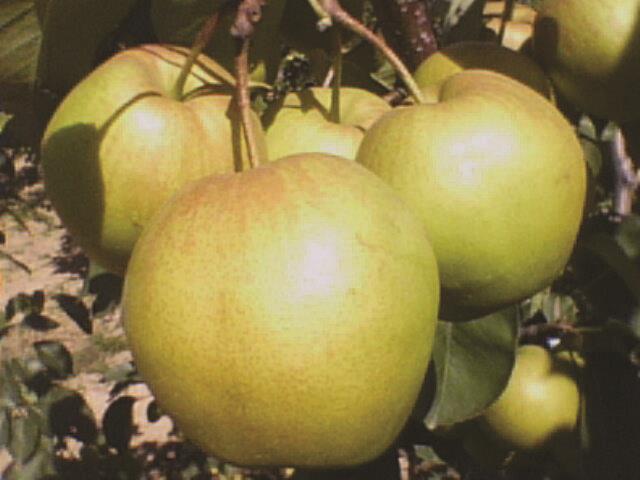
Gaoping City, Shanxi Province, is the main pear production area in the Jincheng region, and the traditional variety "Gaoping Large Yellow Pear" has a cultivation history of more than 1000 years. For many years it was mainly used for processing yellow pear juice, with low economic benefits. In order to adapt to market demand, fruit growers introduced multiple varieties for trial planting, intending to select suitable local varieties from them. Years of trial results show that Yulu Xiang Pear (Figure 1) performs very well, with large fruit, fine flesh, sweet taste and good storage tolerance, and is quite favored by consumers. All the fruit is sold to southern cities such as Guangzhou. The benefit per mu is 5000-9800 yuan, and in recent years it has been developed on a relatively large area in Jincheng.
Figure 1 Fruiting state of Yulu Xiang Pear
2.1 Fruit Characters
The average single fruit mass is 236.8 grams, and the largest fruit mass is 850 grams; the fruit is nearly spherical, with a fruit shape index of 0.95. The fruit surface is smooth and delicate, with a waxy coating and strong water retention. The sunny side has a red blush or dark red longitudinal stripes. At harvest the peel is yellow-green, and after storage it turns yellow with even brighter color. The peel is thin, the core is small, and the edible rate is high (90%). The flesh is white, crisp, without residue, with very few stone cells, extremely juicy, sweet with a delicate fragrance, and excellent in taste; the soluble solids content is 12.5%-16.1%, the total sugar content is 8.7%-9.8%, the total acid content is 0.08%-0.17%, and the sugar-acid mass ratio is 68.22-95.31:1, with excellent quality.
2.2 Biological Characteristics
Young trees have strong growth vigor, and after fruiting the tree vigor becomes moderate. The germination rate is high (65.4%), and the branching ability is medium. Grafted seedlings bear fruit 3-4 years after planting, and top-grafted trees bear fruit 2-3 years later. It is easy to form flower buds, has a high fruit-setting rate, and is high-yielding (Figure 2) and stable-yielding. In this region, the first flowers appear in early April, full bloom is in mid-April, the fruit ripening period is late August to early September, and the fruit can be eaten in early to mid-August. The fruit development period is about 130 days, leaves fall in early November, and the vegetative growth period is about 220 days.
Figure 2 High-yielding state of Yulu Xiang Pear
2.3 Tree Adaptability and Resistance
It has strong adaptability and is not strict about soil. Its resistance to rot disease is stronger than that of Suli Pear and Yali Pear, but weaker than that of the local Dahuang Pear and Xuehua Pear; its resistance to brown spot disease is the same as that of Suli Pear and Xuehua Pear, and stronger than that of Yali Pear and Jinhua Pear; its resistance to powdery mildew is stronger than that of Suli Pear and Xuehua Pear; its resistance to black heart disease is medium (Figure 3). The main pests include pear psylla, yellow mealworm, and fruit borers, and timely control should be carried out.
Figure 3 Yulu Xiang Pear tree
2.4 Storage Tolerance of Yulu Xiang Pear
This variety has large fruit and good quality, and its ripening period is also 2-3 weeks earlier than that of its male and female parents. The best taste is after ripening and after cold storage. From harvest before the Mid-Autumn Festival to June of the following year, one can eat fresh, juicy, crisp, residue-free, sweet and refreshing Yulu Xiang Pear. It can be stored for more than 4 months in natural earthen caves, and 6-8 months in constant-temperature cold storage. The market supply period lasts more than 9 months.
3 Cultivation Techniques of Yulu Xiang Pear
3.1 Pear Orchard Site Selection
The climatic conditions require an annual average temperature above 8°C, and the minimum temperature not lower than -25°C. Loam or sandy loam is preferable, with a thickness above 1.5 m being best. Hilly land, sloping land and terraced land with south-facing slopes below 15° are preferable. Sufficient sunlight is required.
3.2 Planting Density
Medium-density planting is suitable, and the plant-row spacing is generally (2-3) m x 4 m. Use a central leader form or spindle form. Pay attention to the application of techniques such as early bud notching and branch bending to moderate vegetative growth of the tree and promote early fruiting. Yulu Xiang Pear is easy to form flower buds and has a high fruit-setting rate, so timely flower and fruit thinning is required. During the full fruiting period, strengthen water and fertilizer management, maintain a reasonable load, and improve fruit quality. The yield during the full fruiting period should be controlled at 2000-3000 kg.
3.3 Arrangement of Pollination Varieties
Yulu Xiang Pear has a small amount of pollen, so pollinator trees must be provided. Varieties such as Huangguan, Qiyue Su, and Hongxiang Su can be used, with a ratio of 4-6:1. There should be at least two pollinator varieties, all planted in whole rows.
3.4 Planting
In areas with mild winter climate, autumn planting is suitable; in areas with cold winters, planting can be done after the soil thaws in spring. North-south row orientation is preferable. Strictly select and plant first-grade strong seedlings. To improve the survival rate of planting, after pruning the roots, spray or soak the roots with a rooting agent solution. The planting depth should be such that the original soil mark of the seedling (root crown) is level with the ground. Water after planting. For autumn planting, after watering, build a 30 cm high soil mound centered on the seedling, and uncover it after the soil thaws the following spring.
3.5 Training and Pruning of Young Trees
Yulu Xiang Pear has relatively strong apical dominance, a high germination rate, and somewhat weak branching ability. When training young trees, use bud notching and branch bending to moderate apical dominance and promote branching. Timely open the angle of the main branches, increase light inside the canopy, and promote early canopy formation and early fruiting. The free spindle form has a tree height of about 3 m, with 10-12 small main branches extending in a single axis. The small canopy delayed open center form (Figure 4) has a tree height of about 3 m, with 7-8 main branches and obvious layers. When pruning young trees after planting, branches below 50 cm from the ground should be removed, and competitive branches on the main branches should be removed. When the length of a main branch reaches more than 80 cm, it should be bent open to form an angle of 70°-80° with the trunk. Through supporting management, fruiting can begin in 3-4 years, the tree shape can be formed by pruning in 4-5 years, and the full fruiting period can be reached in 6 years.
Figure 4 Small canopy delayed open center form
3.6 Suitable Planting Areas
The suitable area is relatively wide. Pear-suitable planting areas in Shanxi, Hebei, Liaoning, Shaanxi, Xinjiang, Gansu, Ningxia and other provinces (regions) in China can all be planted. [Jishan Huayao]
3.7 Transformation of Pear Orchards by Top Grafting and Variety Change
Pear orchards with aging varieties have low production benefits. To restore their production capacity and improve economic benefits as soon as possible, the existing plant-row spacing and tree canopy can be used to top graft and replace them with suitable excellent new varieties (Figure 5). By strengthening supporting technical management, the goal of "top grafting in one year, canopy recovery in two years, and production and benefits in three years" can be achieved.
Figure 5 Top grafting and variety change