Detailed Explanation of the Training and Pruning Methods for the Slender Spindle Shape of Apple Trees
How do you train and prune apple trees into the slender spindle shape?
The slender spindle belongs to the small canopy form and is one of the tree shapes with the fewest scaffold branches and the most fruiting branches, suitable for relatively dense planting, dwarfing rootstocks and spur-type cultivars. Generally the row spacing is 2.5-4.0 m, the plant spacing is about 2.0 m, and 83-133.3 trees are planted per mu. This tree shape requires light pruning and has moderate growth, making it easy to achieve early fruiting and high yield.
1 Structural characteristics
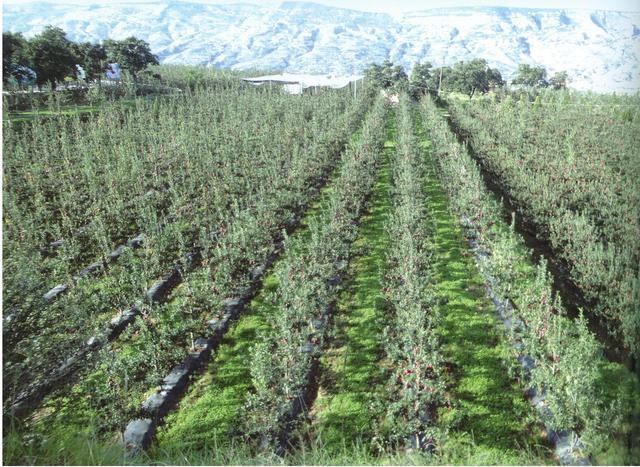
The tree height is 2-3 m, the canopy diameter is 1.5-2.0 m, and on the central leader 15-20 lateral branches of similar vigor, slender and horizontal are evenly borne; the lower branches are 1 m long, the middle branches are 70-80 cm long, and the upper branches are 50-60 cm long. The trunk extension shoot and the lateral branches generally do not need heading back and extend naturally. The whole tree is slender, with a canopy that is large at the bottom and small at the top, forming a slender spindle shape (Figures 1-3).
Figure 1 Overall orchard appearance of the slender spindle tree shape
Figure 2 Fruiting condition of a slender spindle tree in the initial fruiting stage
Figure 3 Fruiting condition of the slender spindle shape
2 Training methods
After the nursery stock is planted, head the tree at 70-90 cm above the ground, and on the training zone above 50 cm, select 3-4 buds in different directions and notch 0.5 cm above the buds to promote branching. In September-October of the same year, bend the resulting branches flat. For cultivars with strong branching ability, the extension shoot generally does not need heading back during winter pruning in the first year. For the branches that grow on the central trunk in the second year, the first bud shoot continues to extend, and all the other lateral branches are bent flat and left unpruned; main branches on the same side are spaced 40-50 cm apart. For the water sprouts on the upper side of the main branches, the methods of summer branch twisting and pinching can be used to control them and transform them into fruiting branches (Figures 4-5).
Figure 4 Morphology of a 2-year-old slender spindle tree
Figure 5 Morphology of a 3-year-old slender spindle tree
During winter pruning in the third year, the extension shoot of the central trunk can still be left unheaded, and whether to change the leader is decided according to tree vigor. For upright branches, some can be thinned out and some can be bent flat and left to grow slowly (Figures 6-7).
Figure 6 Condition of a 4-year-old slender spindle tree
At 4-5 years, adjust the vigor of the central trunk: weak ones are headed back to promote vigorous shoots and restore vigor, strong ones have the lower competing branches thinned out, and the rest are left unheaded. For the middle and lower main branches, cultivate branch groups, stabilize fruiting, and extend outward year by year. Gradually thin out overly dense and overly strong scaffold branches. The central leader is left unheaded for consecutive years, forms more flower buds, and bears abundant fruit (Figure 6).
At 6-7 years, give priority to promoting fruiting on the lateral branches in a horizontal state; for the older lower main branches that have already fruited, cut them back according to their strength, and thin out the overly dense ones, so that the whole canopy becomes a spindle-shaped canopy that is thin at both the top and the bottom and thick in the middle (Figure 7). [Jishan Huayao]
Figure 7 Fruiting condition of the central leader