Detailed Explanation of Variety Selection and Orchard Establishment Techniques for Fresh-eating Mulberry
Variety Selection and Orchard Establishment Techniques for Fresh-eating Mulberry
To enrich the diversity of fruit tree varieties, fill the gap in early-season products in the orchard, and increase the fun of tourist picking, in 2011 Hefei Taoxi Modern Agriculture Development Co., Ltd. introduced from Zhejiang fresh-eating mulberry varieties including Baiyu Wang, Korean Big White Pearl, Seedless Dashi, Four-season Mulberry, and Taiwan Long-fruit Mulberry, totaling more than 20,000 plants, planted in Wangyan Village, Sanshigang Township. The variety selection and orchard establishment techniques for mulberry in the Hefei area are described below.
1 Variety Selection
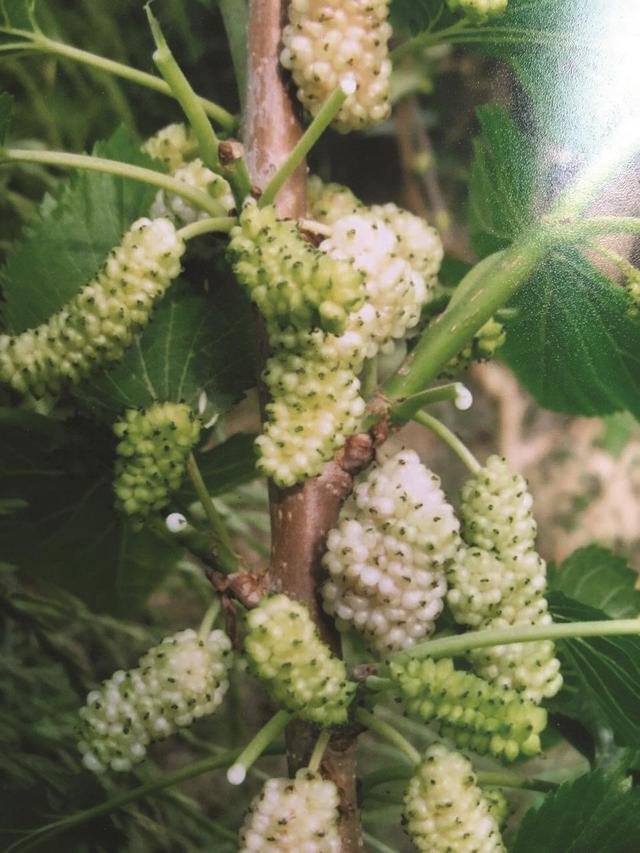
After 5 years of observation and recording in the Hefei area, some fresh-eating mulberry varieties showed excellent characteristics such as early maturity, high yield, high quality, and drought resistance, with strong adaptability. Among them, Baiyu Wang (Figure 1) and Korean Big White Pearl (Figure 2) have small market sales and tourist picking volumes, so they are suitable for small-area planting; Four-season Mulberry (Figure 3) has a long fruiting period, but the fruit is relatively small and high in acid content, so it is suitable for small-area planting; Taiwan Long-fruit Mulberry (Figure 4) is susceptible to freezing damage and requires protected cultivation, with relatively high investment costs, making it suitable as a high-end product for sightseeing orchards; Seedless Dashi Mulberry (Figure 5) is deeply welcomed in the market and has high cultivation benefits, so it is worth large-scale promotion and planting. To meet the market demand in Hefei, after observation and comparison, in 2014 the company purchased an additional 15,000 Seedless Dashi mulberry saplings. They were mainly planted at the Hefei Xinqiao Airport base and the Hefei Binhu Niujiao Dawei base.
Figure 1 Baiyu Wang
Figure 2 Korean Big White Pearl
Figure 3 Four-season Mulberry
2 Standard Orchard Establishment
2.1 Orchard Site Selection
Mulberry has strong adaptability to soil but poor waterlogging tolerance, so it should not be planted in low-lying land. Loam and sandy loam are preferable. The best site for orchard establishment is a plot with deep soil, fertile soil, irrigation conditions, smooth drainage, no industrial pollution, and convenient transportation.
2.2 Orchard Land Preparation
Before planting, level the land and plow it once, with a plowing depth of about 35 cm. Adopt the "high ridge and deep ditch" cultivation model. Open ditches and form ridges according to the planned row spacing, and dig drainage ditches well. The ridge ditch is 40 cm deep, and the waist ditch is 60 cm deep. Along the line where the mulberry saplings will be planted in the middle of the ridge, broadcast commercial organic fertilizer or decomposed farmyard manure (such as cow manure, pig manure, chicken manure) 1000 kg + phosphate fertilizer 25 kg + NPK compound fertilizer 25 kg. Mix and broadcast, then rotary till and level for planting.
Figure 4 Taiwan Long-fruit Mulberry
Figure 5 Seedless Dashi
3 Reasonable Planting
For picking orchards, sparse planting with large crowns is used to facilitate tourists entering the orchard for picking, with a plant-row spacing of 3 m x 6 m, planting 35 plants per mu. For production orchards, a plant-row spacing of 2 m x 3 m is used, planting 111 plants per mu. When planting, dig a pit 50 cm x 50 cm x 35 cm, hold the mulberry sapling upright, and spread the roots evenly in all directions. When the soil is filled to half, gently lift and shake the sapling to let the roots spread, then continue filling soil, tramping it firmly while filling until it is level with the ground. After planting, water thoroughly to accelerate close contact between the soil and roots.
4 Young Tree Management
In the year of planting, mulberry mainly focuses on developing tree shape and robust fruiting branches. It begins to bear fruit in the 2nd year. To achieve early high yield, the following work must be done well in young tree management:
4.1 Regular Watering
After planting, wait for the mulberry saplings to sprout, then water once thoroughly and cover with soil. Later, water according to soil moisture conditions.
4.2 Bud Removal and Topdressing
(1) When new shoots of young seedlings grow to 10-15 cm, remove excess weak buds, and select and retain 2-3 strong buds distributed evenly.
(2) After entering June, when the new roots of young seedlings grow stably, apply 50 g urea per plant, digging 3-4 holes 20 cm away from the seedling for hole application. After mid-July, spray 0.3% potassium dihydrogen phosphate on the leaves 2-3 times to promote rapid growth of young seedlings.
4.3 Pinching New Shoots
When new shoots grow to 45 cm, pinch them. Remove the more vigorously growing branches, retain 2 bud branches per branch, and remove the excess, so as to cultivate an ideal tree shape and robust fruiting trees.
4.4 Intertillage and Weeding
Weeding can be done manually or chemically. For chemical weeding, glyphosate can be used. Before spraying herbicide, weeds around the tree disk should be removed manually, and the herbicide must not be sprayed onto the seedlings to avoid phytotoxicity.
4.5 Pest and Disease Control
From mid-to-late May to mid-to-late October in the year of planting, 40% chlorpyrifos 1200 mg/L can be used to prevent leaf pests such as mulberry borers and leafhoppers. Spray about once every 25 days, and spray evenly on the leaf surfaces and undersides.
4.6 Young Tree Training
Mulberry adopts the medium-trunk training method to develop tree shape. After the mulberry sapling is planted, cut it off 40-50 cm above the ground to develop the trunk. After sprouting, retain 2-3 robust new buds evenly positioned on the trunk, and remove the rest.
4.7 Autumn Fertilization
Begin applying base fertilizer in mid-to-late October, allowing the tree to accumulate sufficient nutrients and overwinter safely. Apply per plant commercial organic fertilizer or decomposed farmyard manure (such as chicken manure, pig manure, etc.) 10 kg + NPK compound fertilizer 250 g + superphosphate (or calcium magnesium phosphate fertilizer) 250 g. [Jishan Huayao]
4.8 Winter Pruning
After complete leaf fall, carry out winter pruning, cutting off the 15-20 cm tender shoot portion at the top of the branches, making full use of nutrients and improving the yield and quality of the coming year.