Detailed Explanation of Virus-Free Container Seedling Breeding Technology for Superior Citrus Varieties
Virus-Free Container Seedling Breeding Technology for Superior Citrus Varieties
1 Three-Level Virus-Free Breeding System for Superior Citrus Varieties
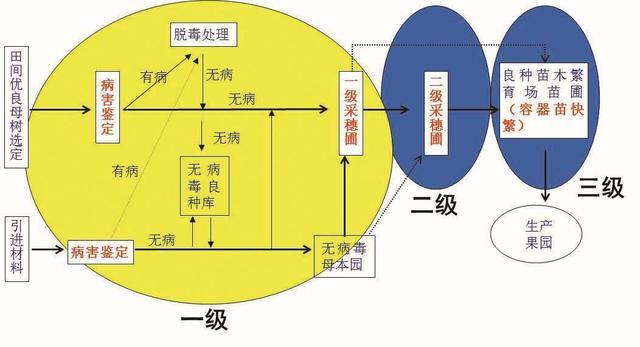
The three-level virus-free breeding system for superior citrus varieties is the foundation of virus-free seedling breeding (Figure 1). The first level is the technical core, which renders superior variety resources from home and abroad virus-free, and establishes a virus-free superior variety preservation bank, mother tree orchard and first-level scion orchard; the second level is the second-level scion orchard, an important link in propagation; the third level comprises superior variety seedling breeding nurseries in various locations. This system is fully functional, established by levels, and exists independently, ensuring the safety of materials at each link and giving the breeding and promotion speed a three-level amplification effect; it has made innovative progress in disease detection efficiency, seedling quality, safeguard mechanisms, promotion models and other aspects, and is a model of citrus seedling breeding technology in China; at the same time, it implements standards and technical requirements such as the National Standard of the People's Republic of China "Citrus Grafted Seedlings", the agricultural industry standard "Code of Practice for Virus-Free Citrus Seedling Breeding" and "Technical Code for Virus Elimination of Citrus Seedlings".
Figure 1 Schematic diagram of the three-level virus-free breeding system for superior citrus varieties
2 Virus-Free Container Seedling Breeding Technology for Citrus
2.1 Basic Components
Virus-free container seedling breeding for citrus requires several major functional areas, including a virus-free superior variety preservation bank, a virus-free mother tree orchard (display orchard), a rootstock seed orchard, a virus-free scion orchard, a rootstock seedling propagation nursery and a seedling breeding nursery, referred to in short as "one bank, two orchards, three nurseries". The specific requirements and functions are described below.
2.1.1 Virus-Free Superior Variety Preservation Bank Superior mother trees in the field or introduced materials must undergo disease testing; disease-free plants are planted and kept in isolation in screen houses, with 2-4 plants per variety, while diseased plants undergo virus elimination before entering the superior variety bank. The targets of disease testing and virus elimination include the citrus huanglongbing pathogen bacterium (HLB), citrus exocortis viroid (CEV), citrus tatter leaf virus (CTLV), strains of citrus tristeza virus (CTV) causing pummelo dwarf disease and sweet orange stem pitting disease, and satsuma dwarf virus (SDV).
2.1.2 Virus-Free Mother Tree Orchard (Display Orchard) Using virus-free materials from the superior variety preservation bank, 2-6 plants of each variety are propagated and planted in the mother tree orchard at a spacing of 3 m x 4 m or 4 m x 5 m depending on the variety. The horticultural traits of each individual plant are investigated, analyzed and recorded; once the inherent horticultural traits are expressed, the plant is selected as a mother tree to provide virus-free scions, and a scion orchard is established at the same time. Attention should be paid to observing disease symptoms, and infection status should be tested every 3 years using indicator plants or methods such as RT-PCR.
2.1.3 Rootstock Seed Orchard To ensure the purity, quantity and safety of rootstocks, a rootstock seed orchard needs to be established. According to the needs of seedling cultivation, the varieties and quantities of rootstocks are determined, and they are planted in isolated single lines to prevent hybridization and variation.
2.1.4 Virus-Free Scion Orchard The scions and rootstocks of the scion trees in the scion orchard all come from the virus-free mother tree orchard and the rootstock seed orchard, and different varieties are densely planted in separate zones. The scion collection time is limited to within 3 years after the plants are planted in the scion orchard.
2.1.5 Rootstock Seedling Propagation Nursery Generally, a greenhouse with controllable temperature and humidity is used, and the facilities, soil and seeds in the greenhouse must all be sterilized.
2.1.6 Seedling Breeding Nursery The seedling breeding nursery is the place for virus-free container seedling breeding. It should be equipped with a mixing area (equipment), a production material storage area, a seedling loading and unloading area (tools), fertilization and irrigation systems, etc., and should have a new seedling breeding area, an old seedling renewal area, etc.
The commonly used tools in each functional area must be dedicated to that area; branch shears, knives, saws, etc. must be washed with soap and disinfected with 1% sodium hypochlorite solution before handling each variety. Staff should pay attention to disinfection when entering and leaving the nursery. Strictly implement the registration system for other personnel entering and leaving and the safety quarantine system. Special reminder: in areas where huanglongbing occurs, the above six major functional areas all need to be established inside screen houses covered with 40-mesh gauze (steel) netting.
2.2 Virus-Free Container Seedling Breeding Technology
What is commonly called a citrus seedling is a grafted seedling that meets the standards of GB/T 5040-2003 "Quarantine Rules for Citrus Seedling Producing Areas" and GB/T 9659-2008 "Citrus Grafted Seedlings". Virus-free container citrus seedlings refer to seedlings cultivated in containers that not only meet the requirements of the above two national standards, but also use citrus materials all from the "one bank, two orchards, three nurseries" and are cultivated according to virus-free management requirements.
2.2.1 The rootstock seedling breeding procedure is as follows: collect seeds - seed storage (or sow tender seeds directly) - preparation of formula soil for sowing - soil disinfection for sowing - seed disinfection - sowing - soil and seedling management after sowing.
The formula soil is a uniform mixture of river sand, rice husk and peat at a volume ratio of 1:1:2; the soil is disinfected with agents such as hymexazol, and the seeds are disinfected with 0.4% potassium permanganate and sown immediately after disinfection, with each seed occupying 9-16 sq cm as appropriate. From after sowing until seedling transplanting, the temperature should not exceed 35°C, the soil moisture content should not exceed 70%, and 0.2%-0.5% water-soluble fertilizer should be added every 7-10 days; attention should be paid to preventing seedling-stage diseases such as damping-off. Common rootstock seedling cultivation methods are as follows (Figures 2-3).
Figure 2 Sowing in seedbeds
Figure 3 Sowing with a seeder
2.2.2 Grafted Seedling Breeding The rootstock seedlings in the rootstock propagation nursery are transplanted into seedling containers for cultivation; when the rootstock reaches a diameter of 0.4-0.5 cm at 15-20 cm above the ground (the grafting position) (Figure 4), vigorous scions are collected from the virus-free scion orchard for grafting. Generally, cut grafting is used when the temperature is relatively low, and small-bud side grafting is used as much as possible when the temperature is relatively high. After grafting, remove the film and regraft in time; for seedlings side-grafted in spring, the rootstock can be bent in summer and autumn to promote sprouting; for seedlings side-grafted in autumn and winter, the rootstock is cut back in the following spring to promote sprouting.
Figure 4 Rootstock seedlings ready for grafting
From the sprouting of the grafted bud until the first flush self-prunes, spray fungicide to prevent anthracnose 3 times, with an interval of about 10 days each time. At the same time, pay attention to preventing pests such as snails, red spider mites and citrus whiteflies. Remove excess tender shoots and rootstock sprouts. After the first flush matures, promptly remove the sprouts of the second flush, keeping only 1-3, and ensure there are no branches within 40 cm of the main trunk.
Virus-free container seedlings have advantages such as robust growth (Figure 5), well-developed fibrous roots (Figure 6), a high grafting position (less prone to pests and diseases), and the ability to be planted in multiple seasons with no transplanting shock period. They control the spread and expansion of pests and diseases from the source; the seedlings are robust and easily enter the orchard to bear fruit early and abundantly.
Figure 5 Qualified seedlings
Figure 6 Fibrous roots of virus-free container seedlings
3 Safety Management Specifications for Citrus Seedlings
Most citrus growers or managers focus on virus elimination during the seedling breeding process, but neglect disease prevention measures in other links, such as the access system for virus-free seedling breeding and supervision of the management process, and the transport and planting environment of virus-free citrus seedlings. These should all be implemented in strict accordance with relevant national laws, regulations, standards and specifications, so as to ensure the healthy and sustainable development of the entire citrus industry and provide a strong guarantee for building a modern citrus industry with "efficient output, safe products, resource conservation and environmental friendliness". [Jishan Huayao]