What types of grape protected cultivation are there?
What types of grape protected cultivation are there?
1 Grape protected cultivation models
1.1 Facility forcing cultivation
Forcing cultivation refers to the cultivation model of covering with film in early spring to keep warm, and retaining the top film later for rain shelter, that is, "early forcing, later rain sheltering". Generally, early and mid-season grape varieties and Kyoho-line grape varieties are forced to become earlier-maturing varieties, which can supply fresh grapes during the off-season in early spring and early summer, and bring high profits to fruit growers. All kinds of greenhouses and sheds can achieve the purpose of forcing cultivation, and they are widely used in different regions. The cultivation techniques are relatively successful, and it is also the main direction of protected cultivation.
The main measures include: (1) Use early-maturing varieties to achieve the effect of obtaining early maturity from early and mid-season types. (2) Adopt measures such as greenhouse heating, multi-layer film covering, and plastic film mulching on the beds to raise the air temperature and soil temperature as much as possible. (3) Apply lime nitrogen or single cyanamide to the branches and buds to break bud dormancy and promote early sprouting. (4) Through measures such as limiting water and controlling yield, and increasing the application of organic fertilizer, promote early fruit ripening.
1.2 Facility delayed cultivation
Delayed cultivation is different from forcing early-maturing cultivation. It mainly relies on facility cold protection in the later growth period to extend and delay the grape growth, ripening, and harvest periods. Delayed cultivation is a cultivation form aimed at extending the grape fruit ripening period, delaying harvest, and improving grape berry quality. Through delayed cultivation, the grape production period is regulated to be marketed during New Year's Day and the Spring Festival, which can not only produce high-quality grapes but also save preservation costs, extend the shelf life, and obtain a higher market "time price difference". This cultivation model is suitable for high-quality late-maturing varieties and varieties that are not resistant to storage and transportation. Some varieties cannot mature normally in open field cultivation in a certain region, and facility delayed cultivation can be used to allow them to fully mature.
1.3 Rain-shelter cultivation
Rain-shelter cultivation is a special cultivation form for grapes. This cultivation model is widely implemented in areas with high rainfall in China, with very good results and rapid development. Rain-shelter cultivation can reduce disease infection, improve fruit set rate, reduce fruit cracking, improve fruit quality, avoid work delays on rainy days, increase productivity, and expand the planting area of Vitis vinifera grapes. In recent years, in southern regions, on the basis of simple rain-shelter cultivation, a new model of forcing plus rain-shelter cultivation has evolved.
2 Facility types
2.1 Facility types for grape forcing cultivation
2.1.1 Solar greenhouse A solar greenhouse is composed of a well-insulated single-layer or double-layer north wall, east and west gable walls, and a front sloped skeleton. The skeleton is covered with plastic film to form a single-slope film roof, and straw curtains are placed on the film for insulation. Because it uses the heat from sunlight to raise the indoor temperature, it is called a solar greenhouse (Figure 1). In some areas, heating equipment such as radiators, heating flues, or stoves is added indoors, making it a heated greenhouse.
Figure 1 Forcing cultivation in a solar greenhouse
The frame of a solar greenhouse can be made of wooden poles, bamboo poles, steel bars, cement, etc., according to local conditions. Because a solar greenhouse has a sloped film roof with a relatively large inclination, it allows sunlight to fully enter the interior during the day. In winter, sunlight directly shines on the north wall, increasing indoor reflected light and heat energy, thereby raising the indoor temperature. At night, the north wall blocks the invasion of cold wind, which is conducive to heat preservation. In some cases, straw curtains or cotton quilts are added on the film roof for better insulation. The disadvantage of a solar greenhouse is that the east and west gable walls have a relatively large shading surface. In the morning, the east wall shades light, and in the afternoon, the west wall shades light, causing plants near the two walls to grow and develop poorly due to receiving less light, and the fruit ripens slightly later. Because this greenhouse has a good insulation effect and can be heated when necessary, it is widely used in the colder grape protected cultivation areas of Northeast China and Northwest China.
2.1.2 Heated glass greenhouse A heated glass greenhouse is suitable for areas north of the 15°C annual average temperature line, heating in cold winters to increase the indoor temperature. The heating system can use radiators, geothermal heat, waste heat from power plants, stoves, etc. The frame of the glass roof is welded from angle steel, using 5 mm thick flat glass or tempered glass. Because a glass greenhouse has heating equipment, the indoor growth environment can be manually adjusted, and the heating date can be selected as needed, so that grapes can be produced year-round (Figure 2). However, this kind of greenhouse requires large investment and has high production costs, making it difficult to achieve good returns in production, so it is relatively rarely used and is mostly used for scientific research experiments with relatively high temperature requirements.
Figure 2 Glass greenhouse
2.1.3 Plastic tunnel A plastic tunnel is a commonly used form of grape forcing cultivation, divided into single-span tunnels and multi-span tunnels (Figure 3, Figure 4). Plastic tunnels are built from steel pipes or bamboo and wood poles, covered with plastic film, and are divided into ridge type and semi-arch type. At present, there are many types of plastic tunnels in various places with different structural specifications. Overall, there are two categories: steel frame and bamboo-wood frame. Among them, assembled steel frame tunnels are simple to construct and highly favored.
Compared with greenhouses, plastic tunnels have advantages such as low investment, high efficiency, simple equipment, and not being limited by location and conditions. The lighting in plastic tunnels is better than that in solar greenhouses; all parts inside the tunnel can evenly receive light throughout the day, and the temperature rises quickly. However, its disadvantages are fast heat loss and relatively poor insulation performance. Plastic tunnels fill the gap between greenhouses and open field cultivation. The improvement of multi-layer film covering has made plastic tunnels more and more widely used. They are most used in North China, the Bohai Rim planting area, and areas south of the Qinling Mountains and Huaihe River. Generally, single-layer, double-layer, or triple-layer film is used according to the region and maturity requirements. In most areas of southern China, the plastic tunnel cultivation model is adopted. In the early stage, temperature increase promotes early maturity; in the later stage, there is more rainfall during the grape growing period, and it can also effectively shelter rain, achieving the goal of early maturity and high quality, and is deeply loved by growers.
Figure 3 Schematic diagram of single-span tunnel structure and its production application
Figure 4 Production application of multi-span tunnels
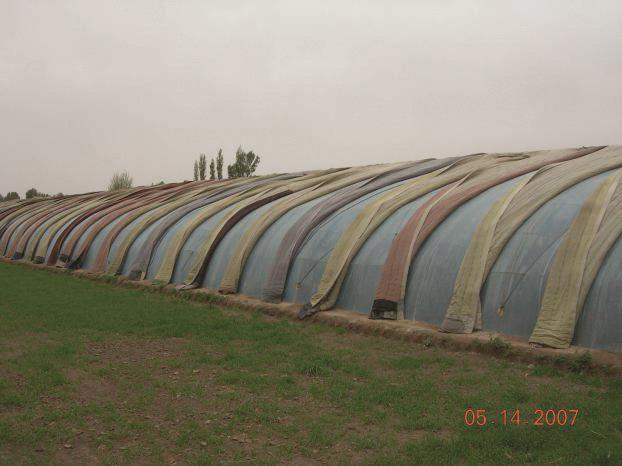
2.1.4 Small plastic arch tunnel A small plastic arch tunnel is a reduced form of a plastic tunnel, with the basic skeleton made of bamboo and wood strips. Because it has advantages such as low investment, quick results, and low risk, it is mostly used by rural or small-scale grape producers.
Small plastic arch tunnels are often set up on the basis of open field cultivation (Figure 5). They are mainly used for simple early forcing cultivation in areas suitable for soil-burial cold protection, and are used more in open field cultivation areas in Northeast China, Northwest China, and the Loess Plateau. They can also be used in vineyards where grapes are not taken down from the trellis or buried in soil in winter; building small arch tunnels can reduce winter freeze damage.
Figure 5 Small plastic arch tunnel
2.2 Facility types for grape delayed cultivation
At present, delayed cultivation mainly uses two cultivation methods: plastic tunnels and solar greenhouses. According to the temperature decline after the beginning of winter in a region and the planned harvest time, the type of facility to be used can be determined. Because the insulation and cold protection effect of plastic tunnels is obviously weaker than that of greenhouses, in places where the temperature drops slowly in early winter, the temperature is relatively high, and the required delayed harvest time is not too long, plastic tunnel delayed cultivation (Figure 6) is mostly used. In places with higher altitude, lower annual average temperature, faster later temperature decline, and a longer required delayed harvest time, solar greenhouse delayed cultivation (Figure 7) is mostly used. In addition, building simple small arch tunnels for frost protection can also delay grape harvest. In southern and central China, where the annual average temperature is relatively high and grapes ripen earlier, large-scale facility delayed cultivation is generally not suitable.
Figure 6 Plastic tunnel for grape delayed cultivation
Figure 7 Solar greenhouse for grape delayed cultivation
2.3 Facility types for grape rain-shelter cultivation
2.3.1 Plastic tunnel This is the same as the plastic tunnel used for forcing cultivation, and trellis cultivation can be used. The skirt films on both sides of the tunnel can be opened at will, and it is best to install partial top roll-up film at the top of the tunnel. According to the timing of film covering and the covering procedure, it can be used for models such as forcing plus rain sheltering (Figure 8) or simple rain-shelter cultivation.
Figure 8 Plastic tunnel structure with skirt films removed to become a rain-shelter cultivation model
2.3.2 Rain shelter A rain shelter is a type between plastic tunnel cultivation and open field cultivation, and is a special form of protected cultivation. It is built on the surface of a grape V-shaped trellis or fence trellis, using bamboo strips or steel pipes to form an arched surface, and then covering it with film (Figure 9). In form, it can be divided into single-span rain shelters and multi-span rain shelters (Figure 10). Unlike plastic tunnels, single-span rain shelters have the characteristics of simple facilities, obvious disease prevention effects, and a high input-output ratio. Rain-shelter cultivation was gradually promoted from southern planting areas. During the grape fruiting period, rainfall is relatively concentrated, causing relatively serious grape diseases. Building rain shelters can effectively solve the disease threat caused by high temperature and high humidity, and rain-shelter cultivation significantly reduces the amount of pesticides used. In recent years, with the improvement of people's living standards, consumers' requirements for grape quality have gradually increased. Planting areas in North China and the Bohai Rim with annual rainfall of more than 500 mm have also begun large-scale promotion. Rain-shelter cultivation has become the most important cultivation model adopted by newly built parks in North China and the Bohai Rim region. [Jishan Huayao]
Figure 9 Simple rain shelter
Figure 10 Multi-span rain shelter