Camellia summer cutting propagation: just cut a branch, insert it in soil, and it will root and sprout
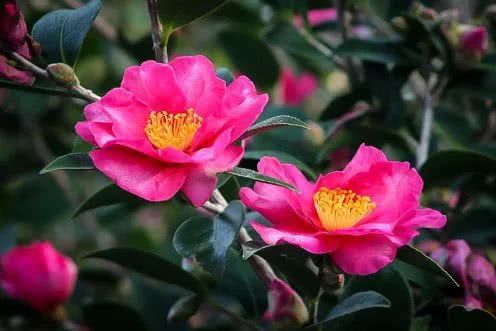
Camellias look extremely gorgeous and charming, and they are especially beautiful when in bloom. Growing some camellias on a balcony or in a yard adds very charming brilliance to the home. In fact, they are very easy to propagate, as long as you cut a few branches, and let's learn how together.
The one above is the brilliant Kanjiro camellia, with charming peach-red petals and yellow stamens, a very vigorously growing flowering shrub.
To propagate camellias by cuttings, be sure to choose a robust shrub-type camellia, select softwood branches for cutting propagation, and prepare a sharp, sterilized knife for pruning.
Prepare some small containers with good drainage, which can be plastic pots or clay pots, prepare some loose, well-draining soil, and you can choose to prepare some rooting powder, plastic wrap and a spray bottle for misting water.
Propagating camellia branches by cuttings is relatively simple. Its own branches and leaves grow very vigorously, and cutting off a few small branches has little effect on it. Camellias can even be propagated from leaves, but the growth rate is too slow. It is best to choose some softwood branches for cuttings. The propagation medium is best perlite or vermiculite, with an appropriate addition of peat moss, which has good water retention and promotes better rooting.
Camellia is a very slow-growing flowering shrub, and caring for it requires great patience. When propagating by cuttings, be sure to choose a particularly sharp pair of garden shears for cutting, preferably sterilized beforehand, and summer is the best time to carry out cutting propagation.
The cut branches should be about 8-10 cm long. The softwood branches that have just grown in summer are the best. Cut the bottom of the branch at an angle, remove all the leaves at the bottom, and keep 2-3 leaves at the top.
Choosing these branches for cutting propagation is relatively easy; inserted into slightly moist soil, they will root and sprout.
When propagating by cuttings, you can prune more branches to ensure the survival rate. Proper pruning of camellias in summer will promote more branching and will not affect the next flowering of the camellia. Before inserting the branches into the soil, they need to be dipped in a little rooting powder.
Each cutting branch should be inserted into a small flower pot; do not choose too large a container. Use a soil mix of perlite + peat moss + vermiculite for cultivation, and you can appropriately add some river sand. If you use a large pot to insert many branches, that is also fine, but there should be proper spacing.
Keep a few leaves at the top of the cutting branch for photosynthesis, and avoid keeping too many leaves, otherwise it is easy for them to dehydrate and then difficult to root. Too many leaves will affect rooting and sprouting.
After that, keep the soil moist, but not overly wet. The soil can be squeezed into a ball, but it must not release water when squeezed. This state is the best.
Cultivating camellias also requires maintaining a warm environment and avoiding too low a care temperature; they need more heat to sprout and root.
Also pay attention to maintaining a certain air humidity and avoiding excessive dryness. Next, just keep them in a bright, ventilated place.
I prefer to use red clay pots for propagating camellias by cuttings. These are the branches I have cut. I trimmed off some of the large leaves at the top, leaving only about 1/2 of the leaves, to prevent too many leaves from drawing away water. You should know that rooting branches need a lot of water.
For beginners propagating camellia branches by cuttings, be sure to prepare some rooting powder. Rooting powder can be made into a solution to soak the branches for about 15 minutes, or you can directly dip the bottom of the branch in a little rooting powder and insert it straight into the soil.
The one above is the charming golden camellia. Isn't it great? It is a camellia variety that blooms from winter all the way to spring, can grow to more than 2-4 m tall, and is a shrub-type camellia variety with very high ornamental value.