Two tricks to win at succulent summer survival: 100% safe summer survival
Tip:
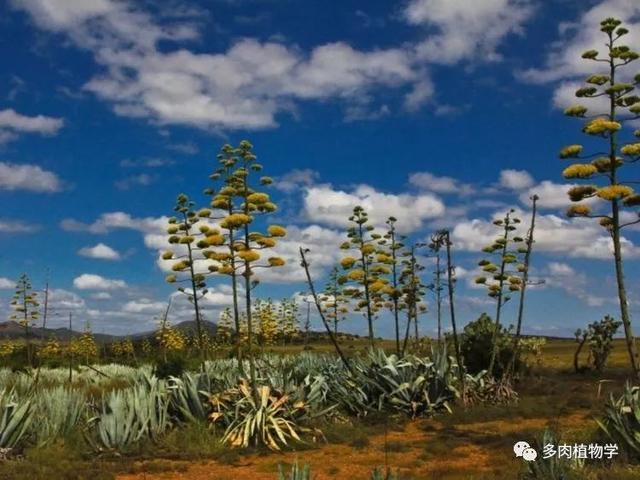
Agave does not bloom in the first five years, ten years, or even fifty years of its life.
Then, just when you have given up, it sends up a flower spike.
The scent given off by the flowers is an intense odor blending musk and carrion.
When the agave blooms, it dies; the flower blooms only once, blocking up everything, casting the dice once.
Decades ago, the United States began planting large tracts of agave, harvesting the heart and young flower spikes, and this continues to this day.
Agave leaves can be made into soap, and agave flowers can be fermented into liquor. In the United States and Mexico, more than one million wild agave plants are cut open every year to make the illicit liquor "mescal".
The reason they like drinking agave liquor is probably the hope that when slightly tipsy, time will slow down, and slow down even more...
Temperatures in many places are now 30°C+, and we have already entered the battle for succulent summer survival!
For beginners, the first thing is to clearly recognize the characteristics & care of succulents in the dormant period and the growing period. As long as you learn these two key techniques, we need not be afraid when summer comes!!!
Dormant period characteristics
Observe body color:
1. Leaf color dull and lusterless;
2. The leaf color of the whole plant is basically uniform;
3. The lower leaf color changes, or the whole plant changes color;
4. The color of the stem tip and branch tip is basically uniform;
5. Fasciated and monstrose varieties have a uniform color throughout the whole plant.
Observe root system:
1. The color of the root tip and the middle section of the root is basically uniform;
2. The root tip and the middle section of the root show mature root system, and the diameter of the root tip gradually decreases;
3. There is no obvious new root system at the roots.
Observe growth state:
1. Central leaves: in pointed-leaf types, the leaves become wider and extend outward. They become shorter and flat-topped; in wide-leaf types, the leaves extend outward;
2. There is a small amount of leaf drop, and withering appears at the leaf tip or leaf apex;
3. Complete dormancy, leaf drop of the whole plant, and in some varieties the stem above the soil withers;
4. The stem tip and branch tip age, thicken, and form an obtuse angle;
5. Plant growth stagnates.
Growing period characteristics
Observe body color:
1. In hairy leaves, the color of new leaves is lighter or darker than that of old leaves;
2. In hairless leaves, old leaves are smooth and glossy, and new leaves are fresh, tender and brightly colored;
3. The color of the stem tip and branch tip differs from that of the middle section of the stem and branch, being darker or lighter, forming two color tones;
4. In fasciated and monstrose varieties, there is an obvious difference in color between the top and the middle-lower part.
Observe root system:
1. The color of the root tip and the middle section of the root is darker or lighter by comparison;
2. The root tip has tender tips 3~5 mm long, and the diameter is greater than that of the middle section of the root;
3. There is a large number of new roots.
Observe growth state:
1. Central leaves: in pointed-leaf types, the leaves are narrow and long, uneven; in wide-leaf types, they close inward or curl inward;
2. There is no leaf drop, leaf withering, or similar phenomena;
3. The stem tip and branch tip are fresh and tender, gradually tapering into an acute angle; 4. The plant is full of vitality.
Dormant period care
In succulents during the dormant period, the activity of active tissues in the body slows down, and functions such as absorption, synthesis, conversion, and release of nutrients and water decrease, or even stop.
At this time, the succulent will stop growing.
1. Reduce the amount of water given; just spray a little water on the soil surface, or even do not water at all, because the internal operation of succulents in the dormant period has basically stopped. Watering at this time cannot be absorbed by the plant, and instead easily causes root oxygen deprivation and rot.
2. Avoid direct sunlight
3. Ventilate and cool down; usually open windows and doors more for ventilation. With just this small action, the succulent can live one more day.
4. You can add a layer of volcanic rock on the soil surface, because volcanic rock is relatively light and has many small pores, and can very well dissipate moisture and heat.
5. For diseased leaves and dead leaves, gently pinch them off with tweezers to avoid rot breeding bacteria and causing infection.
6. Stop fertilizing and giving extra meals. Once it enters the dormant period, do not think about fertilizing or growing plumper anymore. First, preserve its life!
Growing period care
1. Sufficient light
If summer-type varieties do not get sufficient light, they will immediately become leggy, and then they cannot be saved!
Summer has the highest temperatures from June to August. Apart from the hottest period of the day from 11 o'clock to 14 o'clock, succulents can be exposed directly to the sun. The more sun, the more beautiful the color and the thicker the leaves.
During the hottest time, shade must be provided to avoid sunburn. They can also be moved indoors to a place with diffused light.
2. Appropriate watering
Summer-type succulents are generally the most drought-tolerant, but water demand increases during the growing season. Water when the pot soil temperature is low in the morning and evening, and water again after the soil dries.
3. Avoid rain exposure
Summer-type succulents are afraid of rain exposure, because it is highly irritating and can also cause waterlogging damage.
4. Cool down above 38°C
When it reaches above 38°C, quickly move these succulents indoors to a relatively bright place.
5. Apply light fertilizer
For summer-type succulents in the growing period, fertilizer can be applied once a month. Besides buying professional liquid fertilizer and compound fertilizer, dried residues from pressing rapeseed, sesame, and soybeans can also be used as fertilizer. After crushing, sprinkle 2-3 grams into the pot about every 10 days.
·END·
"Succulent Botany"
The most academic WeChat public account in the succulent field
Cute succulent news | Expensive succulent photos | Succulent growing teaching | Disease research | Leaf propagation exploration
Public account: suanming108
Cooperation QQ number: 343660451