Practical experience in achieving stable yields through the renewal of old grapevines
Practical experience in renewing old grapevines for stable yields
Traditional renewal of old vines involves cutting the old vines back hard so that they send out new shoots, with no yield in that year. At the grape experimental garden of the HAIYAN COUNTY INSTITUTE OF AGRICULTURAL SCIENCES in Zhejiang, on 16-year-old and 13-year-old vines of Fujiminori and Zui Jinxiang grapes, renewal of the old vines was carried out successfully while stabilizing that year's grape yield, opening a new path for old-vine renewal and constituting an innovative technique.
1 Condition of the old Fujiminori and Zui Jinxiang grapevines
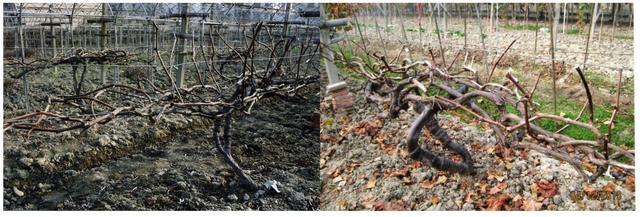
The Huajia No. 8 rootstock Fujiminori grapes planted in the experimental garden in 2000 and the SO4 rootstock Zui Jinxiang grapes planted in 2003 were trained on a double-cross V trellis. By 2015 the vines were already 16 and 13 years old respectively. For the first 9 years, winter pruning was done at 6 buds, leaving 1,000 fruiting canes and 6,000 buds. Fujiminori grapes began 2-bud winter pruning in 2010 and Zui Jinxiang grapes in 2012 (Figure 1, Figure 2). After a few years, the fruiting canes were bent and tied at uneven heights, making 2-bud pruning very difficult in winter again, so renewal was necessary.
Figure 1 The experimental garden's Fujiminori grapes at 4 m spacing between vines: the vine at 8 years old after 6-bud winter pruning and after 2-bud winter pruning (2008-01-07/2013-12-04)
Figure 2 The experimental garden's Zui Jinxiang grapes at 2 m spacing between vines: the vine at 9 years old after 6-bud winter pruning and after 2-bud winter pruning (2011-12-24/2013-12-04)
2 Practice of renewing old vines for stable yields
In 2016, the practice of renewing old Fujiminori and Zui Jinxiang grapevines was carried out. With basically no reduction in yield, the renewed vines grew good new shoots, and at winter pruning the vine spacing was extended to 8 m; in 2017 the new shoots bore more flower clusters, and the renewed vines could reach the yield of before renewal, and the vine form was improved.
Figure 3 The experimental garden's 13-year-old Zui Jinxiang grapevine with the trunk cut back (2015.12.29)
2.1 Arrangements at winter pruning
Fujiminori grapes. At 4 m spacing between vines, 1 vine out of every 3 was renewed, while the 2 adjacent vines continued to bear fruit. Zui Jinxiang grapes. At 2 m spacing between vines, 1 vine out of every 2 was renewed, while the remaining 1 vine continued to bear fruit. For the renewed vine, it was cut back at 30 cm above the bed surface (Figure 3). For the vines that continued to bear fruit, the 2 fruiting canes at each end were bent outward, and they could basically be bent to 20 cm from the renewed vine; fruiting the following year could stabilize the yield.
2.2 Management of the vines that continued to bear fruit
Basically the same as in previous years: shoot spacing 20 cm, 2,500 shoots retained. Shoot tipping at 6 leaves + pinching at 8 leaves, with no secondary shoots retained. From 10 shoots, 6 clusters of fruit were set, retaining 1,500 clusters. Flower clusters were reorganized, trimmed to 16 cm in length, with about 60 berries per cluster after thinning, average cluster weight about 1,000 g, and a yield of more than 1,500 kg. Fertilization and pesticide use were the same as in previous years. The yield and cluster quality were the same as in previous years.
After the grapes were harvested, the fruiting vines were promptly dug out, which favored shoot growth of the cut-back renewed vines (Figure 4, Figure 5).
Figure 4 The experimental garden's Fujiminori grapes: the middle vine of 3 vines cut back and renewed, while the new shoots of the vines on both sides covered the trellis surface and bore fruit (2016-03-30/2016-07-03)
2.3 Management of the cut-back renewed vines
2.3.1 Cultivation of 4 main canes. More new shoots emerged from latent buds, and the 4 earliest emerging new shoots were retained as main canes. 2.3.2 Tying the new shoots well. When the new shoots reached the trellis surface, they were promptly tied to the wires on both sides; as they continued to grow, they were tied diagonally to the wires until growth stopped. Their coexistence with the new shoots of the fruiting vines was not a problem: the new shoots of the fruiting vines were tied upward to the wires, while the new shoots of the renewed vines were tied diagonally to the wires.
Figure 5 The experimental garden's Zui Jinxiang grapes: alternate vines cut back and renewed, with new shoots covering the trellis surface and bearing fruit (2016-03-29/2016-07-03)
2.3.3 Continuous light pinching. Pinch once at about 10 leaves, and continue pinching until growth stops. Repeated continuous pinching favors flower bud differentiation.
2.3.4 Handling of secondary shoots. Secondary shoots emerging at every node must all be retained and cannot all be removed, especially the secondary shoots emerging at about the basal 10 nodes, which must not be removed. New shoots above the 10th node should be promptly pinched or tipped at about 8 leaves, and any new shoots that emerge again should also be promptly removed, otherwise they affect the growth of the terminal shoot.
Continuous light pinching at about 10 leaves and the handling of secondary shoots are the key steps in managing the renewed vines (Figure 6, Figure 7).
Figure 6 The experimental garden's Fujiminori grapes in 2016: of 3 vines, 1 was cut back and sent out new shoots again; after the fruiting grapes were harvested the fruiting vines were dug out, and the new shoots of the cut-back vine are shown (2016-07-29)
Figure 7 The experimental garden's Zui Jinxiang grapes in 2016: alternate vines were cut back and sent out new shoots again; after the fruiting grapes were harvested the fruiting vines were dug out, and the new shoots of the cut-back vine are shown (2016-07-09)
Figure 8 The experimental garden's 16-year-old Fujiminori grapevine: one vine renewed and cultivated at 4 m spacing, developing fruiting canes covering an 8 m distance in one year
(2016-12-05)
Figure 9 The experimental garden's 13-year-old Zui Jinxiang grapevine: one vine renewed and cultivated at 2 m spacing, developing fruiting canes covering a 10 m distance in one year (2016-12-05)
2.4 Winter pruning of the cut-back renewed vines
(1) Cut off shoots less than 0.8 cm in diameter and immature shoots.
(2) Carefully sort all retained shoots off the trellis surface and place them on the ground on both sides.
(3) Bend the 4 main canes in opposite directions and tie them to the wires on both sides. Secondary shoots are not tied down for the time being.
(4) Select secondary shoots according to the thickness of the main canes. Where the main cane diameter exceeds 1 cm, select secondary shoots 0.8-1.0 cm in diameter and bend and tie them at the part of the main cane that exceeds 1 cm in diameter. The entire trellis surface must have fruiting canes 0.8-1.0 cm in diameter, so that the next year's yield can be maintained.
(5) Prune the surplus secondary shoots at 2 buds.
(6) The new shoots may be left to grow long as long as they are mature. If they can reach the position of the adjacent vine, then the adjacent vine is thinned out. In the experiment, the renewed Zui Jinxiang grapevine was 4 m, and at winter pruning the main cane could be extended to 8 m, and the adjacent vine was thinned out (Figure 8, Figure 9).
2.5 Cane and leaf management and flower quantity of the cut-back renewed vines in the second year
In 2017, double-film cultivation was used, and buds sprouted on February 3. The new shoots grew fairly vigorously and fairly uniformly. Shoots were spaced at 20 cm, and 2,500 shoots were retained. Shoot tipping at 6 leaves + pinching at 8 leaves. The new shoots bore many flower clusters, and the clusters were large; the fruiting shoot rate reached 62%, and the double-cluster rate reached 52%. Compared with 2015 before renewal, the fruiting canes were bent very flat, the new shoots grew uniformly, and the flower quantity was greater (Figure 10, Figure 11).
Figure 10 The experimental garden's renewed Fujiminori grapevines: growth of canes, leaves and flower clusters at flowering stage (2017-04-01)
Figure 11 The experimental garden's renewed Zui Jinxiang grapevines: growth of canes, leaves and flower clusters at flowering stage (2017-04-01)
2.6 Flower cluster management and yield of the cut-back renewed vines in the second year
In 2017, flower cluster management was the same as in previous years. From 10 shoots, 6 clusters were set, and 1,500 clusters were set. Flower clusters were reorganized, carefully trimmed, and berries were thinned several times.
For Fujiminori grapes under cultivation for fruit retention and enlargement, the average cluster weight was 1,000 g, the average berry weight was 25 g, and the yield was 1,500 kg. Same as 2016 (Figure 12).
For Zui Jinxiang grapes under cultivation for fruit retention and enlargement, the average cluster weight was 900 g, the average berry weight was 13 g, and the yield was 1,400 kg. Same as 2016 (Figure 13).
Figure 12 The experimental garden's 17-year-old renewed Fujiminori grapevine, a "rejuvenated" vine: first-year ripe fruit (2017-06-26)
Figure 13 The experimental garden's 14-year-old renewed Zui Jinxiang grapevine, a "rejuvenated" vine: first-year ripe fruit (2017-06-30)
3 Summary
3.1 Renewal combined with thinning out
In vineyards with 2 m spacing or 4 m spacing between vines, alternate vines can be thinned out. The vines that continue to bear fruit can maintain the yield. The cut-back vines cultivate new shoots so that the next year's yield is stable.
3.2 Cultivation of the vines that continue to bear fruit
Manage according to the original fruiting vines, including cane, leaf and fruit management, fertilizer, water and soil management, and control of diseases, insects, birds and bird damage.
3.3 Management of the cut-back vines
They must send out more shoots and maintain the original yield the next year, which presents a certain degree of difficulty in management. The whole process practiced with 2 cultivars in the experimental garden can be used for reference. As long as they are managed carefully, they can be cultivated well.
3.4 Fruit-bearing management of the renewed vineyard in the first year
Manage according to premium orchard standards. This includes cane, leaf and fruit management, fertilizer, water and soil management, and control of diseases, insects, birds and bird damage. Special attention: the yield must be controlled fairly strictly, and fertilizer should be appropriately increased. Because this is combined with thinning out, the per-vine area increases by 1-2 times, so the fertilizer amount should be appropriately increased compared with the original; otherwise the canes and leaves grow slowly, affecting fruit enlargement. The yield must not be high, otherwise it is very difficult to grow premium fruit.