Renovation practices for old apple trees: methods for stable yields
Renovation practices for stable yields in old apple trees
With the sustained and rapid development of the apple industry, there are more and more old orchards. Some orchards have trees around 30 years old, with multiple diseases and pests occurring, aged varieties, missing branches and limbs, weakened tree vigor, reduced bearing capacity, poor fruit quality, and declining benefits year after year. If the orchard is destroyed and replanted, there are replant problems, and the interval is relatively long and land utilization is low. For this reason, in recent years we have renovated and renewed a number of old apple orchards through root grafting, with good results.
1 Advantageous characteristics of old orchards that can be utilized
Although old orchards have a poor appearance, with uneven plants and missing branches and trunks; thick branches and few small branches, and many diseases; weakened tree vigor, low yield, decreased quality, and very poor benefits. However, the greatest advantage of old apple orchards is their strong root system, and canker mostly occurs in the upper and middle parts of large branches and the trunk, while there is less canker below 20 cm from the ground on the central leader. The new technology for renewing and renovating old orchards precisely takes advantage of this advantageous characteristic of old apple orchards.
2 Reliability of the new technology for renewing and renovating old orchards
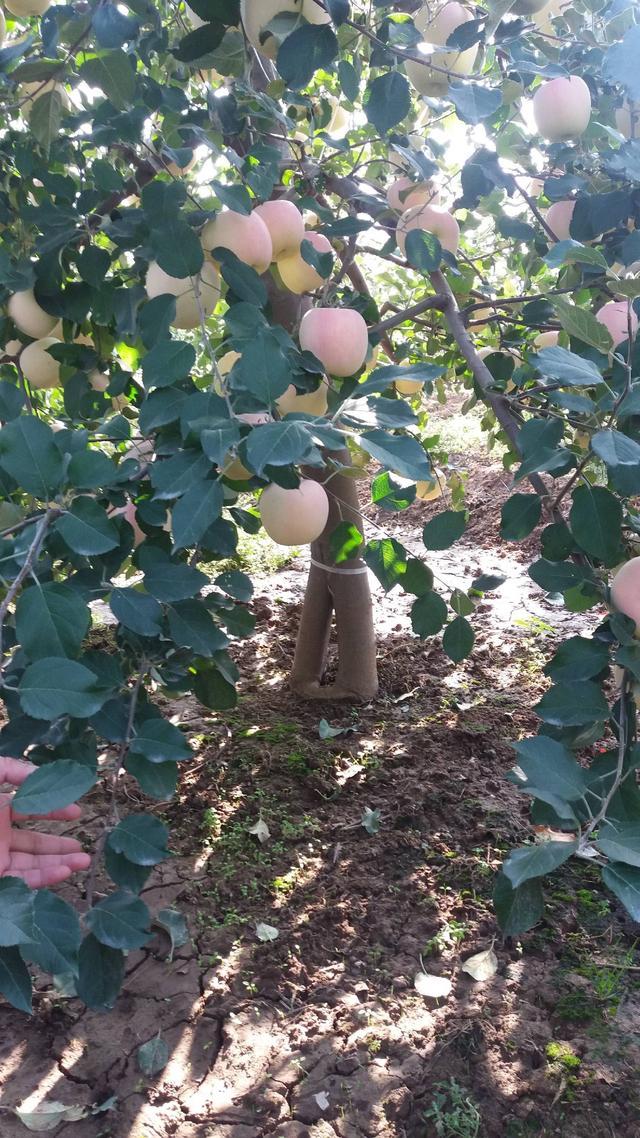
First, large trees more than 20 years after renewal have good fruiting performance. Through our investigations in Miganqiao Village and Caojiazhuang Village in Miganqiao Town, Fengxiang County, we found that a New Red Star orchard planted in 1986 was grafted to Huimin Spur in 1996 and has fruited well for 20 years. A Yellow Delicious and old Red Star orchard planted in 1988 was grafted to Liquan Short Fuji in 1993 and has fruited well for 23 years, without any adverse performance. At the same time, this orchard began its second renewal and renovation grafting last year, and the trees have grown well after renewal. Second, orchards 7-8 years after renewal have good high-yield performance (Figure 1) and high fruit quality. Through our investigations in Fanjiazha Village in Fanjiazha Town and Qi Village in Tianjiazhuang Town, Fengxiang County, the renewed orchards grew well, had high yield performance, and the trees grew robustly, with a per-mu yield of 2,500-4,000 kg and a full-red fruit rate above 90%. Third, orchards 1-4 years after renewal grow quickly and enter the fruiting stage and high-yield stage rapidly.
Figure 1 Growth of trees 7 and 8 years after renovation
3 Implementation of the new renewal and renovation technology
3.1 Preparation before renewal and renovation
Select the orchard to be renovated. In the previous autumn and winter, after the trees shed their leaves, remove the main branches on the trees, leaving only about 1.5 m of the trunk, clean up all remaining branches and fallen leaves, and apply chemicals (such as Fulanke or pruning seal oil) to protect the trunk. On the basis of autumn fertilization, irrigate in winter to keep the trees with sufficient moisture. At the same time, prepare the branches, varieties, or dwarfing rootstocks to be replaced the following spring. Prepare nylon grass, plastic bags, plastic film, and wound-coating chemicals (such as Fulanke, pruning seal oil, or tebuconazole).
3.2 Renewal and renovation grafting technology
Renewal and renovation grafting can be carried out in two operations or completed in one operation. Carrying out renewal and renovation grafting in two operations is relatively faster, uses relatively fewer scion sticks, and the renovation technology is relatively simple, with less grafting difficulty. In actual production, most use the two-time grafting method. The first grafting is carried out around the time of apple tree budbreak (April), and the second side grafting is carried out in early to mid-June. When the renewal and renovation is completed in one operation, grafting is generally carried out around the time of apple tree budbreak. First graft new branches at the root crown of the tree to be renewed. The grafted branches should be long. After the lower part is grafted, perform side grafting at 25-30 cm, leaving only one central leader growing upright.
When grafting around budbreak, first, take out the prepared scions and select scions with robust branches, plump buds, and pure variety. Second, remove the old cut end 2-3 cm from the lower part of the scion, then soak the scion in clean water for 24 hours so that it fully absorbs water, which facilitates survival and vigorous growth. Third, cut down the trunk of the orchard to be renovated. When cutting down, it is best to first remove the large branches on the tree, then cut the tree down at 10-15 cm from the ground on the central leader (10-15 cm for dwarf trees, 5-20 cm for standard trees) (Figure 2). When cutting down the trunk, be careful and meticulous, taking care not to damage the bark left on the trunk cross-section above the ground, then smooth the wound at the trunk cross-section above the ground. Fourth, graft 4-5 branches under the bark at the trunk cross-section. The graft interface on the branches should be cut smooth and flat, with a length of more than 2.5 cm. When renewal and renovation are carried out in two operations, the branches can be cut to 10-15 cm; when renewal and renovation are carried out in one operation, the branches can be left relatively long, and after tying at the cross-section interface, perform side grafting at 25-30 cm to complete the entire grafting in one operation. Fifth, after grafting the branches at the cross-section, wrap tightly with plastic film or plastic bags to protect the wound, then tie tightly and firmly with new nylon grass, leaving no gaps. At the same time, cover all grafted branches with bags, tie the openings, and wrap them tightly (Figure 3) to accelerate wound healing. Sixth, when grafting, try as much as possible to make the first bud on the scion face outward, so as to facilitate the second side grafting and make the wound grow relatively firmly and stably after grafting. Generally, at least 4 scions should be grafted on one central leader. On the one hand, this guards against the death of grafted scions; on the other hand, if the central leader is relatively thick and too few branches are grafted, the bark and xylem at the grafted part of the central leader will not heal well and are prone to disease infection. Seventh, when the grafted branches grow to 40-60 cm, perform side grafting at 25-30 cm on the scion. The side grafting in the same year is generally carried out in early to mid-June. Select at least 4 well-grown branches after successful grafting (the branch orientations should be at the four corners as much as possible), then graft them together by side grafting. After grafting, wrap with 1 cm wide plastic strips (Figure 4). After the wounds have completely healed, in July-August of the same year, remove all the nylon grass, plastic bags, plastic film, and plastic strips applied during the first and second graftings, then clean the wounds at the first grafting site and the trunk, and spray them with 25% propiconazole emulsifiable concentrate at 500 times dilution, or apply Shukang or Fulanke to protect the wounds and trunk, then mound soil up to 1/2 of the distance to the second grafting interface.
Figure 2 Cutting down old trees
Figure 3 Bagging grafted branches, tying the openings, and wrapping tightly
Figure 4 Wrapping with plastic strips after side grafting
3.3 Grafting renovation of special tree bodies
When the base of a large tree has canker and grafting cannot be done at the base of the trunk, the large tree can be dug out and grafting can be done on the small roots under the large tree. After survival, graft the successfully grafted branches together by side grafting.
4 Post-grafting management
4.1 Remove bags and untie in time, and protect with soil mounds
In the same year after renewal and renovation are completed, remove the plastic bags in time after the scions sprout to prevent burning of the buds. In July-August, after the wounds from the second grafting have completely healed, uncover the mounded soil, clean all wounds from the first grafting, spray chemicals to prevent canker, then mound soil around the central leader up to 6-8 cm of the grafted branches to protect the interface and promote growth.
4.2 Strengthen water and fertilizer management
After renewal and renovation are completed, fertilize in time. Using hole application, apply about 100 kg of diammonium phosphate per mu. The fertilization depth is about 35 cm for dwarf apples and about 45 cm for standard apples. Irrigate in time after fertilization. In July-August, before rain, apply 50-100 kg of urea per mu as topdressing. In autumn, in September-October, apply about 2,000 kg of base fertilizer (farmyard manure) per mu in furrows, and irrigate after application.
4.3 Branch bending and training
For apple trees after renewal and renovation, generally no trunk heading is needed. In the same year, many main branches emerge on the central leader, and most main branch angles are relatively open. There are also some competitive branches and some strong vigorous branches that need branch bending and angle opening. According to growth conditions, the main branches can be opened to more than 90°. Before budbreak in the second year, make moderate bud notching. During the growing season, bend branches. In autumn, tree height can reach about 3 m. In the third year, per-mu yield can reach about 1,500 kg. Branch bending during the growing season is very important to promote flowering. In the fourth year, tree training is basically complete and the trees begin to enter the full fruiting stage.
4.4 Disease and pest control
After the renovation of old orchards is completed, attention should be paid to disease and pest control, with emphasis on controlling scarab beetles, shoot-tip tortrix moths, aphids, longhorn beetles, red spider mites, golden leaf miners, green leafhoppers, scale insects, and rust disease and early defoliation disease. In mid-May, spray 30% emamectin benzoate? no, 30% eomanling at 2,000 times dilution or 5% imidacloprid at 2,000-3,000 times dilution; from late May to early June, spray Daconil M-45 at 800 times dilution; in July-August, spray 20% saomanjing at 4,000 times dilution + Haolike at 3,000 times dilution.