Pollution-Free High-Density Pear Orchard Production and Management Techniques
Pollution-Free High-Density Pear Orchard Production and Management Techniques
Pear trees have a long history of cultivation in China and are widely popular for their good taste and high nutritional value. However, in recent years, continuously declining yields and prices in pear-growing areas have reduced growers' enthusiasm for cultivation. Traditional fruit-growing methods can no longer meet the demands and competition of the modern market. Only by introducing new techniques, selecting high-quality varieties, and fundamentally adjusting the structure can increased production and income be achieved.
Traditional pear trees are generally 5-6 m tall, with large canopies and wide row and plant spacings, allowing only 25-30 trees per mu. High-density planting not only increases yield and shortens the time to reach full production, but the reduced plant and row spacings also ensure good ventilation and light penetration, producing pears with bright, vivid color and relatively fewer pests and diseases. The following focuses on pollution-free high-density pear orchard production techniques.
1 Variety Selection
Based on regionalization and improved varieties, plant high-quality pear varieties such as Xueqing, Xinli No. 7, Hongxiangsu, Qiuyue, and Huangguan.
2 Nursery Stock Specifications
One-year-old finished seedling specifications: diameter at 5 cm above the graft union of 0.8 cm or more, trunk height of 90 cm or more, and 3-5 complete roots. One-to-two-year-old rootstock seedling specifications: Hebei Duli (Pyrus betulifolia) or Shanxi Jiangxian Duli, with a basal diameter of 0.8 cm or more and 3-5 complete roots.
Bud specifications: all from vigorous one-year-old branches, sourced from pear orchards of provincial-level leading enterprises in agricultural industrialization in Baoding Gaoyang, Xiongxian, and other areas, ensuring variety purity.
3 Land Preparation Standards
Use mechanized trenching, with trench depth and width of 80-100 cm each, following a plant-to-row spacing standard of 0.8 m x 3.5 m, with rows oriented north-south. Place topsoil (30 cm deep) and subsoil (50 cm deep) separately; mix with organic fertilizer and backfill into the trench, then irrigate heavily to settle the soil, rake level, and set aside for use.
4 Fertilization Standards
Fertilizer types include cow manure, sheep manure, pig manure, etc., applying more than 5 tonnes of organic fertilizer per mu.
5 Planting Requirements
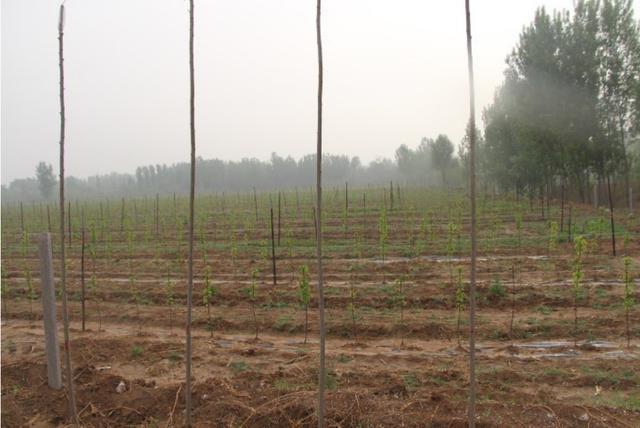
Planting depth should not exceed 15 cm. Plant when pear buds are about to swell, between March 25 and 31; later planting favors survival. Dig planting trenches 80 cm wide and 60 cm deep, keeping topsoil and subsoil separate. Fill the bottom of the trench with 10-15 cm of straw or crushed cotton stalks, and the top 30 cm with a mixture of organic fertilizer and soil, applying 5 tonnes of organic fertilizer per mu. Ensure that the soil in contact with the root zone is all topsoil to favor survival. After planting, irrigate and cover the ground on both sides of the trunk with black plastic film, each 70-80 cm wide, to help increase temperature, conserve moisture, and suppress weeds (Figure 1).
Figure 1 High-density pear orchard after planting is completed
6 Post-Planting Management
For finished seedlings, generally do not head back or head back high, and notch buds at the appropriate time to promote branching. That is, from 60 cm above ground to 30 cm from the tip, notch above each bud when it is about to swell to stimulate new shoots. The terminal bud can form a flower bud in the same year and bear fruit the following year (Figure 2).
Figure 2 Young tree stage
7 Tree Training
In the second year after planting, the average yield per mu is 900 kg; three-year-old trees can reach 2,100 kg per mu; and at 4-5 years they enter full production. The early tree form is a feather duster shape, later becoming cylindrical. Pay attention to opening the angles of scaffold limbs and fruiting branches for good ventilation and light penetration, easy operation, and high labor efficiency. After 20 years of tree age, the trunk only thickens, but the branch units do not grow larger, and the fruiting zone does not shift outward (Figure 3).
Figure 3 Fruiting state of a high-density pear orchard at full production
8 Flower and Fruit Stage Management
(1) Pollination. In addition to natural pollination, methods such as honeybee or mason bee pollination and artificial hand pollination can be used to assist pollination and ensure yield.
(2) Flower and fruit thinning. This is an effective means of ensuring a reasonable crop load on the tree. For flower thinning, follow the principle of keeping the outer flowers and removing the central ones in each flower cluster; for fruit thinning, follow the principle of keeping the good and removing the poor, thinning out diseased, insect-damaged, injured, deformed, and small fruits.
9 Pest and Disease Control
Based on agricultural and physical control, with biological control advocated, and following the patterns of pest and disease occurrence, rationally use chemical control techniques to effectively control pest and disease outbreaks. Specific control measures are shown in Table 1.
Table 1 Annual Pest and Disease Control Schedule for Pear Orchards