Cultivation and Management Techniques for the Inverted Tower-Pine Shape of Yanfu 8 (Shenfu No.1) Apple
Cultivation and Management Techniques for the Inverted Tower-Pine Shape of Yanfu 8 (Shenfu No.1)
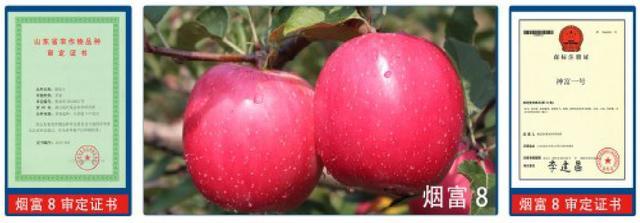
Yanfu 8 (Shenfu No.1) is an excellent late-maturing apple variety with particularly good coloration, selected from bud sport varieties of the Fuji series. It passed appraisal in October 2012, passed examination and approval in November 2013, was officially named Yanfu 8, and obtained a national trademark registration certificate (Figure 1).
Figure 1 Yanfu 8 (Shenfu No.1) Fruit Variety Approval Certificate and Trademark Registration Certificate
1 Selection and Planning of Orchard Site
1.1 Selection of Orchard Site
Choose pollution-free loam or light sandy loam as the ideal soil. If the soil layer thickness is less than 50 cm, the ground must be deep-ploughed with an excavator before planting, and stones removed. Avoid yellow clay, saline-alkali soil and poorly drained waterlogged lowlands as much as possible. The groundwater level should be below 1 m, and the soil pH should be 6.0-7.5.
1.2 Orchard Site Planning
Planting rows should run north-south. Equip with access roads, drainage and irrigation facilities, and buildings according to the planting area.
2 Sapling Planting
2.1 Planting Time
Planting can be done in autumn or spring. Planting in autumn before the ground freezes gives a short seedling recovery period and vigorous growth after sprouting the following year. However, the saplings must endure the severe winter, and the survival rate is lower than spring planting. Planting in spring after the soil thaws but before the saplings sprout: the later the planting, the higher the soil temperature and the higher the survival rate.
2.2 Preparation Before Planting Saplings
(1) Planting density. Standard seedlings: plant spacing 3 m, row spacing 4 m, 55 trees per mu; dwarfing interstock seedlings: plant spacing 2 m, row spacing 4 m, 83 trees per mu; dwarfing self-rooted rootstock (M9T337): plant spacing 1.2 m, row spacing 3.5 m, 158 trees per mu.
(2) Pollinator tree arrangement. For Yanfu 8 (Shenfu No.1), Venus Gold, Gala, Huahong, Orin, etc. can be arranged as pollinator trees, with a proportion of 10%-15%. The layout of pollinator trees should be reasonable, with appropriately more planted along the orchard edges and on the windward side.
(3) Orchard site preparation. Before planting, it is best to deep-plough the ground once with an excavator in winter. Through winter weathering and accumulation of rain and snow, the soil ecology is changed, which benefits subsequent fruit tree growth. Before ploughing, broadcast 4000-5000 kg of farmyard manure per mu or 400-500 kg of bio-organic fertilizer to build soil fertility. Before planting saplings in spring, test the soil pH. If it is not within the range of 6.0-7.5, broadcast soil conditioner to adjust it.
(4) Sapling treatment. First select and grade the saplings to ensure uniformity after planting. Remove the plastic binding strips at the graft union of the saplings, then soak the whole saplings in clean water (preferably running water) for 24-48 hours so the saplings absorb enough water and the survival rate is improved. After soaking, let the saplings air-dry slightly, then soak them in a solution made of 500 times 50% carbendazim and 500 times jinggangmycin for disinfection for 5-10 seconds, then remove and plant.
(5) Dig planting trenches or pits. For dwarfing saplings, dig planting trenches 50 cm wide and 40 cm deep; for standard saplings, planting pits 40 cm square are also acceptable. Outside the planting trench or pit, mix 1.5-2 kg of bio-organic fertilizer per tree evenly with soil, then backfill it into the planting trench or pit.
(6) Planting. After placing the sapling into the planting trench or pit, spread all the roots out fully, then begin filling with soil. When filled to about halfway, gently lift the sapling upward so the roots spread out, then press lightly so the roots contact the soil closely with no gaps, then continue filling with soil up to the original soil mark on the sapling. After planting, water heavily 2-3 times to settle the saplings, then cover the tree basin with black plastic film to raise temperature and conserve moisture.
3 Ground Management
3.1 Soil Management
The key to soil management is to increase soil organic matter content. Through growing grass or mulching on the ground instead of clean cultivation, build soil fertility and increase soil organic matter content.
3.2 Scientific Fertilization
Emphasize early application of organic fertilizer in autumn, making full use of the third root growth peak from September to October to promote root growth, increase nutrient storage in the tree, and provide nutritional assurance for sprouting, flowering and fruiting the following year. Apply 4000-5000 kg of fully decomposed and fermented high-quality farmyard manure per mu or 800-1200 kg of commercial bio-organic fertilizer, combined with 100 kg of nitrogen-phosphorus-potassium compound fertilizer, 500 kg of biological bacterial fertilizer, and 30 kg of the trace element fertilizer "Weimei". To promote sprouting, flowering and improve fruit set rate, apply 2-3 bags (5 kg/bag) of the high-nitrogen high-phosphorus water-soluble fertilizer "Bitianran" (20-48-3) per mu before sprouting. During the nutrient transition period in late May to early June, to ensure the current year's yield and next year's flower quantity, apply 250 kg of "Longfei Dasanyuan" organic-inorganic biological fertilizer plus 250 kg of "Danwang" nitrogen-phosphorus-potassium compound fertilizer per mu. Starting from late July, apply high-potassium water-soluble fertilizer in small amounts and multiple times scientifically, 10 kg each time, to ensure the fruit's nutrient element needs for expansion. For non-fruiting young trees, appropriately reduce the amount; do not apply topdressing before new shoots grow 20 cm in the planting year.
3.3 Water Management
Irrigation timing should be based on the water requirements of the fruit trees and soil moisture conditions, with reasonable watering. Water heavily before sprouting. About 20 days after petal fall, the young fruit rapid growth and development period is another critical water requirement period, and small amounts of frequent watering are appropriate. From mid-July to late August during the fruit expansion period and before fruit harvest, water promptly. After each topdressing, water promptly. Throughout the entire growth period, also water reasonably according to weather conditions and soil moisture to ensure the needs of fruit tree growth and development. Before the soil freezes, water once with wintering water to ensure the fruit trees safely overwinter.
4 Tree Body Management
4.1 Training and Pruning
The inverted tower-pine shape (Figure 2) is suitable for the training and pruning of Yanfu 8 (Shenfu No.1) apple. After the sapling is planted, head it back at a plump bud and cut off the upper immature part. Starting from the 5th bud below the cut bud, notch every 3 buds, notching down to 80 cm above the ground. After sprouting, when new shoots grow to about 20 cm, begin using toothpicks to open the base angle. After the Beginning of Autumn, bend branches to open the angle to 110°-130° (Figure 3). From the second year onward, continue to cut back at plump buds on the central leader to promote a strong, upright central leader to about 3 m (Figure 4). On the central leader, starting from the uppermost branch, notch one bud every 3 buds to promote branching. Repeat the angle opening and branch bending of the previous year. All branches should mainly be left unpruned and extended as single axes. Before Qingming each year, notch the buds on both sides and the underside of the middle section of branches to promote branching. When 60% of branches grow to more than 5 cm, make ring cuts at the base of the branches to promote flowering. As the tree ages, promptly thin and renew excessively dense and thick branches growing on the central leader, cultivate and use vigorous auxiliary branches, and maintain young branch fruiting (Figure 5).
Figure 2 Inverted Tower-Pine Shape of Yanfu 8 (Shenfu No.1)
Figure 3 One-Year-Old Inverted Tower-Pine Shape of Yanfu 8 (Shenfu No.1)
Figure 4 Two-Year-Old Inverted Tower-Pine Shape of Yanfu 8 (Shenfu No.1)
Figure 5 Four-Year-Old Inverted Tower-Pine Shape of Yanfu 8 (Shenfu No.1)
4.2 Flower and Fruit Management
To save stored nutrients, the earlier flower thinning is done, the better. Especially for trees with a large number of flowers, adjust flower quantity starting from pre-bloom pruning. When flower buds swell, thin out overly dense, overly weak and poorly developed flowers. Retain more flowers formed on fruiting spur axillary shoots, and retain more flowers on medium and long fruiting branches, to favor producing drooping, high-crowned fruit. Within 2-3 days of inflorescence separation, before the fruiting spur axillary shoots have extended, remove some overly dense flowers, clustered flower buds, and young inflorescences on medium and long fruiting branches in overly dense areas. This allows the later emerging fruiting spur axillary shoots to form flower buds, achieving the goal of exchanging flowers for flowers.
Begin fruit thinning 10 days after bloom to minimize ineffective nutrient consumption by the tree to the greatest extent. Determine the fruit load based on trunk circumference. For example, if the measured trunk circumference is 30 cm, then the fruit load for this tree is 30 multiplied by the constant 6, which is 180 fruits. For weak trees, the fruit load can be reduced by 10% to favor high quality and high yield. Fruit retention standards: retain single fruit, retain well-formed high-crowned fruit, do not retain misshapen fruit or damaged fruit. Retain drooping fruit, do not retain fruit on the back facing upward. Retain more fruit on strong branches, with the whole tree bearing fruit evenly. Generally, fruit spacing is 20-30 cm, and the leaf-to-fruit ratio is 50:1. Around May 20, when young fruit transverse diameter reaches 2.5 cm, bag the fruit.
5 Integrated Pest and Disease Control
5.1 Agricultural Control
In combination with reasonable training and pruning, improve ventilation and light conditions of the fruit trees, reduce pest and disease damage, promptly clean up and deeply bury diseased branches, diseased fruit and fallen leaves in the orchard, and reduce the pest and disease base.
5.2 Physical Control
Using the phototaxis of pests, set up solar insect-killing lamps to trap and kill pests. Using the taste attraction of pests to sugar-vinegar liquid, during the adult occurrence period, set up sugar-vinegar basins in the orchard to trap and kill pests. Also, hang sticky insect boards at regular times and amounts to trap and kill pests. After autumn, tie grass bundles on the trunks, which can also trap and kill overwintering pests. Whitewash the trunks before leaf fall, which can prevent sunscald, frost cracking, and late frost damage, and also control overwintering pests and diseases on branches and trunks, while reducing winter gnawing of trunks by wild rabbits, especially for young trees.
5.3 Biological Control
(1) Protect and utilize natural enemies of pests to achieve pest control. [Jishan Huayao] Natural enemies include: various green lacewings, small black flower bugs, predatory mites, pine caterpillar trichogramma, peach fruit moth braconid wasps, ladybugs, encyrtid wasps, leafminer eulophid wasps, etc.
(2) Use sex pheromone traps. Currently, pests such as peach fruit borer, apple tortrix, golden striped leafminer, codling moth, apple brown tortrix, pear fruit borer, peach pyralid moth, peach leafminer, etc. can all be trapped and killed and their mating interfered with by hanging sex pheromone lures in the orchard. This accurately monitors the adult occurrence period of each generation, guides targeted pesticide application for control, and achieves the goal of pest control.
5.4 Chemical Control
Before sprouting, spray fungicides and insecticides such as Omexyk and Supersben to control overwintering pests and diseases such as rot disease, ring rot, woolly apple aphid, and scale insects. Before flowering, spray fungicides such as difenoconazole plus jinggangmycin, and insecticides such as pyriproxyfen and emamectin benzoate, and the acaricide Zhumanling. After petal fall, spray 3 rounds of pyrethroid, pyriproxyfen and imidacloprid insecticides and carbendazim and azole fungicides at 10-15 day intervals. After bagging, spray 3-5 rounds, mainly with Bordeaux mixture as a protective agent, with alternating sprays of ethylicin-mancozeb and azole fungicides and emamectin benzoate and pyrethroid insecticide-acaricides. Generally, spraying is prohibited 30 days before harvest.
6 Timely Harvest
Begin removing bags around the Autumn Equinox when the day-night temperature difference reaches above 10°C. The fruit grows in the bag for 110 days. Because Yanfu 8 colors quickly, reflective film is not needed; 4-5 days after bag removal, the fruit can become fully red, and harvest can be done according to market demand. Yanfu 8 fruit color fades slowly and the peel resists shrinkage, so the harvest period can also be extended according to market conditions. When harvesting, wear gloves, handle gently, and prevent bruising, compression and puncture injuries.