Detailed Explanation of the Techniques for Constructing Double-Arm Row-Aligned Trellises and Training and Pruning Mountain Pear Trees
Techniques for Constructing Double-Arm Row-Aligned Trellises and Training and Pruning Mountain Pear Trees
Dehua County, Fujian Province is located in central Fujian, in the mid-subtropical monsoon zone,with cold winters and cool summers. It is a suitable area for early-maturing southern pears at low latitude and high altitude. At present,2467 hm2 of early-maturing high-quality pears have been planted, with an annual output of 29,600 t and an annual outputvalue of more than 103 million yuan, becoming a new highlight of farmers' income. In recent years,with the gradual increase in labor costs and the aging of the rural labor force, peartrellis cultivation has become a new experimental and extension cultivation model. Many pear orchards in Dehua Countyare built on hilly and mountainous land with complex terrain and relatively steep slopes, and lacktrellis cultivation models and training and pruning methods suited to them. Therefore, the authorscooperated with the Institute of Fruit and Tea, Hubei Academy of Agricultural Sciences, andcarried out research on double-arm row-aligned trellis cultivation of mountain pear trees in the pear orchard ofQunfang Agricultural Professional Cooperative in Dehua County, and achieved good results. The trellis constructionand training and pruning techniques are summarized as follows.
1 Advantages and effects
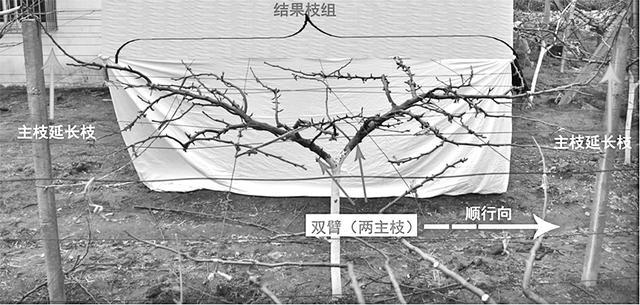
Pear trellis cultivation can overcome many problems of traditional vertical cultivation, such as trees being too tall, inconvenientmanual operation, and difficult mechanical tillage; complex training and pruning techniques and a low degreeof standardization; three-dimensional fruiting, great difficulty in renewing fruiting branches, and large differences in fruit size and quality;poor wind resistance and serious pre-harvest fruit drop. It has been fully adopted in pear-producing areas such as Japan,South Korea, and Taiwan, China. At present, pear trellis cultivation at home and abroadis concentrated in pear-producing areas with flat, open terrain that is convenient for trellis installation.The trellis types are mainly horizontal trellises (also called horizontal net trellises),and the main recommended tree forms are the four-main-branch "cross" type and the three-main-branch "rib" type.This kind of trellis pear orchard is relatively standard, neat, and beautiful, and the effect is also good, butit has high requirements for fertilizer and water conditions, management technology level, and pear seedling quality in the orchard,and the training and pruning are complex, technically difficult, and the canopy takes a long time to form,with late bearing and slow returns [Jishan Huayao]. In recent years, pear-producing areas such as Japan and South Korea have exploredimproved tree forms such as the one-main-branch "keel" type and the two-main-branch "flat arm" type,to adapt to changes such as rural labor transfer and aging, but there are limitationsin extending them in hilly and mountainous pear orchards. Therefore, on the basis of introducing andabsorbing trellis cultivation training and pruning experience from pear-producing areas such as Japan and South Korea, andaccording to the actual situation that most pear orchards in Dehua County are on hillside land, the authorsimproved and innovated the double-arm row-aligned trellis model of pear trees from the Institute of Fruit and Tea, HubeiAcademy of Agricultural Sciences, changing the original multi-row connected trellis (net trellis) into a single-rowindependent trellis (Figure 1).
Figure 1 Structural diagram of the double-arm row-aligned tree form
Through years of practice, it has been found that these improved trellis cultivation modelshave a simple tree structure. The two main branches extend in opposite directions along the row, and thefruiting branches borne on them do not cross. The light conditions are good, and they have fruit-quality and windproof effects,and facilitate standardized management and mechanized operations such as flower and fruit thinning, artificial pollination, bagging, pruning, spraying, and fruit harvesting,especially because the training and pruning techniques are simple(foolproof) and labor-saving, and middle-aged and older people can operate them. This model can fullyuse ventilation and light conditions to carry out three-dimensionalplanting and raising such as "pear-cucurbit" and "pear-chicken"; in this cultivation method, the branches are distributed horizontally on the trellis surface, with a large spaceunder the trellis, and the fruit can be picked by reaching out a hand, which facilitates flower viewing, fruit tasting, fruit picking, and othersightseeing activities, thereby improving economic, social, and ecological benefits. This provides a strongbasis for breaking through technical bottlenecks such as trellis type and training methods inhilly and mountainous areas.
2 Trellis construction
The main materials for the trellis are concrete posts, triangular steel, steel wire, etc. Thetrellis is built in the first winter or the second spring after planting. The trellis is a single-row independent one,that is, a single trellis is built along the terraces of the mountain pear orchard, using 10 cm x9 cm x 270 cm square concrete posts. Holes are drilled in the square posts at 190 cm,220 cm, and 270 cm respectively. At 220 cm on the square post, a 240 cm longtriangular steel crossbar is installed. The triangular steel crossbar is drilled with 5 trellis-surface threading holesspaced about 60 cm apart (Figure 2).
Figure 2 Front view of the support post and crossbar frame
The concrete posts are buried 50 cm deep, with an aboveground height of 220 cm. The tops of the postsare at a uniform height, and the spacing between supports is 400-500 cm. The tops of the concrete supports at both endsare tied with steel wire rope and diagonally anchored into the ground at an angle of about 45 degrees, with ground anchors buriedat a depth of more than 80 cm underground. The flat trellis surface is 170 cm high. From the middle toward both sides,5 parallel steel wires spaced about 60 cm apart are stretched, with a wire diameter of 5-6 mm steelwire, passing over the crossbars, tightened with a wire tensioner and fixed to the exposedconnection points of the ground anchors, and fastened with flange bolts. At 30 cm downward from the middle of the trellis surface(that is, the main-branch positioning line threading hole), the main-branch positioning line is threaded, used to fixthe main branches; at 50 cm upward from the middle of the trellis surface (the raised attraction line threading hole), theraised attraction line is threaded, used for cultivating main-branch extension branches and single-axis long-shoot fruitingbranches. The main-branch positioning line, the raised attraction line, and the trellis surface form a two-line single-surfacetrellis type [2] (Figure 3). After all the main lines are stretched, then stretch the positioning line and attractionline.
Figure 3 Single-row independent trellis type
3 Training and pruning
Year 1: Select grafted seedlings or field-grown seedlings with well-developed roots, thick and strong growth, and no disease,and plant them from after leaf fall in winter to before budbreak in spring. For grafted seedlings, select and retain 1-2 relatively plump and robust buds5-10 cm above the graft union and cut back heavily; for field-grown seedlings, keep a single bud and single shoot ⟧77⟧standing upright. When the seedling sprouts new shootsCut; keep the planted seedling with a single bud and single shoot standing upright and growing straight up. When the seedling sprouts new shoots30 cm long, insert a bamboo pole more than 250 cm long vertically close to the main trunk of the seedling,tie the new shoots to the bamboo pole, and later tie the new shoots additionally according to growth conditionsto keep them upright. In winter, select plump buds on both sides at 120-130 cm to determine the trunk height. For those that do not reach the trunk-heightdetermination height, select plump buds in the middle and cut back short, and among the new shoots that emerge, select one upright branchfor attraction, and determine the trunk height again in the winter of the next year.trunk.
Figure 4 Front view of the double-arm row-aligned tree form of pear trees on a trellis
Year 2: When the new shoots are 60 cm long, pull the branches open at a base angle of 45 degreesand fix them to the main-branch positioning line. Other shoots are propped open to more than 80 degrees with toothpicksand gradually trained onto the trellis. After the new shoots exceed the main-branch positioning line, successively use the trelliswires and attraction lines to attract the new shoots vertically; for overly long ones, bamboopoles can be used for auxiliary attraction. During winter pruning, release the upright branchesthat were attracted during the growing season, fix them on the trellis wires, remove competing branches of the main-branch extension branches, select robust lateral budson the main-branch extension branches and cut back, guide them vertically to the attraction line, and remove alladventitious buds on the upper side of the main branches to reduce the sprouting of upper-side branches the next year (Figure4) 。
Year 3: During the growing season, promptly remove sprouts within 20 cm of the base of the main branches.For water sprouts on the main branches, remove the upper ones and keep the lateral ones; bend and coil auxiliary branches,and tie the extension branches upright using the attraction line to maintain growth vigor. At the sametime, begin to cultivate fruiting branches under the trellis. For each main branch, separately select a robust lateralbranch (with the branch emergence positions respectively near 30 cm or60 cm at the main-branch branching point; if there is no branch, perform bud notching) to extend flatin the opposite direction from the other main branch. For the reverse branch, select an upper bud at 60 cm and cut back short, and at about20 cm from the branching point of the reverse branch, retain one upper-side bud and remove the other buds. Thenew shoots sprouting from the upper-side bud and the cut bud are raised and attracted, forming 2 long branchesmore than 150 cm long with balanced growth vigor. After being left unpruned to flower, they are pulled flat onto the trellis, formingan "F"-shaped single-axis long-shoot fruiting branch group that fills the trellis spaceabove the main trunk. The "F" fruiting branch groups on the two main branches extend left and right toward thespace between rows. By the winter of the third year, the cultivation of the tree structure is basically completed (Figure 5).
Figure 5 Top view of the double-arm row-aligned tree form of pear trees on a trellis
Year 4 and full production period: During this period, training and pruning mainly adopt single-axisextension of the main branches and raise and attract the extension branches to maintain growth dominance; secondly, cultivate near thetrellis attachment points on the main branches and on the trellis surface single-axis fruiting branch groups by selecting laterallong branches with strong buds and cutting back short, allowing the cut branch to extend outward and gradually form single-axis long-shootfruiting branch groups year by year; or select lateral or rear weak branches, cut back heavily, and then attract them vertically,promoting vigorous branches more than 150 cm long, leaving them unpruned to flower and then pulling them flat to bear fruit,forming single-axis long-shoot fruiting branch groups.
Fruiting situation of pear trees on a trellis