How to prune trellised pear trees in winter in southern China? Detailed technical points
Winter pruning techniques for trellised pear trees in southern China
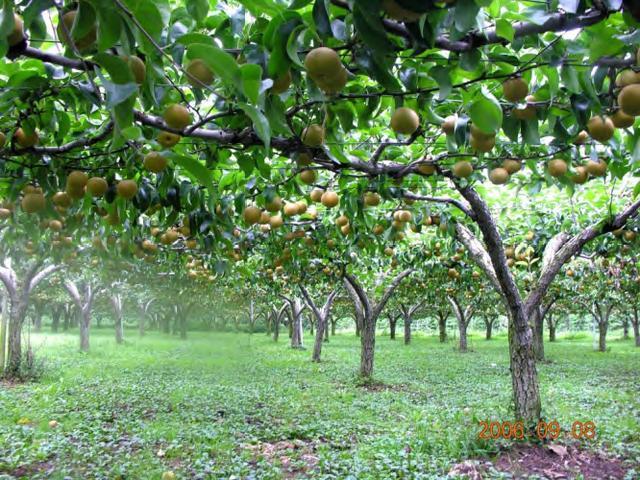
Pear trellis cultivation is a pear growing method that uses a flat trellis surface built from concrete posts (or steel pipes) and steelwire and other materials as support. Since thiscultivation method was introduced into China from Japan in the 1990s, it hasbeen promoted and applied in pear-producing regions across both northern and southern China [1-3]. The originalpurpose of pear trellis cultivation was wind protection [4], but studies show that trellis cultivation has obviousadvantages in improving fruit quality [Jishan Huayao]. Pear-producing regions in southern China have high temperature and highhumidity, and trellis cultivation helps improve ventilation and light conditions in the tree canopy, gives good fruitquality, and makes sightseeing and picking convenient, and it has become a newhighlight of China's pear industry technology [8].
1 Tree shape characteristics and growth and fruiting characteristics of trellised pear trees
Tree shape characteristics of trellised pear trees: no central leader, open-center shape, trunk height110-120 cm, generally 2-3 main branches. Most trellised pearorchards already established are low-trunk, three-main-branch, but the two-main-branch, high-trunk trellis tree structure issimplified, easy to operate, and is the future development trend of trellis tree shapes in China.Growth and fruiting characteristics of trellised pear trees: (1) Main branches and fruiting branches arehorizontal after being trained onto the trellis, and after the main branches are trained onto the trellis their apical dominance is weakened, so water sproutsare easily produced at the base; (2) branches can be freely trained toward the trellis surface to fill space, giving relativelyhigh early yields; (3) without "notching" or applying "branching agents" they still havegood branching ability, and fruiting branch groups are easy to renew after aging; (4) trellised peartrees have good ventilation and light, fruit hangs naturally, is uniform and consistent, and the rate of high-quality fruit is high;(5) branches are tied to the trellis surface to bear fruit, and pre-harvest "wind damage" fruit drop is light.
2 Main techniques for winter training and pruning of trellised pear trees
2.1 Winter training of young trellised pear trees
Pruning trellised pear trees is simpler than the traditional delayed open-center shape. The trunk is headed at1-1.2 m, with at least 4-5 plump buds below the cut. In the firstwinter, select 2-3 vigorous branches from the buds below the cut as main branchesto train, heading them back at the terminal lateral bud, and when the extension shoot droops, train it upward as appropriate.In the second winter, completely remove competing shoots at the tips of the main branches, shoots on the upper side of the branch, andshoots growing from the trunk, and keep the main branch extension shoots growing upward. In the thirdwinter, tie main branches that exceed the trellis surface horizontally to the flat trellis surface, andthrough training, keep the tips growing upward; remove shoots on the upper side of the main branches,select and retain fruiting branch groups directly on the main branches, and for branches that have formed flower buds or short fruiting branches,pull them flat and tie them to the trellis surface. By the third winter, trellised pear trees arebasically formed.
2.2 Winter pruning of mature trellised pear trees
It mainly includes pruning of main branch extension shoots, shoots on the upper side of the branch, fruiting branch groups, and auxiliarybranches, as well as tying branches onto the trellis.
(1) Pruning of main branch extension shoots: Under the high-temperature and rainy conditions of southern China,pear branches grow for a long time and flush multiple times, and the tips are not well ripened, so whenheading back, cut at least to the well-ripened part. The length left varies with the vigor of the branch;when the extension shoot is very vigorous, head it back slightly less severely, and when it is weak,head it back appropriately more severely, but the degree of heading should not be too severe, and the length left should not be less than30 cm, otherwise the branch is difficult to pull flat when trained onto the trellis. If the extension shoot is too weak,a vigorous shoot behind it can be selected for "head replacement." It is best to choose a lateral bud as the cut bud,so that the branch can be easily pulled flat onto the trellis. One-year-old main branch extension shoots should be trained obliquelyupward, and must not be pulled flat during winter pruning that year.
(2) Pruning of shoots on the upper side of main branches: Removal of shoots on the upper side of main branches should dependon the amount of branches near the part being removed. When there are many branches nearby and there is nospace for extension, when removing shoots on the upper side of main branches, the saw cut should be flush against the main branch, enlargingthe sawed surface, to thoroughly remove latent buds at the base of water sprouts on the upper side and reducethe labor of summer shoot removal after latent buds sprout; when branches are lacking nearby and there is spacefor branch extension, pruning can retain the outer latent buds.
(3) Selection and retention of auxiliary branches and training of fruiting branch groups: When branchgrowth on the trellis surface is relatively small, 2-3 relatively weak branches should be retainedas auxiliary branches, which is crucial for the training and pruning of young trellised peartrees. When the trellis surface already has a large amount of branches and leaves, no branches are retained below the trellis. Thetraining method for fruiting branch groups is relatively simple; generally, branches produced from the lower-middlepart of the cross-section of the main branch are selected and retained as single-axis fruiting branch groups. Vigorous newshoots are pulled to a 45° angle after growth stops that year, to favor formation of axillary flower buds,and are pulled flat to bear fruit in winter of that year; weak branches are heavily headedback in winter, and after longer shoots are produced they are allowed to flower, then pulled flat onto the trellis.
(4) Pruning of fruiting branch groups: During winter pruning, remove all brancheson fruiting branch groups, avoid using relatively thin and weak branches to bear fruit, and keep fruitingbranch groups extending in a single axis; at the tips of fruiting branch groups, retain relatively strong branches forheading back, so that fruiting branch groups extend slowly while bearing fruit; fruiting branchgroups are generally not renewal-pruned by cutting back; when the number of flower buds is small and bare areas appear,remove them from the base; the fruiting period is generally about 4 years; 1-2 years beforefruiting branch groups age, begin to train reserve branches, and when the reserve branches form flowers and can fillthe trellis space, remove them from the base. In positions with larger spaces, when reserve branchesare weak, they should be heavily headed back to promote vigorous shoots, and the next year they should be leftunpruned to form flowers, so that after being pulled flat they can occupy a larger trellis space.
(5) Tying branches onto the trellis: Southern sand pear cultivars flower easily; branches thatform long fruiting branches (with axillary flower buds) in the current year can be tiedto the trellis surface to bear fruit in winter of that year; branches that do not form flowers in the current year or form relatively few flowers areleft unpruned or lightly headed back, then trained toward the trellis surface at about 45°, and after they formshort fruiting branches the next year they are pulled flat onto the trellis. Tie branches in a figure "8" shape, not tootight, to avoid "strangulation injury" as the branches thicken.
3 Supporting techniques
1. After winter pruning, wounds with a diameter greater than 2 cm must be coated witha wound protectant.
2. In spring, promptly remove all sprouts on the upper side of the branch and sprouts on pruning and saw cutswithin 1/2 of the length of the main branch from the base. About 20 cmfrom the branching point of the main branch, the upper side of the branch very easily produces water sprouts, and these must be removed. On the upper side of the branch beyond1/2 of the length of the main branch, when they do not affect extension shoot growth, they may be appropriatelyretained.
3. The pruning degree for extension shoots differs among pear cultivars. For cultivars with relatively weakvigor, such as Huali No. 2, heading back should be appropriately severe; for cultivars with relatively strongvigor, such as Cuiguan, heading back may be appropriately light.
4. Trellised pear trees have relatively high fertilizer and water requirements, so fertilizer and water management should be strengthened.When establishing the orchard, apply heavy organic fertilizer, applying more than 2 t of organic fertilizer per 667 sq m.For young trees in the peak growing season (April-July), apply quick-acting nitrogen fertilizer once a month. Formature trees, apply heavy organic fertilizer in autumn, following the principle of "a jin of fertilizer for a jin of fruit," and before budbreakand after petal fall, apply appropriate supplementary fertilizer according to tree vigor.