Thoughts on Double-Dwarf Virus-Free Trellised Cultivation and the Intensive Development of Apples
Thoughts on Double-Dwarf Virus-Free Trellised Cultivation and the Intensive Development of Apples
The roar of large machinery driving into orchards in the Western world awakenedChina's apple industry from its confusion. From mowing, spraying, and harvesting to pruning,a whole series of mechanized operations replaced heavy manual labor, and production costsdropped sharply as a result. Shaanxi Haaisheng Group was the first to introduce a batch of double-dwarf virus-freenursery stock M9T337 from abroad and established a production base in Qianyang, then successively introducedvirus-free shoot-tip tissue culture technology, produced its own nursery stock, and promoted it vigorously nationwide.The Qianyang model was rapidly replicated and promoted in various apple-producing regions, thereby drivingthe upsurge of intensive development in China's apple industry, and in the western Henan region this modelwas demonstrated and promoted for 333.3 hm2 of double-dwarf virus-free trellised cultivation technology, drivingmore than 20 enterprises including the high-mountain orchard at Siheshan in Lingbao City, Luoyang Zhongsen, and Luoning Huafengto invest in orchard establishment in suitable apple-growing areas such as Siheshan in Lingbao and Shangge in Luoning,building 1,333.3 hm2 of orchards and achieving very good results. The reason this planting modelcan stand out uniquely and be widely recognized by the fruit industry is that it hassuperiority in many aspects. The author will discuss some views only on double-dwarf virus-free trellised cultivation and the intensivedevelopment of apples, hoping to give inspiration to the broad community of fruit growers.
1 Double-dwarf nursery stock and trellised cultivation
Dwarfing rootstocks were developed and researched by the East Malling Research Station in the UK at the end of the 18th century,and it has been more than a hundred years since then. The 26 types from M1 to M26 that were publishedthemselves have characteristics such as a high bark-to-wood ratio, well-developed fibrous roots, strong leaf photosynthetic function, reasonabledistribution of photosynthetic products, and early fruiting of the dwarfed tree body. After grafting a suitablecultivar, they can make the tree body small, growth vigorous in the early stage, increase the rate of budbreak and branching,make flowering easy, and advance entry into the fruiting period. Double-dwarf means using the characteristics of dwarfing rootstocksand then selecting a suitable spur-type cultivar for grafting, with a good rootstock-scioncombination, making it more adaptable to the requirements of dense planting. Virus-free stock, simplyput, means taking the shoot-tip tissue of the dwarfing rootstock through a series of virus-eliminationtreatments to kill viruses causing some physiological diseases such as mosaic disease, little-leaf disease, and crown gall disease,so that the nursery stock is in a completely healthy growth state, withmore robust and vigorous growth, overcoming the sub-healthy surface phenomenon of ordinary nursery stock.
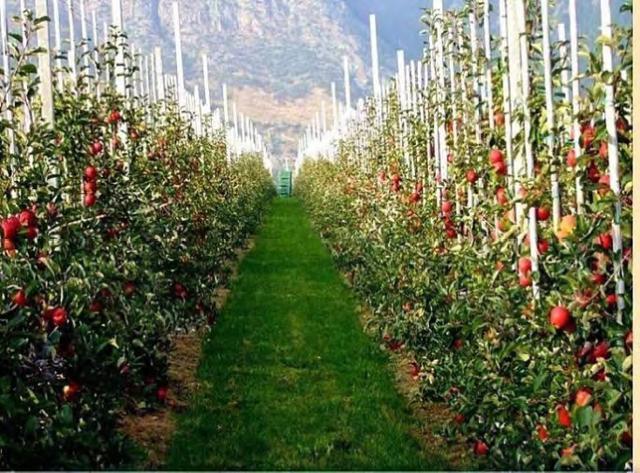
The growth characteristics of dwarfing rootstocks are well-developed fibrous roots, extending horizontally,poor anchorage, prone to lodging, weak trunk, and poor uprightness. To overcome their physiologicalshortcomings and ensure upright growth, a trellis must therefore be set up. The central-leader formis internationally recognized as the most ideal tree structure for double-dwarf cultivation, suitable for widerows and narrow plants, generally with row width 3.5-4.5 m and plant spacing 0.8-1.3 m. Along the rowdirection, bury 1 concrete post 4 m high about every 6 m, with 0.5 m in the soil and3.5 m above ground. On the posts, install 4 runs of 10# wire; the 1st run is about 1 m from the ground, and eachplant is paired with 1 small bamboo pole, to which the nursery stock is tied, growing upright to form a strongcentral leader. The tree pan is covered with black ground fabric, grass is grown between rows, and integrated fertilizer-watermanagement is provided. Large machinery can enter the orchard, saving labor, effort, and money (Figures 1-3).
Figure 1 Fruiting state of three-year-old double-dwarf apples at Luoning Haaisheng Shangge
Figure 2 Double-dwarf apple base of Luoyang Zhongsen Agriculture Co., Ltd.
Figure 3 Fruiting state of three-year-old double-dwarf apples at the high-mountain orchard at Siheshan in Lingbao
2 Physiological advantages of dwarfed virus-free rootstocks
In older orchards of the past, seedling rootstocks and long-branch cultivars were used, vegetativegrowth was vigorous, tree bodies were tall, flowering was difficult, and vegetative growth and reproductive growth weredifficult to balance. In management, fruit growers had to bend branches to open angles, girdle, ring-bark,leave long shoots, cut back, and bend shoots, among many laborious tasks, striving to solve the keyproblem of difficult flowering. With M9T337 virus-free nursery stock, however, fibrous roots are well developed, the tree body issmall, nutrient absorption and utilization efficiency is high, leaves are large and thick, photosynthetic efficiency is high, and 70% of photosyntheticproducts are allocated to reproductive growth, while vegetative growth is small and flowering iseasy. To make fruit trees bear fruit early and achieve high quality and high yield, choosing a reasonable rootstock-scion combinationis also very important. The M9T337 virus-free rootstock showsgood compatibility with the Fuji series, has a very good effect on yield and quality, and fully gives play to the physiologicaladvantages of dwarfed virus-free rootstocks.
3 Simplified tree structure, easy to manage
In sparse orchards with large canopies on seedling rootstocks, the tree form structure is complex, with many branching orders,main branches borne on the central leader, then secondary branches and fruiting branch groups, and thenfruiting branches. Building the canopy generally takes four or five years to complete. They beginbearing fruit in seven or eight years, and only enter the high-yield period after ten years. Management techniques are complex and difficult tomaster, and a slight mistake can cause the tree form to become disordered, delay the years to fruiting, and make it verydifficult to achieve early fruiting and high yield.
Double-dwarf cultivation requires the tree form to be the central-leader form, with few branching orders and onlyone strong central leader, on which single-axis fruiting branches are arranged, with an angle of 100-110°, and the thickness ratio of branches controlled below 1/3, to suppress vigorous growth and formflower buds as quickly as possible. During management, one can reach the top of the central leader by stretching out a hand, making operation convenient, and the techniquesimple and easy to learn.
4 Establishing orchards with high-quality large nursery stock, shortening the juvenile period
Selecting high-quality large nursery stock to establish orchards is one of the principles of modern orchard development.Purchase high-quality large nursery stock with pure cultivar nearby; the cultivar section should have grown for more than 2years and have 6-8 branches. Dig, plant, and water immediately, ensuring full stand in one planting,striving to see flowers in the planting year and 8-10 fruits per plant in 2 years; in the 3rd year, branchesspread out and form effective space; in the 5th year, enter the high-yield period, with a yield per 666.7 m2 of4,000-5,000 kg. If nearby purchase is not possible, a trunk-growing nursery can be set up locally,first concentrating the nursery stock to grow trunks, strengthening fertilizer and water management, and when the nursery stock meets the requirements,dig and plant immediately, shortening the juvenile period, bearing fruit earlier, achieving early fruiting, high quality, and highefficiency, and recovering the investment cost as quickly as possible.
5 Favorable for orchard mechanization
The fruit industry is a labor-intensive industry with relatively high labor intensity. Due to socialinstitutional changes, a large number of rural laborers have moved away, young people go out to work, andthe remaining rural labor force is mostly women and the elderly, who are hard-pressed to handle heavyphysical labor. Intensive orchards, however, with wide rows and narrow plants and the central-leader form, are favorable for variouslarge and medium-sized machinery operations. Mowing, spraying, fruit picking, winter pruning, and a wholeseries of management tasks can all be completed by mechanization, greatly saving investment in labor.
6 Orchard grass growing
Weeds in orchards were favored by our ancestors for thousands of years, yet we misunderstood themfor decades. Fruit growers usually mistakenly believe that weeds compete with fruit trees for fertilizer and water,so large amounts of non-selective herbicides entered orchards to completely eliminate them,not only destroying soil structure and causing soil erosion, but also triggering a series of uncontrollablediseases and insect pests. Modern orchards advocate growing grass in orchards, achieving the new concept of harmoniouscoexistence among people, fruit trees, and grown grass. In fact, the presence of orchard weedscan greatly increase soil organic matter, promote the formation of granular structure, increasesoil porosity, maintain a constant soil surface temperature, improve the soil's water- andfertilizer-retention capacity, and create a good ecological environment for the healthy growth of fruit tree roots;through repeated mowing of weeds, it ensures orchard ventilation andlight, while maintaining the full play of the role of grown grass; the organic matter it producescan also allow beneficial organisms in the soil to reproduce, increase soil activity, and makethe underground and aboveground parts of the orchard form a complete and healthy ecological environment,increasing fruit yield and quality, raising sugar content, and improving flavor and taste; growinggrass can also provide a good environment for natural enemy insects to inhabit, strengtheningcontrol of harmful diseases and pests. Overall, orchard grass growing has both economicand ecological effects.
7 Laying black ground fabric and integrated fertilizer-water management
Orchards in the western Henan region generally have poor irrigation conditions and mainly rely onnatural precipitation. In ordinary years there is spring drought and autumn waterlogging, with most precipitation concentratedin autumn, which is extremely unfavorable to the normal growth of fruit trees. To meet the balanced water needsof fruit trees during the growth period, modern orchards must make good plans at the initial stage of orchard establishment,install a controllable water-saving irrigation system along the row direction---drip irrigationpipes---and then lay black horticultural ground fabric on both sides of the tree row, providing fertilizer and water to fruit treesregularly and in measured amounts. Black ground fabric prevents weeds, is breathable, and preserves moisture, and also solves the problem of difficultmanual labor for watering and fertilizing.
8 There should be a sense of urgency about intensive development
Double-dwarf virus-free trellised cultivation is suitable for large-scale contiguous operation. At present,the scattered operation of rural land clearly cannot adapt to the development needs of modern orchards.Due to limitations in understanding, land transfer is also fraught with difficulties,directly hindering the construction and development of intensive orchards.
Second, double-dwarf virus-free nursery stock is expensive, and there are many investment items in the early stage of orchard establishment,with high costs, making it hard for ordinary farmer households to bear and causing them to shrink back. Moreover, familyfarms and small and medium-sized enterprises have difficulty obtaining financing, so they can only rely on some well-fundedlarge and medium-sized enterprises and large-scale farms to accomplish.
In addition, because the promotion and popularization of intensive cultivation techniques and economies of scalein modern orchards have been limited, many fruit growers are still completely unaware of them, and it is very difficult for themto be willing to join as shareholding partners.
In summary, we should feel a sense of urgency about intensive orchard management,especially the competent government departments and research institutes, which should make greater efforts.In China, there is relatively little research on the double-dwarf virus-free trellis cultivation technique, and it is stillat a just-starting stage. Many issues, such as the effects of different rootstock-scion combinations, variety selection,adaptability evaluation in different regions, and large-scale design,still await further research and discussion.