Plant these 9 fragrant flowers in your yard, and when they bloom, the whole yard will be filled with fragrance
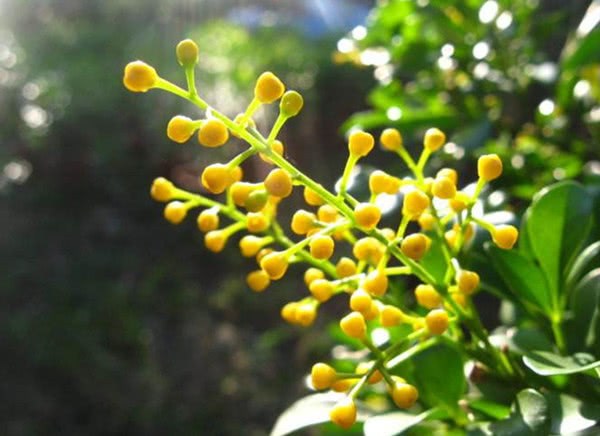
If you have a yard at home and love floral scents, you can plant the following 9 fragrant flowers.
1. Milan: its fragrance resembles Cymbidium
The Milan flower has dense branches and leaves, with lush green and glossy foliage. It blooms multiple times within a year, most profusely in summer and autumn. When it blooms, a delicate fragrance spreads all around, with a scent resembling orchids. The tips of the small branches often bear star-shaped rusty scales; the pinnately compound leaves are alternate, and the flowers are yellow, extremely fragrant, about 2 mm in diameter. The bisexual flower stalks are slightly short and thick, the calyx is 5-lobed, and there are 5 petals, oblong; the berry is nearly spherical, 10-12 mm long, and the flowering period is between summer and autumn. The Milan flower adapts to warm and humid climate conditions, and mature plants need plenty of sunlight. In southern courtyards, the Milan flower is also an excellent landscape tree.
2. Rose: alluringly fragrant
Rose: native to China. It belongs to the order Rosales, family Rosaceae, a deciduous shrub with many prickles on the branches, odd-pinnate compound leaves, 5-9 leaflets, elliptical, with marginal prickles. The petals are obovate, double to semi-double, and the flowers are purplish red or white. The fruiting period is August-September, with flattened spherical fruits. The branches are relatively weak and drooping and densely prickly, and it blooms only once a year, so it is less used for breeding; recently its main valued characteristics have been disease resistance and cold tolerance. When the rose is used as an economic crop, its flowers are mainly used for food and for extracting rose oil essence; rose oil is used in cosmetics, food, fine chemicals and other industries.
3. Gardenia: sweet fragrance, long-lasting
Gardenia, also known as Zhizi and Huangzhizi. It belongs to the family Rubiaceae and is an evergreen shrub with dense branches and leaves, foliage that stays green all year round, and fragrant flowers, making it an important ornamental garden plant. The leaves are opposite or in whorls of three, obovate, leathery, emerald green and glossy. The berry is ovoid, yellow or orange. Besides being ornamental, its flowers, fruits, leaves and roots can be used as medicine, with effects of clearing fire and relieving irritability, clearing heat and promoting urination, and cooling blood and detoxifying. The flowers can be used as a tea fragrance, and the fruits can reduce inflammation and relieve heat.
4. Osmanthus: elegantly fresh fragrance, exceptionally rich
The flowers grow in the leaf axils, with a gamopetalous corolla split into four lobes, small in shape, and there are many horticultural varieties, the most representative being Jinguì, Yinguì, Danguì, Yuèguì and so on. Osmanthus is one of China's traditional top ten famous flowers, an excellent garden tree species combining greening, beautification and fragrance, with both ornamental and practical value. Osmanthus can be so fresh as to be peerless, and so rich that its scent carries far, truly superb. Especially in mid-autumn, when the clustered osmanthus blooms in profusion, and in the still night with the full moon, drinking wine and admiring the osmanthus, with its aged fragrance assailing the nose, makes one feel refreshed and uplifted.
5. Plum blossom: delicately elegant fragrance, uniquely distinctive
A small tree, rarely a shrub, 4-10 m tall; the bark is light gray or tinged with green, smooth; the branchlets are green, smooth and hairless. The leaves are ovate or elliptical, the leaf margins often have small sharp serrations, grayish green. The flowers are solitary or sometimes 2 born together in one bud, 2-2.5 cm in diameter, strongly fragrant, opening before the leaves; the calyx is usually reddish brown, but the calyx of some varieties is green or greenish purple; the petals are obovate, white to pink. The fruit is nearly spherical, 2-3 cm in diameter, yellow or greenish white, covered with soft hairs, sour in taste; the flesh adheres to the stone; the stone is elliptical, slightly flattened on both sides. The flowering period is winter and spring, and the fruiting period is May-June.
6. Orchid: one branch in the room, and a delicate fragrance fills the air
Orchid: epiphytic or terrestrial herb, with several to many leaves, usually born at the base of the pseudobulb or on the lower nodes, two-ranked, ribbon-like or rarely oblanceolate to narrowly elliptical, the base generally with a broad sheath that wraps around the pseudobulb, with a joint. The raceme has several to many flowers, with colors including white, pure white, white-green, yellow-green, pale yellow, pale yellow-brown, yellow, red, cyan and purple.
7. Narcissus: delicately quiet fragrance
Narcissus: also known as Chinese narcissus, it is a variety of polyanthus narcissus. It is a perennial herbaceous plant of the family Amaryllidaceae. The leaves of narcissus emerge from the greenish-white tubular sheath at the top of the bulb, and the flower stem (commonly called the scape) is drawn out from among the leaves. Generally each bulb can produce 1-2 flower stems, and at most up to 8-11 stems, in an umbel. The petals are mostly 6, with the tips of the petals goose-yellow. Outside the stamens there is a bowl-like protective cover.
8. Chloranthus: mellow, long-lasting fragrance
Chloranthus spicatus is so named because its flowers are small, yellow like millet, and delicately fragrant like orchids. Its flowers are round like pearls and bloom at the same time as Jianlan, and their fragrance is similar, so it is also called Zhulan, Zhenzhulan, Jizhualan and so on; its flowers also resemble fish roe, so it is named Yuzilan; its leaves are shaped like tea leaves, and its flowers can be used to scent tea, so it is also called Chalan. The branches and leaves of Chloranthus are emerald green and tender, with an elegant posture. Grown at home in summer, its fragrance is rich, suitable for display by windows, on balconies and on flower stands, filling the room with fragrance and making one feel relaxed and happy.
9. Wintersweet: fragrance like plum, pleasantly fragrant
Wintersweet, also known as Lamei, with aliases Jinmei, Lahua, Lameihua, Lamu, Mamuzi, Shiliangcha, Tangmei, Xiangmei, Latin name; Chimonanthus praecox (Linn.) Link, a plant of the family Calycanthaceae and genus Chimonanthus. It is also called Dongmei because it blooms in winter. Wintersweet blooms before spring, ahead of all other flowers; especially the Hutimei, which puts out flowers in the tenth lunar month, so people call it Zaomei. Wintersweet blooms first and then leafs out, with flowers and leaves never meeting; when wintersweet blooms, the branches are dry and thin, so it is also called Ganzhimei. Wintersweet often blooms on days of swirling auspicious snow; to admire wintersweet, one waits until after the snow and comes treading through the snow, so it is also called Xuemei. And because wintersweet begins to bloom in early winter, bears fruit at the end of winter, and accompanies the winter throughout, it is also called Dongmei.