Watering succulents so that it splashes onto the leaves can easily damage the leaves
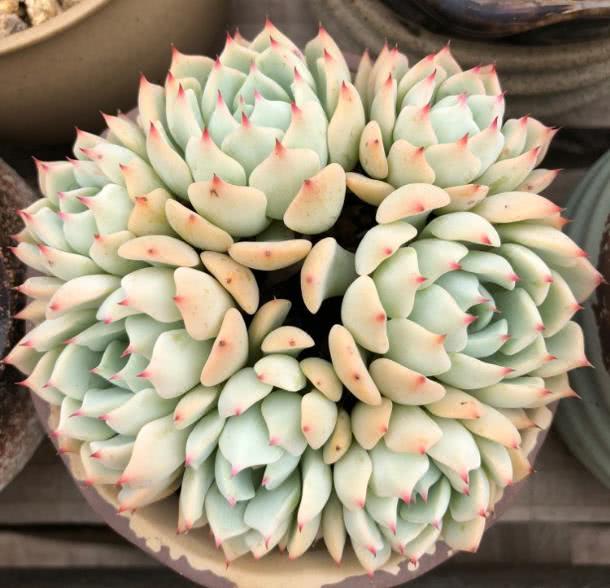
Gardeners often ask whether succulents can be watered on their leaves. Yes, they can, but doing so frequently over the long term is not recommended. Watering onto the leaves does not mean something will definitely go wrong; it just raises the risk of problems. It is still best to water along the soil surface near the plant. If the plant has already filled the pot, water along the rim of the pot or use the soak-and-drain method, and you can also consider repotting. If you are not satisfied unless you water the leaves, you can use a spray bottle to mist them, with fine droplets in a mist form that dries quickly and prevents standing water; this is generally used more often for Haworthia-type succulents.
The saying that you cannot water onto the leaves does have some truth to it. In summer, for example, water droplets on the leaves act like a magnifying glass, burning the leaves and leaving sunburn spots. At this time, try to avoid watering onto the leaves. If water remains on the leaves, you need to blow it off with a bulb blower or dry it with an electric fan. Some people may ask, then what about the thousands of pots of succulents in a garden? How long would it take to water them with a small watering can? Moreover, succulents in their native habitat have no artificial watering and can only rely on rainwater to sustain their growth.
Succulents can be watered on their leaves. Watering onto the leaves can clean dirt from the leaves and stems. In addition, the gentle force of spraying will not rub off the farina on the leaves. You just need to be careful to blow away any standing water on the leaves in summer. There is one situation in which you cannot water the leaves of succulents: succulents grown indoors, where the external environment is relatively poorly ventilated. If water is left on the leaf surface every time you water, long-term water accumulation in the center can easily cause heart rot. So gardeners growing succulents indoors are advised to water at the roots. If you find water droplets in the leaf center of a succulent, you should take a bulb blower and gently blow away the standing water on the leaves and in the leaf center.
Various methods for judging whether succulents need watering: before watering, first weigh the pot itself, then after watering weigh it again when it is fully saturated. From then on, when the pot becomes light, you can water. You can also check whether the leaves or stems of the succulent are plump and glossy. Most plants have bright, glossy leaves when water is sufficient, and this is especially obvious in succulents; when severely short of water, wrinkles may also appear.
Make sure to get the watering time for succulents right. In spring, summer and autumn, it is best to water in the evening or in the cool part of the afternoon, while in winter, because the temperature is too low, it is best to water around noon. When watering, pour along the edge of the flower pot and do not let water drip onto the leaves. Try to avoid water flowing into the center of the leaves and forming standing water, because such standing water acts like a magnifying glass, concentrating sunlight onto one point and directly burning the leaves. For beginners, you can water at a fixed time, such as once a week; this approach allows most succulents to survive.
You can use terracotta pots with good breathability, as moisture can escape through the pot walls, so you basically do not need to worry about dangers such as root rot. With containers that have holes, as long as drainage and ventilation are handled well, alternating between dry and wet periods is not a big problem. Succulent roots are generally shallow, and overly deep containers tend to collect water at the bottom, so when using them you should lay down a sufficiently thick breathable layer. Containers without holes need a drainage layer, and the watering frequency should also be lower than with other containers.
This is a gathering place for succulent lovers, sharing succulent care tips; you are welcome to follow and join the discussion.