What kind of light do potted orchids like? A farmer shares practical methods
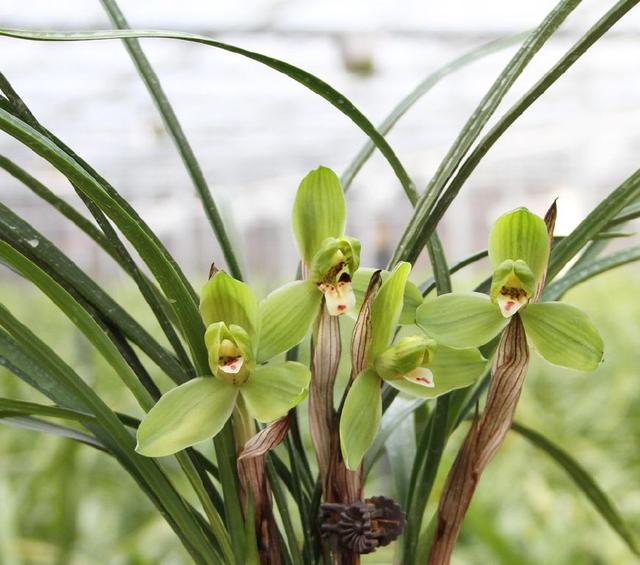
What kind of light do potted orchids like? This is what farmers do. The secret we want to tell everyone is that orchids like different degrees of light in different seasons. Different orchid varieties also like different degrees of light. For example: Cymbidium goeringii (spring orchid), Cymbidium kanran (cold orchid), Cymbidium ensifolium (sword-leaf orchid), and Cymbidium sinense (Chinese cymbidium) are all different.
Sunlight can produce nutrients for orchids and can also sterilize them. With light, the growth of orchids can be promoted. Especially in winter, the warming effect of sunlight should be brought into full play. Orchids grow in sparse forests on the mid-slopes of mountain valleys. Generally, there is a tree layer covering the upper layer, while the shrubs in the middle and lower layers are smaller, and the ventilation and light transmission conditions are relatively good.
Orchids and orchid grasses grow in wild mountain forests. The trees sway with the wind, forming a "half-shade" light condition. At noon, the sun is at the top of the trees, the light is blocked by the leaves, and only fragmented light or light spots shine through. Farmers refer to this situation when shading orchids.
Therefore, orchids mostly grow on slopes with slanting sunlight in the morning or afternoon, or in the middle part of southeast-facing slopes. Farmers refer to this situation when going into the mountains to look for orchids.
After entering autumn, the trees in the forest begin to shed their leaves, and sunlight exposure increases. By spring, the trees begin to sprout, and the leaves above grow denser and denser. Before the sunlight becomes stronger and the weather turns scorching hot, the green leaves have already built a "canopy" for the orchids. Farmers refer to this situation when shading orchids.
Different regions, different types and different ornamental characteristics, and different seasons require choosing different shading schemes. This is also a farmer's skill.
There are differences. For example, Cymbidium sinense (Chinese cymbidium) and Cymbidium kanran (cold orchid) need less light, Cymbidium goeringii (spring orchid) and Cymbidium ensifolium (sword-leaf orchid) come next, and Cymbidium faberi ( Faber's cymbidium) can have appropriately more. Farmers refer to this situation when shading orchids.
For the shade density on sunny days from 9 a.m. to 4 p.m., Cymbidium ensifolium (sword-leaf orchid) is 60% - 70%, Cymbidium faberi (Faber's cymbidium) is about 60%, Cymbidium goeringii (spring orchid), Cymbidium goeringii var. longibracteatum (spring sword orchid), and Cymbidium tortisepalum (lotus-petal orchid) are about 70%, Cymbidium kanran (cold orchid) is 70% - 80%, Cymbidium sinense (Chinese cymbidium) is 80% - 85%, and variegated-leaf orchids are about 80%. Every morning and evening, there should also be little or no shading, with shading at noon. I think
On sunny days and under strong sunlight, provide more shade; in summer, provide more shade than in other seasons. Farmers refer to this situation when shading orchids.
Do you think this technique is useful?