How to identify, manage and water succulents during their dormant period?
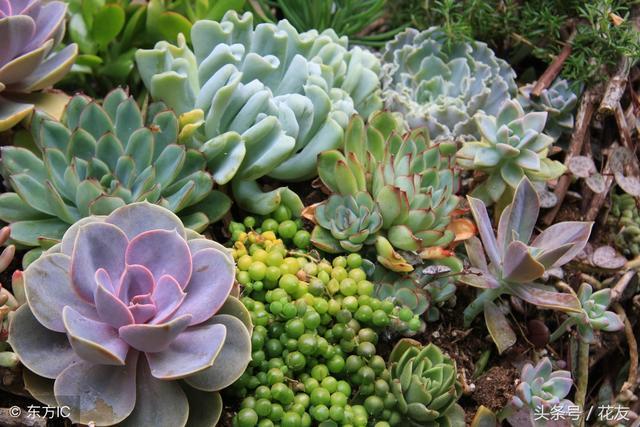
In their places of origin, succulents have adapted to the environment, and almost every variety has developed the physiological habit of an inherent annual dormant period or semi-dormant period (depending on the variety, some have their dormant period in summer, some in winter, and a few varieties in both summer and winter. Even though they have "moved" to foreign lands and propagated for ten or eight generations, or even thousands upon thousands of generations, this habit remains "unchanged in their devotion." Because of this habit, the management during the dormant period differs from that during the growing period. If treated "all the same," succulents are prone to poor growth, or even rot and death, resulting in failure or loss. Therefore, identifying the growing and dormant periods of succulents and managing the corresponding periods is crucial for growing and caring for succulents.
Succulents: Succulent cutting methods and post-cutting care
Succulents
I. Identifying the dormant period
Identifying the dormant and semi-dormant periods is easy for experienced professional growers, but for amateur enthusiasts it seems a bit "tricky." In fact, when succulents are dormant, a series of physiological changes occur within them, which inevitably manifest outwardly. As long as you observe carefully and attentively, seeing through the appearance to the essence, you can judge and identify it based on changes in certain characteristics of the plant.
Succulents
II. Management during the dormant period
When succulents are in the dormant period, the activity of the active tissues within them slows down, and their functions of absorbing, synthesizing, converting and releasing nutrients and water decrease or even stop, so the plant stops growing. During this period, the following key measures should be taken:
1. Fertilizer management
Apply fertilizer sparingly during semi-dormancy. Regardless of the type of dormancy, stop fertilizing to avoid fertilizer burn and root rot.
Succulents: Is enclosed growing good for succulents? Whether enclosed growing is good depends on the type of succulent
2. Temperature control
Because succulent varieties differ, the temperatures they need during the growing period vary, but during dormancy the temperatures they need are very similar. Practice has shown that the most suitable temperature is 25°C-32°C for summer dormancy; 2°C-5°C for winter dormancy; and 7°C-10°C for the few that are sensitive to cold.
III. Watering during the dormant period
When succulents enter dormancy, their root systems generally stop growing and active, and many fine hair roots gradually disappear. Since this is the case, we do not need to worry too much about preserving the fine hair roots. Because the plant has lost its ability to absorb water, if watered too much at this stage, not only will the water not be fully absorbed, but it will instead cause the fine hair roots to rot, further affecting the plant's main roots. If allowed to spread, it may even cause the stem tissue to rot. Therefore, succulents in the dormant state should be strictly controlled when watering.
So, do succulents in the dormant period not need any water replenishment? In fact, this is a misconception. Watering is not the only way to replenish water for plants. Many plants can also be given water by spraying their leaves, especially plants that have entered dormancy. If you water plants in the dormant state, it is generally not easy to get the amount right, and too much water usually causes rot.
After succulents enter the dormant period, we mainly replenish water by spraying. Increasing the humidity of the air and the potting soil in this way is safer, so that succulents in the dormant period will not suffer physiological disorders due to the air and potting soil being too dry.
Succulent dormant period
Of course, the dormancy of succulents is generally relative, and quite a few succulents do not show obvious dormant characteristics, such as Haworthia cooperi and Conophytum varieties. In such cases, water replenishment should be handled flexibly according to the plant's current condition, but on the whole the principle to grasp is: during the dormant season, if a succulent shows signs of dehydration, and the growing point has clearly lost its luster, or even the plant's color deepens all day while the leaves appear somewhat soft, we should treat it as being in the dormant state, so watering or replenishing water should also follow the standard for the dormant period.
Friends interested in growing flowers can follow the public account: Hua You, where wonderful articles on growing and appreciating flowers are shared with you every day, and fellow flower lovers can enjoy the sea of flowers together with you. Submission email: [email protected].