Paris polyphylla is named for its seven leaves supporting a single flower.
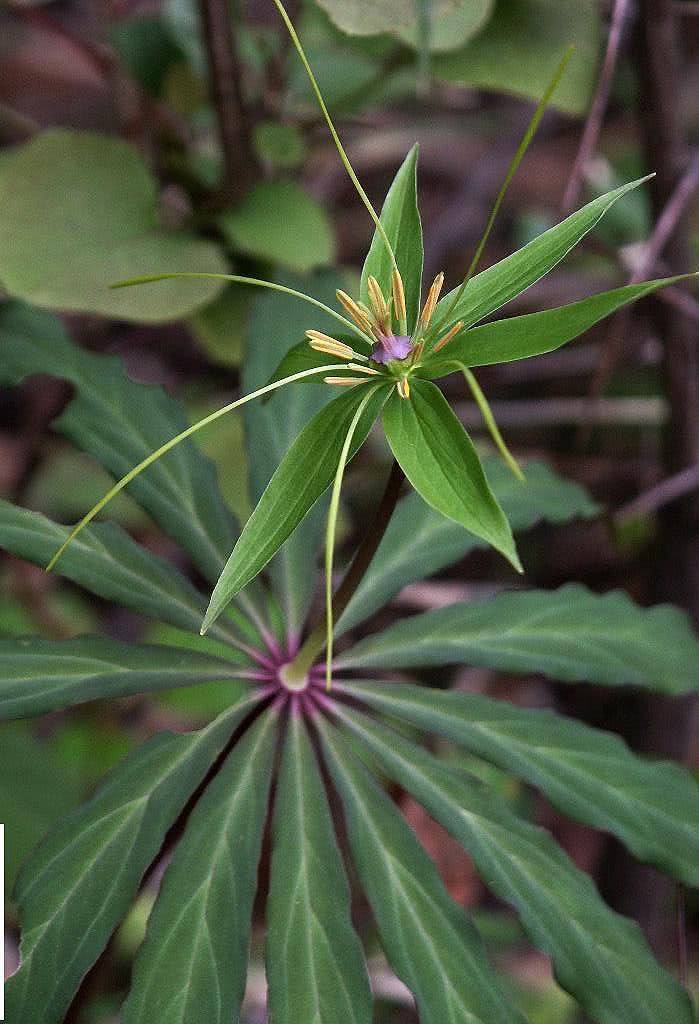
Paris polyphylla is a plant in the genus Paris of the family Liliaceae. Also known as Zaoxiu, Chixiu, Chongtai root, Zhengxiu, Caoheche, Chongtai grass, Baigansui, JInxian Chonglou, Chonglou, Jiudaogu, Yuanyangchong, Zhihuatou, LuosQi, HailuoQi, DengtaiQi, Baiheche, Luotuo Sanqi, TusSanqi, also known as Qiyelian. Its distinguishing feature is a single flower emerging from a whorl of leaves, and the flower's shape closely resembles its leaves. It can be divided into two parts, outer whorl flowers and inner whorl flowers; the outer whorl flowers resemble the leaves, about 6 in number, while the inner whorl flowers number about 8. The phyllotaxis of Paris polyphylla is whorled, and the number of leaves varies among individuals, ranging from 4 to 14; "seven leaves" is merely a name. The flower structure is special: the leaf center opens into a whorl-like flower, the calyx is green, and the petals are narrow and ribbon-like. In early Taiwan, China, it was used to treat snake venom and sores, ulcers and swelling. It has the effects of clearing heat and detoxifying, reducing swelling and relieving pain, and soothing the liver and calming convulsions. It is used for boils and swelling pain, sore throat, snake and insect bites, traumatic injuries, and convulsions.
Paris polyphylla
Growth habits:
Paris polyphylla grows on hillsides under forests and in shaded, damp places in thickets. It grows under forests at an altitude of 1,800-3,200 m. It likes warmth, moisture and shade, but is also cold-resistant and drought-tolerant, and fears frost and direct sunlight. It is planted in sandy soil and loam with an average annual temperature of 13-18°C and higher organic matter and humus content, especially suitable for planting by riversides, beside bamboo groves, and on shaded hills.
Paris polyphylla
Origin and distribution:
Paris polyphylla is produced in Tibet (southeastern part), Yunnan, Sichuan and Guizhou. It is also distributed in Bhutan, Sikkim, Nepal and Vietnam. It is distributed in South China, East China, Southwest China and Shaanxi, Shanxi, Gansu, Henan, Hubei (Enshi, Yichang, Shiyan, Xiangyang, Huanggang, Xianning, Shennongjia Forestry District), Tibet, Jiangxi, Guangxi and other places.
Paris polyphylla
Legends and allusions:
Paris polyphylla is a medicinal herb for clearing heat and detoxifying, with a long history of medicinal use, and has always been praised as a miracle drug for snake bites and boils.
According to legend, the name of this medicinal herb comes from a myth. Long ago, in the Tianmu Mountain area of Zhejiang, there lived a young man named Shen Jianshan. His parents died early, and he had no brothers or sisters, so he made a living by gathering firewood on the mountain. One day, while he was cutting firewood, a venomous snake suddenly darted out from the grass. Before he could dodge, his lower leg was bitten hard by the snake. Before long, he fell unconscious on the ground. As it happened, at that moment the seven fairy maidens in heaven were just stepping on colorful clouds to bathe in the Tianchi of Tianmu Mountain. They saw Shen Jianshan lying unconscious and were moved to compassion. They formed a circle around him and each took out the silk handkerchiefs they carried, covering the area around his wound. Coincidentally, the Queen Mother of the West also arrived there on auspicious clouds, saw the young man, the wound and her daughters' silk handkerchiefs, and understood everything. So she casually pulled the jade hairpin from her hair and placed it in the center of the 7 silk handkerchiefs. Perhaps because the wound received the immortal essence of the silk handkerchiefs and the jade hairpin, the snake venom quickly dissipated, and Shen Jianshan gradually regained consciousness. The instant he woke, he heard a whoosh of wind, and the silk handkerchiefs and jade hairpin fell to the ground together, immediately turning into a wild plant with 7 green leaves supporting a golden flower. He was stunned, as if he had just had a dream, and then looked at his lower leg: there was no trace of a wound. In the end, he understood that this beautiful wild plant had saved him from the snake bite. So, after going down the mountain, he repeatedly told the villagers the strange story of being rescued after a snake bite, and led the villagers up the mountain to identify the medicine. The villagers speculated that this herb contained immortal essence and could overcome snake venom and demons, and so whenever anyone was bitten by a snake, they would dig up this medicine, and it produced miraculous effects. When everyone curiously asked the name of the herb, Shen Jianshan thought for a moment and said: "Paris polyphylla."