Succulents on the windowsill looking ugly? Prune here and they will fill the pot and turn beautiful
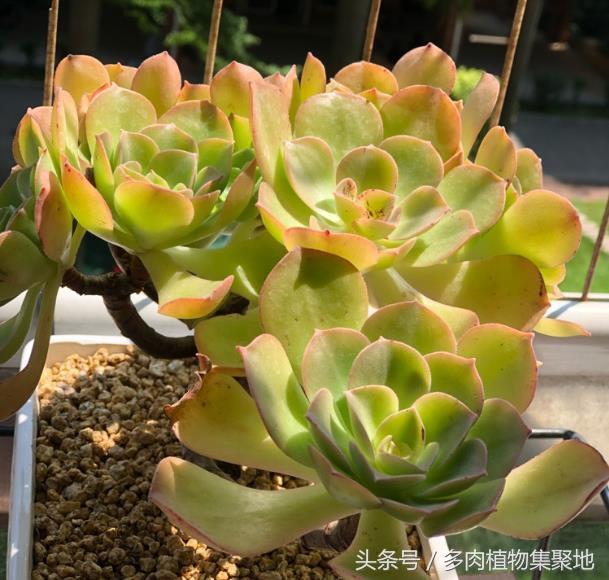
Succulents can grow larger, and under conditions of ample sunlight and fertile soil their growth can be accelerated; under normal circumstances they grow rather slowly. Succulents like sunlight by nature; a lack of light causes leggy growth, while under ample light they grow short, sturdy and compact. However, in summer, especially at midday, shade is needed. In summer beware of long hours of high-temperature exposure; the thick, fleshy tissue cells of succulents dissipate heat slowly, making leaf sunburn very easy. In other seasons, full sunlight helps the plants grow. Many plants that need shade, such as the soft-leaved series of the genus Haworthia, certain species of the genus Plectranthus in the mint family, and certain species of the genus Senecio in the aster family, need to be protected from sunburn. In the muggy summer, improving ventilation at night will reduce the risk of sunburn.
If you are caring for them on a balcony, without ample light even growing succulents will grow relatively slowly. The grower did not mind, but later, when there was still no growth, the grower felt something was wrong. Generally, when succulents do not grow, it is mostly caused by poor roots. When repotting the succulent, the grower took the opportunity to prune the roots. Because it was winter in the north and winters there are very long, and watering was not frequent, more than half of the succulent's roots had dried up. Fortunately, the grower did not water much; once dried-up roots are overwatered, the soil becomes too moist and easily leads to black rot in succulents.
After root pruning, the succulent must be repotted. Once it has settled into the pot, it begins to grow slowly, and in less than 1 month it had grown much bigger and fatter, nothing like its former thin, small self. So when we encounter a succulent that has not grown for a long time during care, we might as well check its roots to see whether there is a problem with them.
Clustered succulents are surely loved by many growers, but clustered succulents on the market are quite expensive. Besides buying ready-made clusters directly, how else can we obtain clusters? The first method is to let nature take its course. Some varieties easily produce offsets, and becoming clustered simply takes a certain amount of time, such as Echeveria derenbergii, Graptopetalum macdougallii, Graptopetalum paraguayense, Graptoveria 'Titubans', Sinocrassula yunnanensis, and most varieties of the Echeveria elegans group.
Beheading an old, thick-stemmed plant is a main way to obtain a cluster. After removing apical dominance, the growth energy is stimulated, and a large number of new side shoots are the power of clustering. For beheading, autumn is the preferred time; in regions where summer is not too hot, spring can also be chosen, and in regions with warming measures, winter can be used. First you need a sharp blade or a piece of fishing line, and cut off the top from the upper part of the plant. Next, place the cut-off part upside down, let the wound dry, and once the wound heals it will root, giving a new plant, while the original plant will sprout new shoots within about one month. As shown in the picture below, the new buds on the beheaded Echeveria 'Red Powder' are growing delightfully, and a charming clustered succulent is thus born.
Keeping the potting soil slightly dry can effectively reduce the height of succulents and prevent leggy growth, so pay attention to controlling watering well. Aim for "dry then wet". "Dry" means that after watering once, wait until the soil surface turns pale and the moisture in the surface and inner soil has dissipated before watering a second time; do not wait until the potting soil has been completely dry for a long time before watering. The usual method is to put your finger into the soil and water once it feels dry inside.
This is a gathering place for succulent lovers, sharing succulent care tips; you are welcome to follow and exchange ideas.