What are the key technical points for managing new grape shoots?
How should grape new shoots be managed? New shoot management techniques for grapes
New shoot management in grapes is an important technique that determines grape yield and quality. If the technique is not properly applied, it will cause too many and too dense new shoots to sprout from the buds, dispersing the tree's nutrients, which not only affects new shoot growth and wastes nutrients, but also leads to poor ventilation and light penetration, low fruit set rate, poor flower bud differentiation and decreased fruit quality.
1 Principles and techniques of bud removal and shoot thinning
After sprouting, excess buds should be removed according to variety characteristics to reduce nutrient consumption and promote flower cluster development.
1.1 Remove buds with strong growth vigor
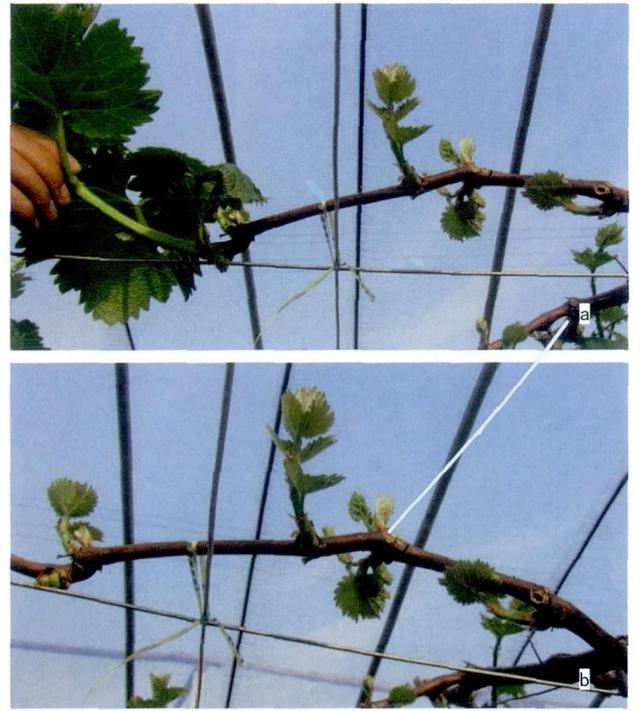
Buds at the front part of the main cane grow vigorously and often inhibit the sprouting of buds or the emergence of new shoots at the rear part. To balance the growth vigor of all parts of the main cane, remove the main bud of the strong upper-position bud with strong apical dominance; its secondary bud has relatively moderate growth vigor, which can balance the growth vigor and ensure that the buds at the rear part of the main cane develop into fruiting new shoots (Figure 1).
Figure 1 Removing buds with strong growth vigor ensures that buds on the main cane do not fail to sprout and grow in a balanced way (Photo by Wang Shiping)
a. The upper-position buds of the main cane have strong growth vigor, and the basal buds will be unable to sprout; b. After removing the main bud new shoot of the upper-position bud, the growth vigor of its secondary bud after sprouting will be close to that of the lower-position buds
1.2 Remove high-position buds and retain low-position buds
When multiple new shoots sprout on the mother cane, according to the location of the mother caneafter determining the number of buds to retain based on the amount of space, select and retain new shoots with flower clusters at the middle and rear parts of the mother cane,and remove the flower buds at the upper part of the mother cane to avoid the fruiting position moving outward (upward)year by year (Figure 2)
Figure 2 Remove high-position buds on the mother cane and retain low-position buds on the mother cane
Note: The red short sticks in the figure indicate cutting off or removing new shoots at the front part of the mother cane to avoid the fruiting positionmoving outward (upward) year by year (Photo by Wang Shiping)
1.3 Balanced shoot thinning
About two weeks before flowering, the final shoot removal and shoot thinning should be carried out. Accordingto the leaf size of the variety, set the density of new shoots on the trellis surface. For varieties of the Kyoho line,the leaves are large, and the spacing between new shoots is generally 18~22 cm. In a T-shaped trellis training orchard with a plant spacing of 2 m and a row spacing of 8m, the number of retained shoots is 5 new shoots per square meter of trellis surface,and the number of retained shoots per mu is 3,200~3,500 shoots. For varieties with small leaves and small clusters,the number of retained shoots can be appropriately increased. In some places in Jiaxing, Zhejiang, shoot-thinning ropes have been developed,which can avoid the phenomenon of too many retained shoots or uneven density caused by growers' inexperience or reluctance to thin shoots,and ensure that new shoots are distributed at equal distances (Figure 3).
Figure 3 Using shoot-thinning ropes to ensure uniform distribution density of new shoots (Photo by Wang Shiping)
2 Shoot twisting
In order to prevent damage during pulling and tying, and to change the growthdirection of new shoots, shoot twisting is carried out after the base of the new shoot becomes semi-lignified; if the growth vigor among new shoots of the wholetree is uneven, with some growing vigorously and some growing slowly,shoot twisting can also be carried out on new shoots with strong growth vigor.
The specific method is to use the thumbs and index fingers of both hands to pinch the secondand third nodes at the base of the new shoot respectively, and gently twist so that they are injured, and the direction of the new shootbecomes more gentle (Figure 4). Shoot twisting should not be excessive; if the injury is too severe, it will affect flowercluster development and may even cause flower and fruit drop.
Figure 4 Shoot twisting method (Photo by Wang Shiping)
3 Pulling and tying
In order to allow every leaf to receive good light as much as possible, through pullingand tying, the retained new shoots can be evenly distributed on the trellis surface, and new shoots can be preventedfrom being broken by wind.
Pulling starts from the new shoot with the strongest growth vigor; weak shoots should be pulledafter they have fully elongated. For trees with weak growth vigor, the new shoots are short and the leaves are small, so as many new shoots as possible should beretained. For new shoots with strong growth vigor, shoot twisting should be done before pulling andtying. New shoots with a poor growth direction are easy to break if pulled directly; start pulling slowly from the middleof the new shoot and gradually change the direction.When pulling and tying, bud removal and shoot thinning can be combined, and the final number of retained shoots can be determined.
4 Pinching
4.1 Fruiting shoots
For varieties whose new shoots grow vigorously in the early stage, 7~10 days before flowering, pinchoff the unexpanded tender shoot part of strong new shoots, and there should be 6~7 mature leaves before the cluster;in order to promote fruit set, from 3 days before flowering to the beginning of flowering, leave 8~9leaves before the cluster and pinch again. Of course, new shoots with moderate growth may not be pinched.
For trees that grow weakly before flowering and grow vigorously after flowering, the pinchingtime should be postponed, and pinching the main and secondary shoots at full bloom can promote fruit set. For suchtrees, if pinched before flowering, a large number of secondary shoots will appear during flowering,causing insufficient fruit set.
For varieties with strong growth vigor such as Kyoho and Alexander, in order to preventnew shoots from growing too vigorously and to promote fruit set and berry enlargement, pinching must be done beforeflowering. Begin pinching when the new shoot length is 30~40 cm; for strong new shoots leave2~4 mature leaves before the cluster, and for moderate new shoots leave 6 mature leaves.
4.2 Secondary shoots
After strong new shoots are pinched, secondary shoots will emerge before flowering and should be pinchedin time to promote fruit set and berry enlargement. For trees whose new shoots grow moderatelybefore flowering, secondary shoots will grow vigorously after full bloom and should also be pinched in time. The topmost1 secondary shoot at the tip of the new shoot can continue to extend, and the secondary shoots behind it should be pinchedafter 2~3 leaves.
Pinching is carried out 10~15 days after flowering: for vigorously growing secondary shoots, leave2~3 leaves and pinch; secondary shoots that stop growing on their own may not be pinched. Afterward, forvigorously growing secondary shoots, repeat pinching after 2~3 leaves.
Within two weeks before the berries soften, heavy pinching of secondary shoots will delayberry coloring. Therefore, for secondary shoots that emerge again, light pinching or shoot twisting is preferable to make the secondary shoots droop;for areas where secondary shoots are too dense, thinning should wait until the third week after coloring beginsbefore removal.
4.3 Main cane extension shoots
In principle, main cane extension shoots should not be twisted; they should be pulled along their natural direction to continueextending. However, from early August to early September, they should be pinched to promote fruitripening. Especially for virus-free nursery plants, which are very prone to excessive growth, pinching is necessary.Secondary shoots on main cane extension shoots should all be pinched after 2~3 leaves. After pinching, newly emergedsecondary shoots should be pinched once about every 15 days.