Trellis Cultivation Techniques and Pest and Disease Control Methods for Atago Pear
Trellis Cultivation and Pest and Disease Control of Atago Pear
1 Trellis cultivation
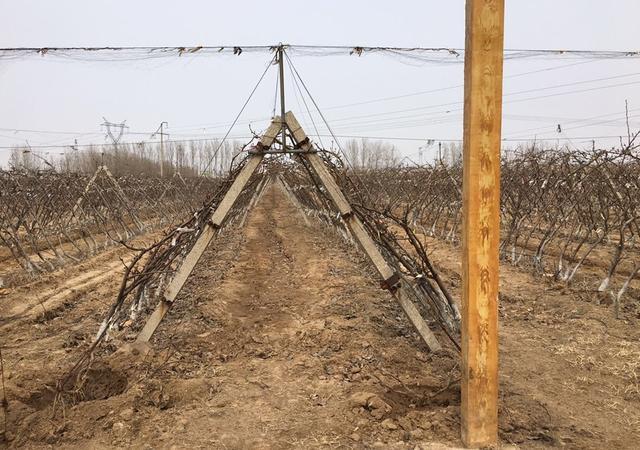
Compared with the traditional upright cultivation model, trellis cultivation can effectively improve the ventilation and light penetration conditions of the tree body, effectively regulate the supply of nutrients and water, promote the balance between vegetative growth and reproductive growth, and facilitate refined orchard management. Commonly used cultivation trellises include the inverted V-shaped trellis (Figure 1) and the simple pergola trellis (Figure 2). The inverted V-shaped trellis is suitable for high-density cultivation, with a plant spacing of 0.75-1 m x 4 m, and tree height controlled at about 2.5 m. For the simple pergola trellis, 15 cm x 10 cm x 330-350 cm concrete posts are erected around the perimeter of the orchard, and at positions about 1 m on each side of the planting row, a support post is erected vertically at intervals of about 15 m, and the main trellis wires and densified trellis wires are tightened so that they cross each other to form a net-like structure, maintaining the pergola height at about 2.5 m.
2 Training and pruning
With inverted V-shaped training, when the central leader grows to 1.5 m, the first row of pear trees is pulled and slanted toward the west, and the second row of pear trees is slanted toward the east, with the angle between the central leader and the ground at 45°-55° (Figure 1). Note that upright branches on the back should be promptly pulled to both sides and fixed or thinned out to prevent interference with the tree shape.
With simple pergola trellis training, after planting, two main branches are selected and retained for training, and the angle between the main branches and the ground is kept at 60°-70°. During winter pruning, heading back is carried out at 80 cm on the main branches, competitive buds are removed, and the main branches are kept extending in a single axis. Emphasis should be placed on strengthening summer pruning by taking measures such as continuous pinching or branch bending and shoot twisting to slow vigorous shoot growth, and thinning out overly vigorous branches to promote flower formation.
Figure 1 Inverted V-shaped trellis cultivation
Figure 2 Simple pergola trellis cultivation
3 Scientific fertilization
Atago pear has relatively high requirements for fertilizer and water conditions, but its root system is sparse and its absorption capacity is weak, its growth response is slow, and it is very difficult to form absorbing roots after root cutting. Therefore, fertilization should be carried out scientifically according to the growth characteristics of the root system and the characteristics of fertilizer demand. First, basal fertilizer applied in autumn should be applied early; applying basal fertilizer promptly after fruit harvest is beneficial for new root growth and increases the stored nutrients of the tree body. For every 1 kg of Atago pear produced, 2 kg of basal fertilizer is applied. The furrow fertilization method is adopted, with a fertilization depth of 30-50 cm, to prevent roots from floating upward. Second, soil topdressing should use small amounts applied frequently, with key attention to pre-flowering fertilizer, post-flowering fruit-promoting fertilizer, fruit expansion fertilizer, and late-growth topdressing. Third, foliar spraying should pay attention to concentration: before bud break, spray a 3%-5% zinc sulfate solution to prevent little leaf disease; in the early growth stage, spray 0.3%-0.5% urea; at flowering stage, spray 0.2%-0.3% borax; after physiological fruit drop and before fruit maturity, spray 0.2%-0.3% monopotassium phosphate multiple times, which can effectively improve fruit quality.
4 Growing grass and mulching with grass
In Atago pear orchards, growing grass between rows and mulching with grass under the trees can effectively improve the soil environment, increase soil organic matter content, and improve fruit quality. The natural grass-growing method is often used, but malignant weeds must be removed promptly. When the grass height exceeds 40 cm, mow it regularly, and cover the cut grass over the tree disk. Cover the tree disk with other materials such as wheat chaff, sawdust, weeds, wheat straw, corn stalks, and soybean stalks, then spray a 10% urea solution and cover with a thin layer of soil to accelerate decomposition and increase soil organic matter content.
5 Fruit thinning and yield control
Atago pear fruits are large. If yield is not controlled carefully, problems such as uneven fruit size, deformed fruits, and severe pre-harvest fruit drop are likely to occur, and it is also unfavorable for improving fruit quality. In Atago pear orchards at full bearing stage, the yield per 666.7 sq m is generally controlled at 2500-3500 kg. Thin flowers and fruits early, leaving 1 flower cluster at intervals of about 30 cm, and retaining 1-2 well-developed side flowers per flower cluster. To improve fruit surface smoothness, bagging cultivation is best adopted, and the paper bags should preferably be high-quality kraft paper bags that are yellow on the outside and black on the inside and have good ventilation and air permeability. When bagging, the young fruit should be suspended in the paper bag to reduce friction, and the bag opening should be tied tightly with wire. There is no need to remove the bags early until the fruits are harvested for market.
6 Pest and disease control
With agricultural control as the foundation, biological control as the core, and rational use of chemical control techniques, implement unified pest and disease prevention and control and joint prevention and control, and control pests and diseases economically, safely, and effectively. During the dormant period, strengthen orchard sanitation management, centrally destroy diseased fruits, diseased leaves, and scraped bark, and plow the entire orchard before the soil freezes to reduce the overwintering base of pests and diseases. Before bud break, apply lime sulfur mixture stock solution to the trunks or spray the entire orchard with 5°Be lime sulfur mixture. During the growing season, hang insect-killing lamps to trap and kill Lepidoptera and Coleoptera pests; hang 1 yellow sticky trap every 15 m or so to control aphids; use sugar-vinegar liquid to trap and kill pests such as scarab beetles, noctuid moths, and peach fruit moths; hang bird nets above the pergola trellis to reduce bird damage. In chemical control, choose pesticides that are safe for humans and livestock, non-polluting to the environment, and highly effective and low-toxicity against target pests. Use pesticides rationally according to the pesticide safety interval to reduce pest and disease resistance and improve fruit quality and safety. In the Qihe area, the main diseases of Atago pear include pear black spot and pear scab. When diseased shoots first appear in the orchard, spray 50% carbendazim 800-1000 times dilution 1-2 times; when the disease worsens, spray 50% mancozeb 500-600 times dilution or Fuxing 400-500 times dilution. The main pests include pear fruit borer, pear stem sawfly, and pear yellow gall aphid. The main control agents include 1.8% abamectin 1000-1200 times dilution, 10% imidacloprid 800-1000 times dilution, or 3% acetamiprid 1000-1200 times dilution. Note to alternate pesticides to prevent pests and diseases from developing resistance.