Key Technical Points for Modern Intensive Cultivation of Dwarfing Rootstock Apples
Modern Intensive Cultivation Techniques for Dwarfing Rootstock Apples
1 Basic Information of the Trial Orchard
The trial orchard was established at Huangchaopo, Xiadian Town, Zhaoyuan City, with a trial area of 1 hm2. The main cultivar was Yanfu 3, with the rootstock-scion combination Yanfu 3/M26/Baleng Haitang (Malus robusta Rehd.). Hongmanao was used as the dedicated pollinizer. The planting spacing was 2 m x 4 m. The soil was brown soil with a pH value of 6.2. During the trial period, the annual average temperature was 12.1 degC, and the annual precipitation was 768 mm. From November to February of the following year, the cumulative number of days with temperatures above -13 degC averaged 5 days per year. For 4 consecutive years, the winters were cold and the springs were cool, and the flowering period was around May 1.
2 Main Technical Measures
2.1 High-Standard Orchard Establishment
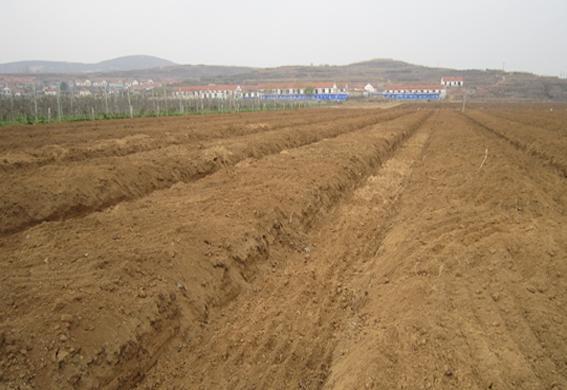
In the Huangchaopo trial orchard, planting trenches 1 m wide and 80 cm deep were dug along the row direction according to the plant and row spacing. The topsoil was turned into the bottom of the trench, and 1000 kg of decomposed organic fertilizer was applied per 666.7 m2. After backfilling, water was applied to settle the soil. High-bed cultivation was adopted, with a bed width of 1-1.5 m and a height of 15-20 cm. With the planting line as the center, soil 10-15 cm thick within a 1 m wide strip along the row was gathered to both sides of the planting line and shaped into beds, and the bed surface was watered to settle (Figure 1).
Nursery stock more than two years old was selected, with a height above 1.2 m, basal diameter above 1 cm, a complete root system, no pests or diseases, and no air-drying. Nursery stock was strictly graded, and differences in height, thickness, and uprightness were controlled within 10%, while root size and type were kept consistent. Unqualified nursery stock was discarded. Before planting, roots were moderately trimmed, rotten roots were cut off, and wounds were trimmed smooth. The stock was soaked in water for 24 hours, then sprayed with lime sulfur and other agents for disinfection.
Figure 1 Schematic diagram of the high-bed cultivation bed surface (top) and watering (bottom)
At planting, planting holes 40 cm long, 40 cm wide, and 40 cm deep were dug at fixed points according to the plant spacing. After the roots of the nursery stock were dipped in mud slurry, the stock was placed into the planting hole, with the roots spread out, the interstock exposed 5 cm above the ground, and then covered with soil. The nursery stock was lifted gently, and after firming the soil, water was applied immediately. After the water seeped down, the tree dish of each plant was covered with plastic film with an area of more than 1 m2, and soil was piled around the edges and compacted. The trunk of the nursery stock was headed at a height of about 1.2 m. Starting 15 cm below the cut, one bud was notched every 3 buds down to 60 cm above the ground. A plastic bag 5 cm wide and 80-100 cm long was placed over the trunk, with the lower opening tied tightly, and removed after bud break.
A concrete support was set every 10 m along the row, and one bamboo pole support was set for each plant. The supports and poles were 3-4 m above the ground. Along the horizontal direction, stainless steel wires were stretched at 1 m, 2 m, and 3 m above the ground on the supports and poles, and the anchor lines at both ends were tightened and strongly secured to the ground. The poles were tied to the three wires, and the central leader of the nursery stock was tied to the pole (Figure 2).
Figure 2 Schematic diagram of support pole installation in the apple orchard
2.2 Soil, Fertilizer, and Water Management
Orchard sod culture. Natural grass was allowed to grow between orchard rows, and malignant weeds such as amaranth were removed promptly. When the grass reached about 30 cm, it was mowed mechanically, leaving a stubble height of about 15 cm. Mowing was carried out 3 times per year. The cut grass was used as mulch under the tree canopy. Along the row direction, ground fabric 1 m wide was laid on both sides of the plants to keep warmth and preserve moisture.
Fertilizer and water management. From 2 to 4 years after planting, organic fertilizer was the main input, with 200-300 kg of commercial organic fertilizer and 20-30 kg of nitrogen, phosphorus, and potassium fertilizers applied per 666.7 m2. For fruiting trees, decomposed organic fertilizer was applied according to the principle of one jin of fertilizer per jin of fruit. Topdressing was mainly with special compound fertilizer for fruit trees. Generally, for every 100 kg of apples produced, 2 kg of pure nitrogen (N), 1 kg of pure phosphorus (P2O5), and 0.8 kg of pure potassium (K2O) needed to be applied. During the growing season, when drought occurred, water was replenished promptly, and good drainage of the orchard was ensured.
2.3 Flower and Fruit Management
Osmia pollination. Nest boxes were set up in the orchard at intervals of 40-50 m. Two to three days before flowering, 200 osmia bees were released per 666.7 m2. Paper nesting tubes with a diameter of 5.5-6.5 mm and a length of 15-16.5 cm were placed in the nest boxes, with the tube bottoms sealed tightly and the tube openings coated in red, yellow, green, and white at a ratio of 10:7:3:3. Each nest box held 100-200 nesting tubes. The area in front of the nest box was open, and a small pit was dug nearby to keep water available. Insecticides were prohibited during the bee release period.
Flower and fruit thinning. This was generally carried out about 15 days after petal fall, leaving one central fruit at intervals of 15-20 cm and removing side fruits, small fruits, deformed fruits, fruits from axillary flower buds, and fruits on the upper side of branches.
Fruit management. Fruit bagging was adopted, and fruits that were large, well-shaped, free of pests and diseases, free of thorn injury, and had a fruit spur were selected for bagging. The paper bag was opened to make it round, then placed upward from below so that the apple hung freely inside the bag. The bag opening was folded from both sides toward the middle, then folded back upward, and the wire was bent to clamp the bag opening tightly. When bagging, inner-canopy fruits were bagged first, followed by outer fruits, and upper fruits were bagged first, followed by lower fruits. Ten to fifteen days before harvest, water was applied first, and then the bags were removed. Two to three days after bag removal, rosette leaves and shading leaves around the fruit were removed in 2-3 sessions. The amount of leaf removal was preferably 10%-15%. At the same time, along with leaf removal, the fruit was gently turned so that it received light all around.
2.4 Training and Pruning
Yanfu 3/M26/Baleng Haitang (Malus robusta Rehd.) adopted a spindle-shaped tree form. The tree height was 3.5-4 m. On the central leader, 20-25 main branches or large fruiting branch groups were developed, spaced 20-30 cm apart and distributed in a spiral pattern. Fruiting branch groups were borne directly on the main branches, and the fruiting branch groups were small spindle-shaped with single-axis extension. The ratio of the branch axis diameter of the main branches or large fruiting branch groups to the central leader was 1:2-3 (Figure 3).
Figure 3 Spindle-shaped tree form of Yanfu 3/M26/Baleng Haitang
For Yanfu 3/M26/Baleng Haitang, pruning adopted the measures of "heavy pruning in the first and second years to build the central leader; branch bending in the third year to promote flower buds." In the year of orchard establishment, for vigorous orchard blocks, during summer pruning, vigorous branches were severely cut back to 1-2 buds; for orchard blocks with moderate vigor, during winter pruning, severe cutback or removal was adopted, and the extension shoot of the central leader was lightly headed or left unpruned. In the second year, if there were fewer than 5 lateral branches or growth was weak, pruning to build the central leader was continued. In the second to third years, the opening angle of the main branches was 90 deg-110 deg, and the measures of "keep what can be kept, remove competitors, and carry out branch bending and bud notching simultaneously" were adopted, along with methods such as fertilizer and water regulation to promote flower buds. In the fourth year, the approach of "fruit first, form second, gradual adjustment" was maintained, removing large branches and keeping small ones, generally removing 1-2 large branches to stabilize tree vigor.
2.5 Pest and Disease Control
Pest and disease control should be based on improving tree resistance, with comprehensive application of agricultural, biological, and physical measures to reduce the number of chemical control treatments. In winter, trees and the orchard were cleaned to reduce sources of pests and diseases. Diseased and pest-infested branches were pruned out, and dead branches and fallen leaves were cleared to reduce the overwintering population of pests and diseases. Sod culture between rows could promote root growth and reduce the occurrence of physiological diseases. Fruit bagging controlled damage by the peach fruit moth. Frequency-vibration insect-killing lamps were used, with one lamp installed per 5333.6-6667 m2 (8-10 mu). Chemical control was based on mineral-source pesticides, with biological pesticides as the main body and low-toxicity organic synthetic pesticides as supplements. Moderately toxic pesticides were used to a limited extent, and highly toxic, acutely toxic, and high-residue pesticides were prohibited.