Detailed Explanation of High-Efficiency Cultivation Techniques for Pear Trees with Wide Rows and Close Planting
High-Efficiency Cultivation Techniques for Wide-Row Close-Planted Pears
1 Orchard Establishment
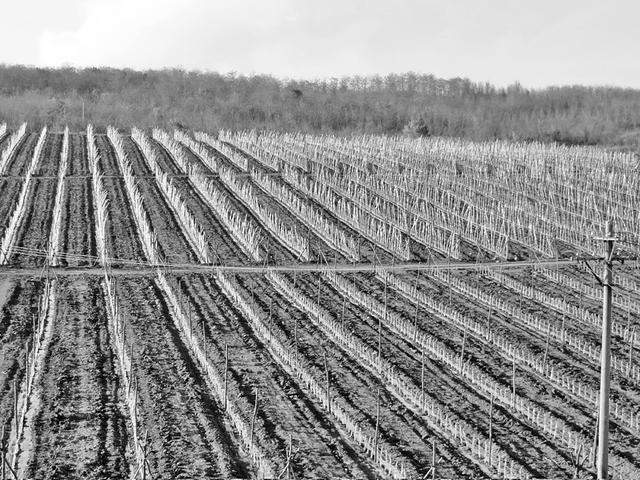
Select a flat site with light loam soil, good fertility and good irrigation conditions to establish the orchard. In the autumn of 2010, prepare the land by using a trencher to dig planting trenches 80cm deep and 80cm wide, and apply per 666.7 sq m 0.5t of corn straw and peanut shells, 50kg of urea, and 3t of decomposed organic fertilizer. First place the prepared nursery stock in a cellar or a dark, cool place. When the temperature rises and pear buds in surrounding orchards begin to sprout, take out the nursery stock, soak the roots in water for 24 hours, and then plant. Use high-quality large and vigorous nursery stock for direct planting to establish the orchard, with a wide-row close-planting form, rows running north-south, spacing of 0.7m x 3m, and a rectangular orchard layout (Figure 1). After the nursery stock is planted, cover the trunk with a plastic film bag (Figure 2) to reduce tree moisture evaporation, provide a good growing environment for pear bud development, and accelerate pear bud development. At the same time, lay black plastic film on the ground within the rows to raise soil temperature and accelerate root growth and development. Set up poles and wires along the planting direction of the nursery stock, and tie and secure the nursery stock.
Figure 1 Rectangular orchard layout along the row direction
Figure 2 Plastic film bags covering the trunks after pear tree planting
It is advisable to choose varieties that are easy to flower, have a high fruit-setting rate and high economic value as pollinizer trees, such as Zaosu, Huasu, Zaojinsu, Xueqing, etc., which can serve as pollinizers for each other. The ratio of main cultivars to pollinizer varieties is 5:1.
2 Management Techniques
2.1 Under-Tree Management
Natural grass growing. After land preparation, allow wild weeds to germinate and grow freely, and timely pull out (or mow) tall and vicious weeds such as ragweed, amaranth, lambsquarters, velvetleaf, and Humulus scandens. Mow timely during the growing season to regulate grass species succession and promote grasses of the Poaceae family as the main grass species. The mowing time should be before the selected retained grass species (such as crabgrass and barnyardgrass) produce inflorescences, and before the grass species to be eliminated (such as lambsquarters, amaranth, and velvetleaf) produce seeds. Mow 4 to 6 times per year, and stop mowing in the late rainy season. A stubble height of about 20cm is appropriate. Spread the mowed grass on the ridges within the rows.
Fertilization. After fruit harvest in late August, apply high-quality decomposed farmyard manure, with the amount applied equivalent to the current year's yield. It can be applied in furrows or broadcast on the surface and then mechanically rotary-tilled. Irrigation. Build ridges 30cm high along the trunks to increase the amount of water applied per irrigation and reduce the number of irrigations. Water once each before bud break, after flower drop, during fruit enlargement, and before freezing.
2.2 Training and Pruning
Under a planting density of 0.7m x 3m, adopt a cylindrical tree form. Its main characteristics are: tree height 3.0 to 3.5m, trunk height about 60cm, 24 to 26 medium and small fruiting branch groups directly borne on the trunk, the basal thickness of branch groups not exceeding 1/3 of the diameter of the central leader at the point of attachment, and branch group branching angle of 70 to 90 degrees. The branch spread in the row direction does not exceed 1/3 of the row spacing (Figure 3).
Figure 3 Cylindrical tree form of pear trees
The key points for developing the cylindrical tree form are: do not head vigorous nursery stock, do not shorten, and do not cut back; make multiple bud notches to promote branching, and fruiting branch groups extend on a single axis; the thickness of fruiting branch groups on the central leader is less than 1/3 of the central leader; do not shorten the extension shoot of the central leader, do not open the top of the canopy, and when the tree becomes too tall, choose a lower weak extension shoot for a new leader.
Figure 4 Opening the angle with toothpicks after bud notching
Figure 5 Shoot growth in the same year after bud notching
First-year pruning. Do not head the nursery stock. Before bud break, deeply notch the buds on the central leader (do not notch at 60cm above the ground and 30cm downward from the top). The notch position is 0.5cm above the bud, the notch length is 1/2 to 3/4 of the branch circumference, and it reaches the xylem. At leaf fall, tree height reaches 2.5 to 3.0m, forming 30 to 40 branches. When new shoots are 15 to 20cm long, use toothpicks to prop the basal angle of the new shoots to 90 degrees (Figure 4, Figure 5). Basically do not prune in winter, only remove competing shoots at the branch tips or remove branches with a branch-to-trunk ratio greater than 1/3 by leaving a stub.
Second-year pruning. Before bud break, continue bud notching on the extension shoot of the central leader (except the distal 30cm). In autumn, flatten individual branch groups with an angle less than 45 degrees and a length greater than 75cm. Winter pruning should be light, focusing on removing individual competing shoots at the branch tips or removing branches with a branch-to-trunk ratio greater than 1/3 by leaving a stub.
Third-year pruning. In autumn, flatten individual branch groups with an angle less than 45 degrees and a length greater than 75cm. During winter pruning, remove individual competing shoots at the branch tips or remove branches with a branch-to-trunk ratio greater than 1/3 by leaving a stub, and for overly tall branch tips use lower weak branches for a new leader. Complete cylindrical training in 3 to 4 years. From Table 1, it can be seen that in the second year after planting, all tree heights reached more than 1.8m. Through multiple bud notching, the average number of branch groups per tree in that year reached 31, the average length of new shoots was 27.2cm, and the canopy spread was controlled within the range of 54cm x 49cm. After the fifth year of planting, by bending branches to open angles and removing individual overly long branches, the canopy spread was maintained within the range of 160cm x 110cm. [Jishan Huayao]
Table 1 Growth of pears under wide-row close-planting cultivation in Huludao City
2.3 Flower and Fruit Management
Fruit thinning. Thin fruits 10 days after fruit set. According to tree vigor and the requirement of "using fruit to suppress canopy", maintain an appropriate crop load. Generally, leave 1 fruit every 25cm for Zaojinsu and Zaosu pears; leave 1 fruit every 20cm for Zaojinxiang. Fruit bagging. Bag 30 days after flowering. Spray fungicides and insecticides before bagging. When bagging, tie the bag opening tightly, keep the fruit suspended inside the bag, and open the ventilation opening at the bottom of the bag.
From Table 2, it can be seen that 3-year-old trees begin to bear fruit, with more than 91% of trees bearing fruit. In the early fruiting stage, fruiting is mainly on axillary flower buds, and later gradually mainly on short fruit branches. The yield per 666.7 sq m was 1328kg for 3-year-old trees and 4130kg for 5-year-old trees, with an average high-quality fruit rate of 93% (Figure 6).
Table 2 Flowering and fruiting of pears under wide-row close-planting cultivation in Huludao City
Figure 6 Flowering of pears in 2014
2.4 Pest and Disease Control
Agricultural control. Before freezing, rotary-till the soil between rows in the pear orchard once, turn weeds into the soil, and combine with irrigation to destroy the living environment of overwintering pests in the soil and eliminate some hawthorn spider mites, fruit borers, tent caterpillars, and slug moths. Before bud break, thoroughly scrape off rough old bark and disease galls. Thoroughly remove weeds, fallen leaves, residual branches, and mummified fruit; prune out diseased and pest-infested branches and dead branches, take them out of the orchard and burn them in a centralized manner, to reduce the overwintering pest and disease base of pear scab, black spot, ring rot, valsa canker, pear psylla, yellow aphid, Kondo mealybug, hawthorn spider mite, and others.
Chemical control. Before bud break, spray the whole orchard with 3 to 5 degrees Be lime sulfur mixture to eliminate overwintering pests and diseases. In early April when flower buds begin to sprout, spray once with 4% flusilazole 2000 to 2500 times dilution. In late May before fruit bagging, spray once with 50% carbendazim 800 times dilution plus 10% imidacloprid wettable powder 1500 times dilution to control pear scab, aphids, and others. After fruit bagging, focus on protecting leaves, mainly controlling pear scab, powdery mildew, yellow aphid, pear psylla, leaf roller moths, and others. In early July, spray once with 70% thiophanate-methyl 1000 times dilution and 10% imidacloprid wettable powder 1500 times dilution. In mid-August, spray once with 80% mancozeb 1000 times dilution and 50% bromine permethrin 3000 times dilution. During the growing season, on the basis of accurate forecasting, strictly apply leaf protectants, insecticides, and fungicides evenly and thoroughly according to the specified concentration, annual use frequency, and pre-harvest interval requirements.
3 Conclusion
Adopting wide-row close-planting cultivation and controlling the canopy are the keys to achieving high quality and high efficiency. (1) The row width should be more than 200cm greater than the plant spacing, so that the orchard as a whole has good ventilation and light transmission. (2) Second, control the canopy through pruning. For young trees, thinning
is the main method, with no heading and no cutting back. After fruiting, continuously renew fruiting branch groups, replacing large ones with small ones, which can both keep fruiting branch groups young and effectively control the outward movement of fruiting positions. (3) Use fruit to suppress the canopy. Through measures such as bending branches to open angles and selecting varieties that fruit easily, achieve the goals of early fruiting and early high yield in close-planted pear orchards. The cylindrical tree form can form a narrow-canopy hedge, which facilitates canopy control and is conducive to tree operations and the use of orchard machinery.