What are the common ornamental varieties and cultivated species of the genus Cypripedium in the orchid family?
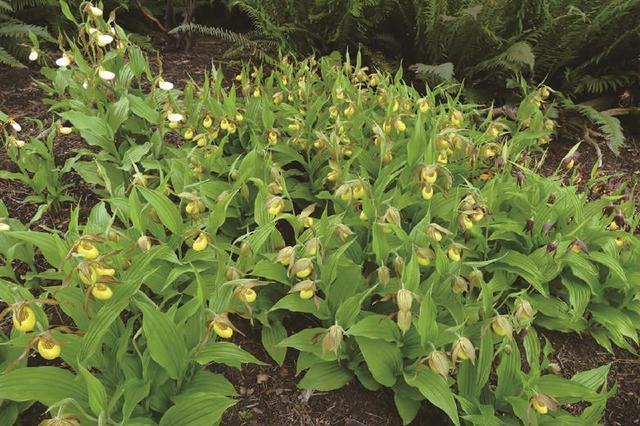
What are the common ornamental varieties of the genus Cypripedium in the orchid family? The cultivated Cypripedium species and varieties include
▲'Multiflower Yellow' Cypripedium 'Multiflower Yellow'
▼Large-flowered Cypripedium Cypripedium macranthos
All plants of the genus Cypripedium in the orchid family are terrestrial herbs, with creeping rhizomes and many rather thick fibrous roots. The stems are erect, with 2 to several leaves that are alternate, subopposite or opposite, sometimes nearly prostrate; the leaves are mostly elliptic to ovate, less often cordate or fan-shaped, with fan-like plicate veins, radiating veins or 3-5 main veins, sometimes with dark purple spots. The inflorescence is terminal, mostly single-flowered, a few with 2-3 flowers, very rarely with 5-7 flowers; the bracts are usually leaf-like and distinctly smaller than the leaves; the flowers are large, mostly beautiful; the dorsal sepal is erect or leaning over the lip; the 2 lateral sepals are usually connate to form a synsepal, free only at the apex, positioned below the lip, very rarely completely free; the petals are spreading, pendent or embracing the lip, sometimes twisted; the lip is deeply saccate, globose, elliptic or of other shapes, generally with a broad mouth. The fruit is a capsule.
The genus comprises about 50 species, mainly distributed in the temperate regions and subtropical mountains of East Asia, North America and Europe, reaching southward to the Himalayan region and Guatemala in Central America. China has 36 species, of which 25 are endemic, and China is one of the distribution centers of Cypripedium.
The flowers of Cypripedium are extremely unusual, and the pouch-shaped lip varies greatly in color, making them the most ornamental of species; they are cultivated fairly widely in Europe and Japan. The introduction of Chinese Cypripedium plants to foreign lands dates back to the early 18th century, when the British plant hunter Wilson collected Cypripedium flavum in Songpan and Pingwu, Sichuan. From that time on, Britain began to domesticate and cultivate Cypripedium and bred a large number of varieties. Britain has a temperate maritime climate, controlled by the westerlies, warm and humid all year round, with little seasonal variation. The highest temperature generally does not exceed 28°C, the lowest generally does not fall below -8°C, and the average annual precipitation is about 1000 mm. But British weather is changeable, with sunshine and rain within a single day. Its unique geographical location and climatic environment suit the growth of most Cypripedium; its only native wild Cypripedium species is Cypripedium calceolus, which is currently on the verge of extinction in the wild. Cypripedium plants are commonly cultivated in parks and botanical gardens, and occasionally in courtyards, mostly used in rock gardens or at forest edges, beside paths or walls, combined with other flowering plants.
Each Cypripedium species has a different habitat, so the soil chosen for cultivation varies, but most prefer to grow under forests or on alpine meadows rich in humus. For ground planting, a mix of leaf mold with a small amount of bark chunks is mainly used, and the soil layer should be more than 15 cm deep and able to drain rainwater promptly; for pot planting, the main material is humus soil with a small amount of charcoal chips or shell powder. Before planting, remove dead and rotted roots, and appropriately remove some old roots that are still viable, which helps new roots sprout and grow. When potting, place some stones or ceramsite at the bottom of the pot to aid drainage, and after covering with soil, just slightly cover the orchid buds. During the growing season, Cypripedium likes water and prefers moist over dry conditions, to prevent irreversible damage from root dehydration. The daytime temperature should preferably not exceed 25°C; if the temperature is too high, it can be lowered appropriately through ventilation and watering, and when the temperature is lower, light should be increased as much as possible, which helps nutrient accumulation.
The cultivated Cypripedium species and varieties mainly include:
1. Cypripedium calceolus, found in Heilongjiang, Jilin, Liaoning and Inner Mongolia in China, and also in Japan, Korea, Russia and Europe; it grows under forests, at forest edges, in thickets and on forest grassland.
2. Kentucky Lady's Slipper (Cypripedium kentuckiense), native to the United States, often growing in acidic soils and sandstone gorges; the cultivated variety is 'Pink Blush' Kentucky Lady's Slipper 'Pink Blush'.
3. Large-flowered Cypripedium (Cypripedium macranthos), found in Northeast China, Inner Mongolia, Hebei, Shandong and Taiwan, China; it grows under forests, at forest edges or on grassy slopes. It is also found in Japan, Korea and Russia.
▲'Album' Queen's Lady's Slipper Cypripedium reginae 'Album'
?'Walter' Queen's Lady's Slipper Cypripedium reginae 'Walter'
4. 'Walter' Queen's Lady's Slipper (Cypripedium reginae 'Walter'); the original species Queen's Lady's Slipper is native to northern America, growing in open forest swamps and also seen under coniferous forests. It is currently the more widely cultivated Cypripedium, and the cultivated variety is 'Album' Queen's Lady's Slipper 'Album'.
?'Inge' Cypripedium 'Inge'
?'Parville' Cypripedium 'Parville'
?'Pueblo' Cypripedium 'Pueblo'
?'Siggi' Cypripedium 'Siggi'
?'Sabine Pastel' Cypripedium 'Sabine Pastel'
?'Victoria' Cypripedium 'Victoria'
5. In addition, there are a large number of intergeneric hybrids in horticulture, cultivated fairly commonly in Europe and the Americas, mainly including: 'Inge' Cypripedium 'Inge', 'Pueblo' Cypripedium 'Pueblo', 'Parville' Cypripedium 'Parville', 'Siggi' Cypripedium 'Siggi', 'Sabine Pastel' Cypripedium 'Sabine Pastel', 'Victoria' Cypripedium 'Victoria', 'Multiflower Yellow' Cypripedium 'Multiflower Yellow' (lead image).