Facility Rain-Shelter Cultivation Techniques for Hutai No. 8 Grape in Guangdong
Facility Rain-Shelter Cultivation Techniques for Hutai No. 8 Grape in Guangdong
Hutai No. 8 is a cultivar bred from a bud sport of Olympia, a Euro-American hybrid grape, and is currently one of the outstanding table grape cultivars in China [1], highly favored by the market [2]. In July 2014, a public tasting was held for Hutai No. 8 and several other high-quality grape cultivars introduced by the Foshan Institute of Agricultural Sciences, and Hutai No. 8 was the most popular. Because Guangdong has abundant rainfall, which greatly affects grape growth, flowering, fruiting and disease incidence, facility rain-shelter cultivation techniques were implemented with good results.
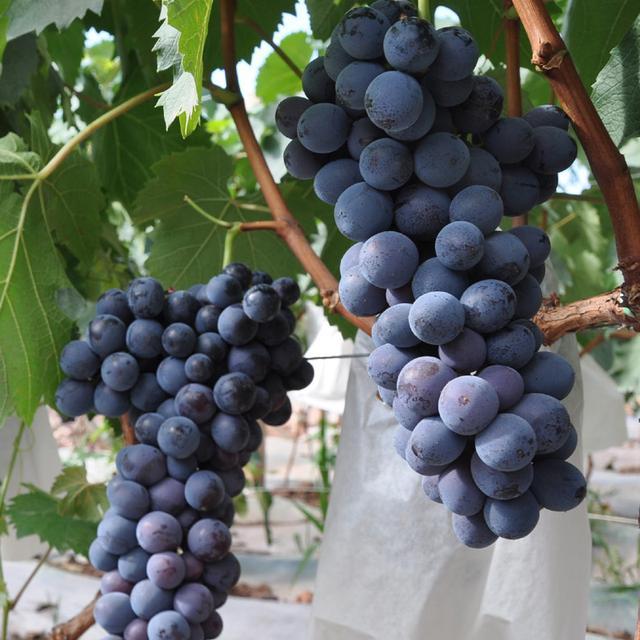
Figure 1 Fruit clusters of Hutai No. 8
1 Trait Performance of Hutai No. 8 Grape in Guangdong
Hutai No. 8 plants are vigorous, and can produce multiple flushes of shoots in the same year. Young shoots are green and glossy, with a smooth upper surface and sparse fine hairs on the lower surface; leaves are nearly circular, five-lobed, with deep sinuses at the tip and shallow sinuses at the base, sparse fine hairs on the underside, and an open circular petiolar sinus. Flowers are bisexual [3]; fruit clusters are conical and compact, with an average cluster length of 174mm and a single-cluster weight of 300-600g; berries are nearly round, with a single-berry weight of 6.89g; the skin is purple-black, and the skin separates easily from the flesh; the flesh is thick and crisp, with a soluble solids content of 18.0%, high quality and excellent taste [4]. It is early-maturing, ripening in late June in Guangdong, and tolerant of storage and transport (Figure 1). In the second year after planting, the yield per 666.7 sq m can reach 708kg. Its ability to bear fruit multiple times a year is extremely strong. It is tolerant of high temperatures and resistant to disease [3].
2 High-Yield Cultivation Techniques with Rain-Shelter Sheds
In the Foshan area of Guangdong, Hutai No. 8 is cultivated with rain-shelter shed facilities (Figure 2), which can effectively solve the problems of frequent grape diseases and flower and fruit drop caused by abundant rainfall.
Figure 2 Rain-shelter facility cultivation of Hutai No. 8
The rain-shelter shed technique introduced by the Foshan Institute of Agricultural Sciences adopts the "fruit tree rain-shelter shed trellis cultivation" technique invented by Mr. Zeng Yanyue of Guilin, Guangxi. The shed frame is free-standing; the trellis consists of cement posts and V-shaped steel pipe frames, with 4 steel wires stretched at 30cm intervals on the frame to secure grape canes; the first steel wire is 1.2m high, at the bottom of the V-shaped steel pipe; the top of the shed is designed with steel bars and film, with the film spread 2.2m wide and 2.3m high (Figure 2). In Guangdong, the film is applied after Spring Festival and before flowering to shield against rain and prevent it from hitting the flower clusters. The film is removed at the end of October to promote the grape canes entering the winter dormancy period.
2.1 Seedling Planting
Choose hilly land or loamy land that does not easily accumulate water and drains well; clay land is not very suitable for planting. Build high beds and dig deep furrows for drainage. Plant from January to March; before planting, dig furrows 0.5m deep and 0.5m wide, and apply 1500kg of well-composted organic fertilizer per 666.7 sq m. Select vigorous seedlings and plant at a spacing of 1m x 2.5m between plants and rows, and water thoroughly after planting.
2.2 Training and Pruning
A trellis with a Y-shaped tree form is used. In the first year after planting, after spring budbreak, select and retain one vigorous new shoot to train as the trunk, and remove the remaining buds; when the trunk shoot reaches 6 leaves, pinch it for the first time, retaining the terminal lateral bud and removing the other lateral buds; when the trunk shoot reaches 1m, pinch it again, retaining the top 4 bud shoots as main canes, removing the other lateral bud shoots; after each of the 4 main canes retains 8 leaves and is pinched, secure them separately to the steel wires on both sides. Pinch the secondary shoots produced by the main canes; the top 3 secondary shoots are pinched repeatedly leaving 3 leaves, and the lower secondary shoots are pinched repeatedly leaving 1 leaf (Figure 3), ensuring that the winter buds do not sprout and that nutrients are supplied to the main canes. Prune around the Major Cold solar term; after the main canes are cut back leaving 5-6 winter buds, tie them horizontally to the first steel wire at 1.2m high. About 15 days before Spring Festival, evenly apply a 25-fold dilution of 50% hydrogen cyanamide (dormancy-breaking agent) to each winter bud to promote uniform budbreak.
Figure 3 Schematic diagram of pruning and training of Hutai No. 8 grape
For trees planted more than 2 years, after the main canes sprout in spring, remove multiple shoots and overly weak shoots. When new shoots reach 3 leaves, retain the new shoots with large inflorescences, tie them diagonally toward the steel wires on both sides, and space and tie the shoots at 18-20cm intervals on the second steel wire. The first new shoot at the base of each main cane is retained as a reserve shoot for the fruiting mother cane of the following year, and all other new shoots are used as fruiting shoots or vegetative shoots for the current year [5]. After new shoots have 8 leaves, top them, and prune secondary shoots in the same way as in the first year. During winter pruning, retain 5-6 winter buds on the first reserve shoot at the base of the main cane, and tie it horizontally to the first steel wire at 1.2m high; if the flower quantity of the reserve shoot cannot be guaranteed, retain 1-2 more fruiting shoots as fruiting mother canes for the next year, leaving a total of 4-6 canes per plant as fruiting mother canes for the next year.
2.3 Promoting Flower Retention and Fruit Set
In the second spring after grape budbreak, when inflorescences are 4-5cm long, spray the whole plant with a 1500-fold dilution of Bicace (produced by Biolchim, Italy; translated into Chinese as phosphorus-potassium-boron-molybdenum acid by Wangzhiyuan Plant Co., Ltd.), and spray once more after 7 days, for a total of 2 sprays before flowering, to elongate the flower clusters. After flowering, fruit retention can be achieved by spraying only the flower clusters with a 300-fold dilution of 0.1% forchlorfenuron (Chengdu Shiteyou Chemical); 7-10 days after fruit set, spray once more with a 1250-fold dilution of phosphorus-potassium-boron-molybdenum acid to elongate the fruit clusters and reduce the workload of fruit thinning.
During the berry enlargement stage, spray elemental fertilizers such as boron, calcium, magnesium, zinc and potassium multiple times to promote berry enlargement, reduce large and small berries, and prevent fruit cracking. When berries reach the size of peanut grains, thin the fruit, removing small and misshapen berries, retaining conical berries that do not press against each other, to improve commercial value. After fruit thinning, bag the fruit clusters on sunny days with grape-specific paper bags (Figure 4). Before bagging, spray once with a protective fungicide and a broad-spectrum insecticide, such as a mixture of 3750-fold Fogo plus 1500-fold Amistar, evenly sprayed on leaves and fruit clusters.
Figure 4 Bagging of Hutai No. 8 after fruit thinning
2.4 Fertilizer and Water Management
Fertilization is mainly based on base fertilizer, supplemented by topdressing, and fertigation by drenching gives good results. In the early growth stage, nitrogen fertilizer is dominant, and in the later stage, phosphorus and potassium fertilizers are dominant. During the seedling stage, apply frequently and lightly; options include Haizhuangyuan, Qiaolv, humic acid, Genzhuangbao liquid fertilizers, etc., applied as a 800-fold drench, once every 10 days. In May and June, apply compound fertilizer once each, 25-50g per plant, to promote seedling growth. In August and September, increase the application of phosphorus and potassium fertilizers; after each application of granular fertilizer, water thoroughly in time, and combine with foliar fertilizer spraying. In early November, apply base fertilizer; dig furrows about 0.4m away from the roots and 0.3m deep, and apply 1500kg of organic fertilizer, 80kg of phosphorus fertilizer and 40kg of potassium fertilizer per 666.7 sq m.
For fruiting trees, apply high-phosphorus liquid fertilizer before and during flowering to promote and retain flowers; during the fruit enlargement stage, apply nitrogen-phosphorus-potassium-boron fertilizer to the soil and spray foliar fertilizers of phosphorus, potassium, boron, calcium, magnesium, zinc and other elements to avoid large and small fruits, misshapen fruits, fruit cracking and other issues. In the later stage, drench repeatedly with a 600-fold dilution of well-composted peanut meal (the peanut meal and the soaked liquid are mixed with water and drenched together) to increase the sweetness of the grapes. After fruit harvest, apply compound fertilizer once, 60-80g per plant.
In Guangdong, April to August is the rainy season, so attention should be paid to timely drainage so that the vineyard does not accumulate water after rain. During drought, maintain moisture through water-fertilizer drip irrigation; during the berry enlargement stage, apply heavy fertilizer and heavy irrigation; during the fruit coloring and ripening stages, control fertilizer and water to avoid fruit cracking; from mid-October, stop fertilizer and water to allow the grape canes to gradually mature and the leaves to gradually turn yellow and fall. After applying the dormancy-breaking agent hydrogen cyanamide in winter, buds begin to sprout one after another about 20 days later, and irrigation should be carried out in time to keep the soil moist until new buds sprout.
2.5 Control of Diseases, Pests and Bird Damage
Guangdong has abundant rainfall, and diseases are prone to occur and spread; the main diseases are 5 types: grape black pox, anthracnose, powdery mildew, gray mold and downy mildew [4]. During the seedling stage, mainly prevent black pox and downy mildew; options include 60% Baitai 750-fold, 57% dimethomorph-propamocarb 750-fold, 50% dimethomorph 1500-fold, 78% Kebo (Bordeaux mixture-mancozeb) 800-fold, 80% Daconil M-45 800-fold, 68% Jinlei 400-fold, etc. During the flowering and fruit growth stages, mainly prevent gray mold, rachis disease and anthracnose; options include 50% iprodione 1000-fold, 10% difenoconazole 1500-fold, 50% fludioxonil 5000-fold, 50% Kaitai 1250-fold, 25% Amistar 1500-fold, 50% procymidone 1000-fold, 50% thiram 1000-fold, etc. In the later stage of fruit tree growth, pay attention to controlling powdery mildew; options include 25% ethirimol 1500-fold, 25% Kairun 1800-fold, 30% Cuize 1000-fold, etc. While controlling diseases, attention should also be paid to controlling thrips at the same time; options include 5% Ailvshi 1000-fold, 0.3% matrine 1500-fold, 3% acetamiprid 1000-fold, etc. After winter pruning and before budbreak, spray once each with 3-5°Be lime sulfur mixture.
Bird damage control. After the fruit ripens in late June, birds peck at the berries; after the grape skin breaks and juice flows, it easily attracts Japanese beetles, flies and other insects to feed, causing grape rot, reducing quality and decreasing yield [6]. To prevent bird damage, under the premise of protecting birds, the following methods can be used: (1) Use grape-specific paper bags with strong toughness and good quality. (2) Set up scarecrows, placed higher than the grape fruit clusters. (3) Use reflective ribbons of various colors, hung on the steel wires of the rain-shelter shed frame between each bed. (4) Use bird repellent (Huangshan Shuangbao Technology granular bird repellent), using 60-120 granules per 666.7 sq m. (5) Install ultrasonic bird repellers, placing 1-2 per 666.7 sq m.