Hangtai Aquarium: 5 wrong ideas about keeping arowanas, how many do you fall for?
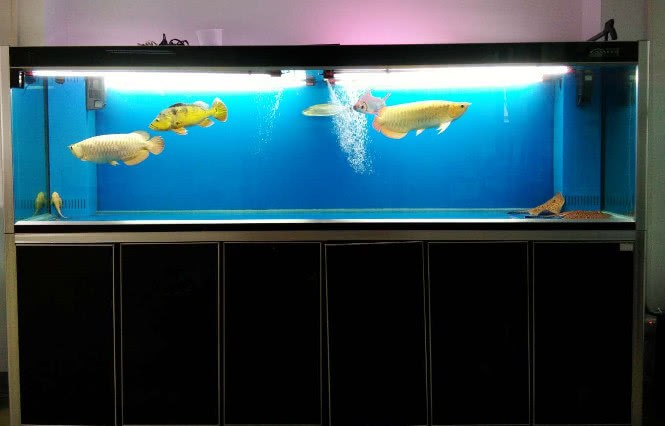
When we keep arowanas, especially as a beginner just stepping into the arowana world, we ask for advice humbly, afraid of making even the slightest mistake, but sometimes opinions vary, and as soon as we hear a little something we can't wait to try it... But often it is exactly like this, putting the beloved arowana in a deadly situation. Below we will talk about a few wrong ideas on the road of keeping arowanas:
"Excessive pursuit of a large water volume"
When it comes to keeping arowanas in tanks, everyone always says the bigger the better, as it can provide the arowana with ample growing space. There is nothing wrong with that, but it is easy to overlook one problem, namely that arowanas (especially small ones) are very neurotic. They look mighty and domineering, but in fact they are easily startled. Moreover, most of the arowanas everyone gets are small ones around ten to twenty cm, and it is very hard for such a small arowana to adapt when placed in an extra-large water volume. It often causes problems such as lying on the tank bottom, refusing to eat, clamped fins, and drop eye. So a reminder to everyone: you can partition off a small area for it within a large water volume, letting it adapt slowly. You can also add more small fish to keep it company; parrots, pineapple fish, flying fox, and pig-nosed are all good choices. Never let a small arowana be alone in a large water volume.
"Keeping arowanas at high temperature, spoiling the arowana"
Perhaps having heard the concept of a fire dragon bath, many people get the illusion that arowanas are very delicate, and they take extra care of their beloved arowana by turning the water temperature up very high, afraid of any problem. I have seen people keep arowanas at a high temperature of thirty-one or thirty-two degrees. In fact, 26-27 degrees is fine for adult arowanas, and 28-29 degrees for small ones; temperatures above thirty degrees are treatment temperatures. Long-term high temperature easily breeds bacteria and increases oxygen consumption, which is harmful to arowanas.
"Powerful filtration = no need to change water"
The filtration on arowana tanks is generally designed to be very powerful. I often see many friends trying every possible way to flush away the poop. The purpose may be that they do not want to change the water or want to reduce water changes. In fact, changing the water regularly and in fixed amounts is very necessary; how nice it is to manually siphon out the poop every few days and add new water. It achieves multiple benefits at once. If the water is not changed for a long time the water quality becomes old, and arowanas are very prone to problems such as gill curl, burnt tail, and pimples. So a reminder to everyone not to be lazy and leave everything to powerful filtration.
"Everyone says arowanas are best fed live food"
Everyone enjoys watching the arowana's ferocious feeding scenes. But the safety issue of the bait is often overlooked. When feeding bait with strong mobility, it must be processed. For example, stunning it by throwing it or cutting it with a knife will do. Otherwise it easily causes impact injuries and perforated intestines. Also, quarantine is very important. Diseases such as enteritis and ascites are caused by unsanitary bait.
"Keeping arowanas in salt water"
This mistake is often made by beginners. They always like to add a bit of salt to the water. Salt is used to treat illness, not to keep arowanas. Adding salt must reach a certain concentration to be effective for treatment. If there is always salt in the water long term, then when salt is truly needed for treatment, the effect may not be obvious. Humans cannot abuse antibiotics, and arowanas even less so. In addition, I think that long-term low-concentration salt in the water will breed bacteria, which is beneficial and harmless to arowanas.
Experience is always summed up slowly. One of my arowanas has already accompanied me through five springs, summers, autumns and winters, and I really hope it can keep accompanying me on and on...
The above content comes from the internet, and the copyright belongs to the original author.