What kind of succulent is Dudleya farinosa? This article introduces it to you
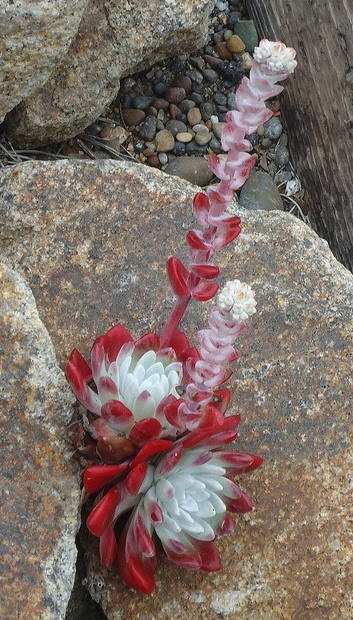
Dudleya farinosa, also known as Chuxiang, Yujian, Liudan Baihao, and Apple-leaf Dudleya, is a succulent belonging to the genus Dudleya in the family Crassulaceae. The Latin species epithet means "covered with white frost."
Dudleya farinosa
Morphological characteristics:
Rosette
4-10 cm in diameter, with 15-30 leaves, usually with many branches.
Leaves
Oblong to ovate, 2.5-6 cm long, 1-2.5 cm wide, acute at the apex, usually with a clear keel about midway on the leaf underside, with smaller keels beside it, usually covered with a thick layer of white farina. Some individuals are not powdery, and the leaf surface appears glossy green. In environments with intense sunlight and a certain temperature difference, the leaf tips and outer leaves turn bright red or deep red.
Inflorescence
The flowering stem is 10-35 cm long, and the inflorescence is usually fairly compact, flat-topped, 4-8 cm in diameter, with scorpioid cyme branches, the branches 1-3.5 cm, bearing 3-11 flowers, and the pedicels 1-3 (-5) mm.
Dudleya farinosa
Calyx
The calyx is 5-8 mm, the sepals triangular-ovate, sharp, 3-7 mm, the petals oblanceolate, not touching, 10-14 x 3-5 mm, pale yellow, the tips of the lobes sometimes spreading, the apex sharp to blunt.
Growing environment:
The ideal growing temperature is 10-25 °C. It likes light, but cannot be exposed to full sun all day. Water should not be excessive either.
Distribution range:
Native to the west coast of the United States, it is distributed in southwestern Oregon and along the northern and north-central coasts of California, growing in the cliffs of steep headlands, in vertical rock crevices, between huge boulders, or under shaded stone walls facing the sea.
Dudleya farinosa
Propagation methods:
The ideal growing temperature is 10-25 °C. It likes light, but cannot be exposed to full sun all day. Water should not be excessive either. The flowering period is from May to September, and the farther north the growing environment, the later it is delayed. The flowering stem is bright red, and the flowers are yellow. Under strong light, the leaves display a flame effect like flowing vermilion, while the white farina in the center of the rosette becomes even thicker. The propagation methods are stem cuttings and division. Leaf cuttings are also possible.