An Analysis of Plant Feng Shui in Landscape Gardens
Feng shui is a culture with a long history among the Han ethnic group, and its more scientific name is kanyu.
Feng means vital energy and field energy, while shui means flow and change.
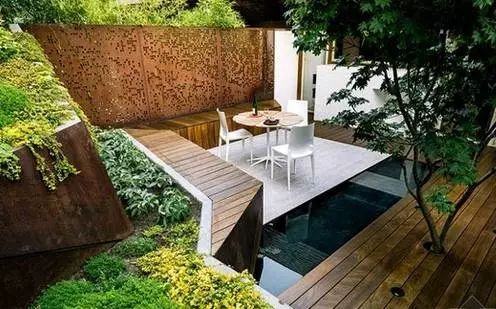
In courtyard design, flowers, plants and trees can improve the environment, purify the air and make the courtyard beautiful, with a range of styles.
Mountains can boost the family line, water can gather wealth, and when mountains and water are matched, they bring out the best in each other.
Courtyard Feng Shui · Plants
In ancient Chinese feng shui, it was already advocated that courtyards should have more trees and planted flowers and plants. This not only has functions such as "storing water, sheltering from wind, dissolving sha qi and increasing prosperity and good fortune", but also reduces air pollution and noise hazards, creating a fresh and vital environment.
The Five Elements of Plants
According to the principle of mutual generation and mutual overcoming, plants can be divided into five categories: metal, wood, water, fire and earth. Planting them appropriately can change feng shui and make everything "rise with wind and water".
1) Metal - white, apricot, gold
Yellow-toned plants must be paired with metal flower vessels or accessories, with money tree, narcissus and calamondin being the best.
2) Wood - cyan, green
All green plants belong here, with seed plants being suitable, symbolizing the meaning of "prospering", such as the green gem.
3) Water - black, blue
Represented by hydroponic plants, paired with blue or transparent glass flower vessels, such as the Chinese evergreen.
4) Fire - red, purple
Plants that bloom or bear fruit, using red flowers and containers, such as anthurium, moth orchid and so on.
5) Earth - yellow, brown
Represented by shade-tolerant indoor plants, suitable for black flower vessels or vessels inlaid with gemstones, such as cactus.
Plant Selection
There are choices when planting trees in a courtyard. In feng shui, plants are divided into auspicious and inauspicious types.
There are two standards for the inauspicious: one is whether they are toxic or have toxic sap, because scholars' research shows that plants such as night-blooming jasmine emit a strong irritating odor that has adverse effects on patients with heart disease and high blood pressure, and oleander, for example, is toxic, and its floral scent easily makes people drowsy, so neither is suitable for planting in a courtyard.
The second is judging auspiciousness or inauspiciousness by tree shape. Trees that are "bent and hunched", "like a crouching ox" and so on, with irregular, ungraceful shapes and abnormal development, are inauspicious (except for those with special tree shapes grown for ornamental purposes).
Auspicious trees are determined according to plant characteristics, symbolism and homophones. For example, among feng shui scholars, palm, citrus, Chinese toon, pagoda tree and osmanthus are considered auspicious plants, while peach, willow, soapberry, gourd and so on have the function of warding off evil and averting disaster. Courtyard landscape design can draw on this appropriately.
Planting Position
1) It is not suitable to plant trees in the center of a courtyard
From the appearance, planting a tree in the exact center of a courtyard makes the shape resemble the character "kun" (meaning trapped), which carries a certain obscure meaning; a large tree will affect ventilation, hinder the flow of fresh air between the house and the courtyard, and cause the rapid removal of moisture and harmful gases indoors to be blocked; the root system of a large tree has strong growth power and absorbs a lot, easily damaging the flat courtyard and then affecting the stability of the house foundation; and if it is a deciduous tree that constantly drops leaves, it is difficult to clean up, and is also unfavorable for beauty and hygiene.
2) There should not be a leaning tree in front of the house
If there is a leaning tree in front of the house, it indicates that the house receives light at a specific angle, and the tree's center of growth will always be in a fixed direction. Over time, the trunk may be unable to support the branches, creating a safety hazard.
3) There should not be a dead tree at the front door
If all the trees wither, it indicates that there is a problem with the soil environment of the site, and it is also unsuitable for people to live there for a long time. On the other hand, a dead tree in front of the door easily breeds negative emotions visually and psychologically. Therefore, if there is a dead tree in front of the residence, it should be cleared away immediately.
4) There should not be trees in front of the window
The dancing tree shadows outside the window and the scene of sunlight shining into the house give residents a refreshing mood, but it should be noted that trees should not be too close to the window. Generally speaking, trees in front of the window should be more than two meters away from the house, keeping a friendly distance between the residence and the trees.
Auspicious Tree Species
1) Palm
With an upright posture and evergreen through the four seasons, it has extremely high ornamental value, and in feng shui it has the function of generating and protecting wealth.
2) Money Tree
Its leaves are thick, bright in color and grand in appearance, shaped like a sycee, and Chinese people call it the money tree. It has strong vitality and symbolizes bringing in wealth and treasure, riches and honor.
3) Citrus Tree
"Ju" (orange) is homophonous with "ji" (auspicious), symbolizing good fortune. Its fruit colors are red and yellow, full of festivity, and its leaves have the function of soothing the liver and relieving depression, bringing joy to the household.
4) Chinese Toon
The Chinese toon is a tree of longevity and has the functions of protecting the residence and praying for long life.
5) Pagoda Tree
Its wood is hard, representing "lu" (official salary). Among many trees, the pagoda tree ranks highest in taste and is a representative for guarding the residence.
6) Osmanthus Tree
Osmanthus symbolizes noble purity. In summer, its fragrance fills the air and it is a natural air freshener. "Gui" is homophonous with "gui" (noble), so planting osmanthus in front of the door brings wealth and honor to the household.
7) Plum Blossom
The plum tree has strong adaptability to soil, and its flowers open in five petals, carrying the meaning of "plum blossoms open the five blessings", increasing fortune for the family.
8) Banyan
It carries the meaning of "great capacity brings greatness, and without desire one is strong", encouraging self-improvement in cultivation.
9) Pomegranate
The red pomegranate flower is a symbol of vitality and vigor, and since ancient times the pomegranate has carried the meaning of many sons and much blessing.
10) Crabapple
Its flowers are delicate yet grand, with an innate noble air, a flower of wealth and honor before the hall.
Plants' role in improving the environment and their ability to delight the mood are beyond doubt. As for symbolism, that is the icing on the cake.
Courtyard Feng Shui · Rocks
Rocks are the finishing touch in a courtyard. Because of their special shapes and endless combinations, they are deeply loved. When they merge into the environment, they become rich with a strong human warmth.
If the arrangement of rocks is reasonably matched with the water features, flowers and trees in the courtyard, mutually enhancing each other, it can improve interpersonal relationships and boost the family line.
Feng Shui Directions
Rocks belong to earth. The east is thunder, and thunder is the image of shaking, belonging to wood in the five elements, and wood overcomes earth, so rocks should be avoided in the east as far as possible. The west is marsh, belonging to metal in the five elements, and earth generates metal, so it is suitable for arranging rocks. The south is fire, and fire generates earth; rocks are also earth, so earth would be too prosperous, and going beyond the limit is as bad as falling short. The north is water, and earth overcomes water, which would suppress the feng shui of the north, so it is also unsuitable for rocks. The northwest is heaven; rocks are earth, the image of the great earth, and it is a good choice for piling rocks. The northeast is mountain, and rocks are the image of obtaining the proper position in feng shui, very auspicious.
Therefore, the suitable positions for piling rocks are the west, northwest and northeast.
Design Principles
1) The principle of diverse unity
Rocks originate from nature and, after carving, have strong plasticity. Therefore rocks can be well used in everything from natural style to formal style, from classical to modern courtyards. But space is limited, and within it, coordination and unity in aspects such as color and lines must be ensured, making the space appear more stylish.
2) The principle of attention to texture
Rocks are diverse and their textures vary. Rocks and flowers and trees can blend perfectly and bring out the best in each other, creating a distinctive interest.
3) The principle of simplicity and generosity
In design, simplicity is pursued. Simplicity expresses emotion through a "refined" approach, and modern courtyard design pays more attention to a simple and practical beauty. A few rough stones placed as accents on the courtyard lawn can serve as seats for people to rest; a long stone placed on the grass, paired with a few flowers and trees, forms a natural interest...
Courtyard Feng Shui · Water Features
Among the feng shui elements of a courtyard, the changes and movement of water are a kind of art, and water is the most active. Nourishing life, enhancing the vitality of space, and keeping wealth flowing endlessly all depend on the influence of water.
Water has ornamental value, can regulate the microclimate within the courtyard, and also has environmental value. A residence takes spring water as its blood vessels. A complete courtyard cannot do without the flexible use of water.
In courtyard design, there is no shortage of designs centered on a pond, paired with rocks, swimming fish, water lilies and so on, creating various different forms such as streams, swimming pools, bubbling springs, ponds and small waterfalls, bringing distinctive scenery, more vitality, interest and function to the space, and also having the effect of boosting the residence's energy.
Forms of Water Features
Courtyard water has two types, dynamic and static. Dynamic water has diverse handling methods and can enliven the atmosphere of the space and lift people's spirits.
Static water is mainly represented by swimming pools, water bowls, mirror-surface ponds and so on. In a courtyard, it is generally paired with plants to create a concise and bright space, giving people a feeling of tranquility and peace of mind. Water features of this form generally should not be too large in area, otherwise the original space of the courtyard will appear dull, empty and monotonous, and practicality will also be insufficient.
Shape Design
From the perspective of feng shui, whether it is a swimming pool, fountain or pond, designing it in a shape similar to a circle is relatively suitable.
1) Storing wind and gathering wealth
2) Elegant style
3) Convenient cleaning
4) Safety and health
Points to Note
1) Judge by the orientation of the residence which direction can have a pond dug, and then determine in what form and shape to excavate. Generally, it is relatively suitable for the water system to flow toward the front of the house in a soft curve, which can avoid wealth water flowing outward.
2) Chinese people like to have mountains behind and water in front. Similarly, if water is behind the house, it runs counter to the basic layout and gives people a bad feeling psychologically. If a pond is set directly behind the house, it is not suitable to dig deep underground, and it is better to choose to build a pond wall high on the ground.
3) Pay attention to the distance between the pond and the house. Just as trees should not be too close to the house, the pond should not be too close either.
4) Fountains, swimming pools, ponds and so on must not dry up, and at least 80 percent full should be ensured. Dried-up water will have an adverse effect on wealth luck, because in feng shui, water generally represents wealth. Therefore, properly arranging water in a courtyard has a close relationship with the homeowner.
Through the organic combination of plants, rocks and water features, an interesting courtyard slowly emerges, with the vitality of plants, the warmth of rocks and the liveliness of water features. In addition, there is another element that cannot be ignored, and that is the courtyard wall, which reflects the style of the residence and affects the overall aesthetic of the residence...
Courtyard Feng Shui · Walls
As a vertical spatial partition structure that encloses, divides and protects the courtyard, the wall affects the overall aesthetic, safety and comfort of the courtyard. Therefore, when building a wall, taking into account practicality, aesthetics and conformity with scientific feng shui principles can make the wall a beautiful scenic line in the courtyard.
Wall Shape
Walls are suitable in circular or square shapes. According to the idea of "round heaven and square earth", for residences generally appearing square or rectangular, the wall can adopt a curved or circular form. Square or rectangular walls, following the principle of being square and upright and steady on all sides, are the most widely used.
Avoid the form of "wide at the front and pointed at the back", commonly known as "retreating-field pen", which mainly signifies loss of wealth. In addition, a triangular wall will make family members feel pressure and easily cause negative effects in aspects such as emotion and health.
Wall Height
The wall and the house should be coordinated and unified, so the wall height is generally around 1.5 m, that is, slightly taller than a person's height, which is suitable. If the wall is too high, it will give people a sense of oppression, as if imprisoned. Moreover, an overly high wall blocks the windows, which is unfavorable for lighting and ventilation and also hinders aesthetics.
Of course, the wall should not be too low either, as there would be no sense of security, it would lose its function and fail to provide protection, and it would also be unfavorable for storing wind and gathering qi.
Points to Note
1) Wall Spacing
It is not recommended for the wall to be too close to the house. At least a distance of more than two meters should be maintained to ensure appropriate privacy. Otherwise, it easily leads to poor ventilation and lighting, making the space appear oppressive, and over time people moving within it will also become mentally depressed.
2) Wall Type
Wooden walls, brick walls, iron railing walls, green walls and so on. There are many kinds of materials for making walls, and the design should be determined according to the overall style of the courtyard, otherwise it will appear out of place. Generally, European-style courtyards mostly use wrought iron walls; American-style natural pastoral courtyards mostly use walls that highlight texture, such as wooden walls and brick walls.
3) Orientation of the Wall Gate
The wall gate is the entrance to the courtyard, chosen according to auspicious and inauspicious feng shui positions. If the auspicious position of the courtyard is in the south and the inauspicious position is in the northeast, the gate orientation should be set in the south. At the same time, it must not face places with heavy yin energy, such as directly facing the roof corner of a temple, the entrance of a hospital, a garbage collection site and so on.
4) Wall Decoration
It is not suitable for wild vines to cover the wall completely. You may think this is very poetic, but it will fill the courtyard with yin energy, and over time the wall will also be damaged by the plants. Green walls are another matter. If flower and stone materials are used to decorate the wall, although the colors are gorgeous, from the viewpoint of feng shui these things belong to yin energy and are likewise unsuitable for excessive use.
A courtyard is different from interior decoration. No matter how good the courtyard is, it requires long-term careful maintenance. As the saying goes, "three parts planting, seven parts maintenance". Without good maintenance, even the best courtyard is only a fleeting show. Only by maintaining and regulating feng shui with professional and careful care can everything go smoothly, rise with wind and water, and good luck continue endlessly.
If there is any infringement, please contact us for deletion
Dear friends who like it, you are welcome to like and share
Plant Network
Everything Plant-Related, All in One Place