The plum rain season arrives, tread carefully and cherish every step on the succulent-growing journey
Follow
Follow the encyclopedia · meet beauty (WeChat ID: duoroubaike)
The main text begins:
Thanks to the author [Morning ai?r] for theoriginal submissionsharing
Submission date: 2018-04-24
Edited and compiled by: Encyclopedia Jun
Coordinates: Changzhou, Jiangsu Province
Summer has arrived, and southern Jiangsu has also welcomed the plum rain season. How to get the succulents safely through the summer and the high-temperature, high-humidity plum rain season, and reduce casualties caused by diseases and pests? There is no other way but to plan ahead and prevent trouble before it happens. What's more, spring in southern Jiangsu never gives any warning with its extreme weather; before you know it, a single week runs through spring, summer, autumn and winter. Growing succulents in the spring and summer in southern Jiangsu can be described as treading on thin ice at every step, so cherish the present, and tread carefully and cherish every step.....
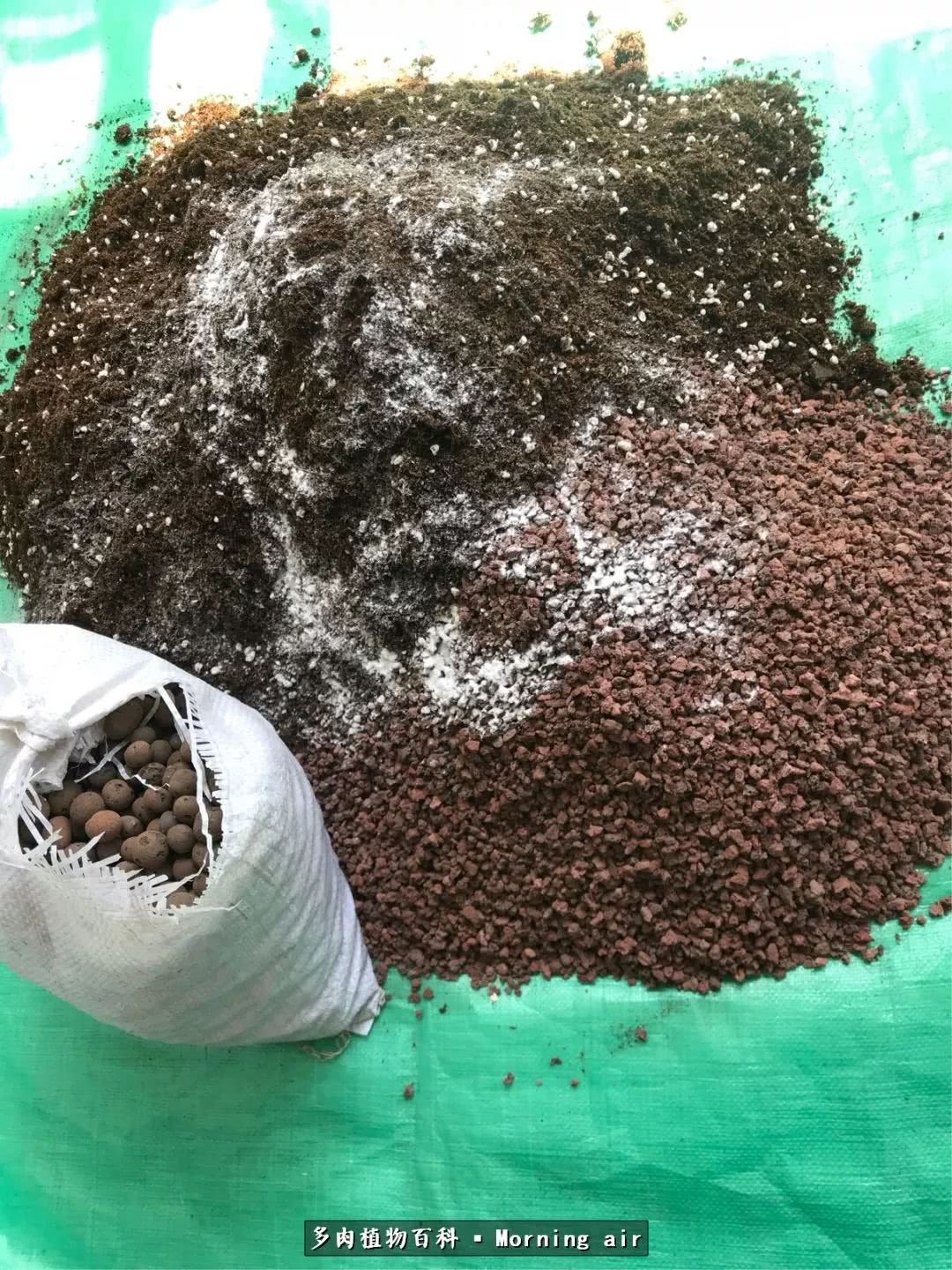
When the weather is good and the potting soil is dry, do a thorough repotting and soil change. For the soil mix I use imported growth-type peat, coco coir, and perlite (available on Taobao). I chose it because it is loose and airy, and the textured coconut fibers can prevent compaction. Loose, airy soil is more suitable for growing roots. Only when the roots are well grown and the succulents grow vigorously can they contend with the scorching heat. Being airy alone is not enough; the drainage of the soil mix must also be increased. For the additional granular component ratio, I chose volcanic rock. The surface of volcanic rock is honeycomb-like, and its air and water permeability is quite good! The key is that I like how light and pressure-free it is, making the potting soil even more airy. Ceramsite is used for the bottom layer.
A 5:5 ratio. Here, do not overlook the perlite in the peat and coco coir; perlite is also a granular component. Sprinkle on carbendazim: ratio 1 gram of carbendazim per 1 liter of soil. Here I use 20 grams of 80% carbendazim. The mixed result looks like this
Repotting succulents with good root systems, like these, is there still any pressure for them to get through the summer?
Apart from coarse ceramic pots, the pots are basically uniformly black square pots. I chose black square pots because of the openings at the bottom. When potting, line them with mesh screen and spread a layer of ceramsite
Volcanic rock can also be used as top dressing, but there is a lot of rain in spring in Jiangnan, and last year summer in southern Jiangsu had 40°C high temperatures lasting for more than a month. Looking back now, the scene was still quite tragic! So I chose not to use top dressing.
The uniform black square pots look somewhat neat
Here are a few succulents after the rain. Mom no longer worries about water accumulation. The slots are also hollowed out, with 360-degree air, water and ventilation permeability, no room for argument
Still not reassured about getting through the summer like this? Drenching the roots with carbendazim every 2 weeks is a must! I read Encyclopedia Jun's articles every night and have learned quite a lot of knowledge. Let me show off a bit here: water accumulation in succulents is not the real cause of root rot; it is the high-temperature, high-humidity soil that provides nutrients and opportunities for bacteria, fungi and mold to grow and invade. Black rot and sooty mold come about exactly like this. So during the plum rain season and summer in Jiangnan, succulents should still be regularly sprayed with fungicide.
Ratio: 1 gram of carbendazim mixed with 1000 milliliters of water. However, carbendazim easily leads to resistance, so you can choose mancozeb to alternate with it. Dilute mancozeb with water and spray every week, also at a 1:1000 ratio, and use carbendazim to drench the roots once every two weeks. Once these basics are done, growing succulents will be just fine! Of course, ventilation, water control and shading are another matter.
A 1-gram medicine spoon and a 500-milliliter narrow-spout kettle. Whether drenching roots or spraying, make sure they cannot be rained on within six hours after application.
On a cloudy morning after the rain, Echeveria 'Hakuhou' looks more and more fairy-like.
With too much rain, Tia and Spring Miracle are lush green!
The peach eggs have faded in color and look a bit puffy
Compared with the peach eggs that successfully made a comeback in March, I want to cry!
Qiluo turned red and then green again. In summer I do not pursue perfect condition; if you are well, it is a sunny day!
Although it has turned green, it has produced many pups
Leaf-propagated seedlings, raised from a single leaf, my eyes are full of love
Cuican
So fake clusters can be like this. No wonder Taobao says that when the soil is removed they may fall apart
These are all from last autumn to now, with leaves increasing and growing layer by layer, and wrapping up is truly not easy! Witnessing their growth is my happiness!
When they were young they were very messy; once they grow up, rules must be set
Once they are a bit bigger they are moved to pots, because the light intensity they need differs from small to large. Once the mother leaf detaches, they need separate living quarters.
Leaf propagation can produce double heads, multiple heads, and even fasciation. Spring is the season when leaf-propagated seedlings grow fastest. The spot where a leaf is pulled off has a wound, so avoid pulling off too many leaves at once, as this will damage the succulent itself.
Writing an article is so tiring, but I still enjoy it endlessly, because sharing is happiness!
Encyclopedia Jun's rambling thoughts:
Let me mention here that the original poster's soil mixing method is a fairly typical greenhouse soil mix. Perlite, as one of the cheaper granular components, has the advantage of being inexpensive, and its porosity greatly promotes the growth and development of fine roots in plants, but its disadvantage is that it easily turns to powder and produces a lot of dust. For ordinary home soil mixing, it is recommended to replace it with other granules. In addition, regarding the ratio of carbendazim and other fungicides, it is recommended to pay attention to the "effective ingredient content" on the outer packaging of various carbendazim products. For example, 25% carbendazim can simply be diluted 400 to 500 times. Also, although spraying carbendazim on leaves can also exert its effect, it easily leaves white water stains, so it is recommended to dilute carbendazim and use it to drench the roots. For more ways to use the medicine, you can search Baidu or refer to the medication instructions.
Advertisement ADVERTISEMENT
This article has beenexclusively authorizedby the author to WeChat public account: Succulent Plant Encyclopedia (ID: duoroubaike). The content of the article does not represent the views or stance of the public account
- Review of the previous excellent push -
- Encyclopedia featured articlesRecommendation -