Bonsai branch bending method: a practical example of drilling as an aid
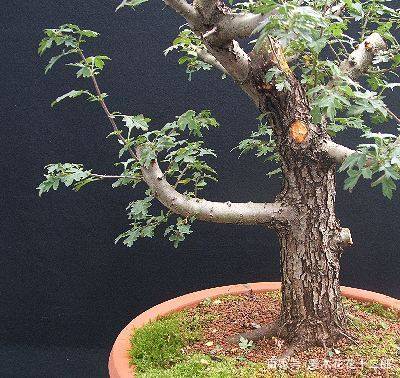
There are many ways to bend a branch, and different situations call for different choices. For thicker branches or brittle species, some auxiliary means may be needed to succeed. Drilling a hole in the branch as an aid is also a commonly used technique. However, it will leave a permanent scar. Fortunately, for bonsai, a scar is not necessarily a bad thing. Let's see how the experts do it.
This is a wild-collected English hawthorn (Crataegus laevigata) that has been grown for some time, and the plan is to style it. We can see that the first branch point is fairly low, which is good, but the branch's line is not good. If it were shortened and a new branch grown out again, it might take some time, and the result would not necessarily be good. If it can be bent down, that would save trouble. But the branches of this kind of hawthorn are rather brittle and break easily. So the bonsai artist chose to drill a hole in the branch as an aid.
To avoid affecting the appearance, the bonsai artist chose to drill the hole on the back side.
First, find the right spot to bend. The horizontal section of this branch is too straight, so bend it at a suitable point.
The hole was gouged out like this. The size of the hole does not matter, but the premise is that the cambium must not be gouged away, otherwise the branch will die.
Two wires are used to pull and hold it in shape. According to the bonsai artist himself, bending it was very easy.
After the branch is bent into place, secure it, then fill the gap with sphagnum moss, wrap it with black tape, and then comes the long wait.
Two years later, the hole has healed very well and should now be set in shape.
There are two points to note when using this method:
1. The season for the operation must not be the winter dormant period; it should be in late spring and early summer when branch growth is at its most vigorous, as recovery is faster at this time.
2. The second point was mentioned just now: do not damage too much of the cambium.
Any operation that wounds the branch to the bone can bring risks, ranging from the branch drying up to the whole tree dying.