This plant has many benefits: it aids digestion, boosts brain function, treats spermatorrhea and strengthens the body. Do you have it at home?
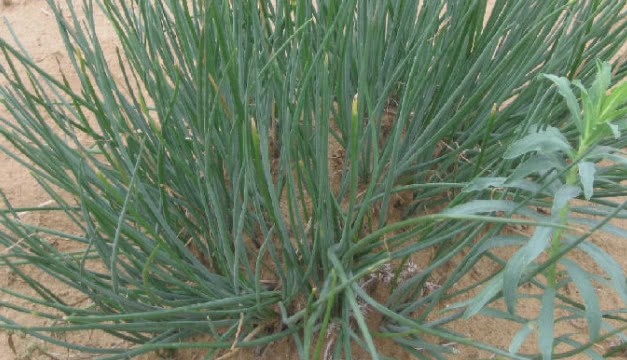
Allium mongolicum (sand onion) belongs to the genus Allium in the lily family and is a perennial herb. It has rhizomes and clustered columnar bulbs. The basal leaves are slender and linear. The scape is cylindrical. Numerous small flowers are densely arranged into hemispherical and spherical umbels, bright pale purple to purplish red. Flowering period is June to August. Its seeds have a long lifespan and may still germinate after being buried in sandy soil for several years. It is a companion plant of desert meadow vegetation and often grows in sandy loam gobi at higher altitudes. Because it resembles young scallions, it is called sand onion. Sand onion can be made into various delicious dishes and also has certain medicinal value. Because sand onion grows scattered in sandy loam gobi and is extremely difficult to harvest, and because of limitations imposed by its biological characteristics, its yield rises and falls with the climate of each year; in years with abundant rainfall, the yield can increase substantially.
Sand onion is a fine delicacy loved by the people of northwest China. Sand onion baozi made with freshly picked sand onion and newly slaughtered large-tailed mutton is served to guests. After picking the scallion flowers, pickle them with salt or dry them in the sun; when making soup or boiling meat, put a handful of scallion flowers into the pot, and the soup and meat will be filled with fragrance. The tender stems of sand onion are not easy to store for long, but they can be made into a seasonal delicacy: blanched sand onion. Wash the tender stems of sand onion, blanch them in boiling water for one minute, then take them out and mix with refined salt and aged vinegar. Its pickled products can be stored for more than five months. Sand onion has high nutritional value and certain medicinal value, is rich in multiple vitamins, and has a certain effect on lowering blood pressure. Its pickled products have a refreshing taste, a mellow and pungent flavor, aid digestion and strengthen the stomach, and can be called an excellent food. "Compendium of Materia Medica, Vegetables 1, Allium victorialis": "Allium victorialis is wild scallion, found in mountains, plains and flat land. The kind growing in sandy land is called sand onion, and the kind growing in marshes is called water onion; country people all eat them. It bears white flowers, and its seeds are like small scallion heads." Eating it often can enhance children's intelligence, improve immune function, effectively prevent the occurrence of senile dementia, and also inhibit and reverse the abnormal proliferation of cancer cells, thus helping health and longevity. The aboveground part can be used as medicine; it can stimulate the appetite, promote digestion and kill parasites, and is mainly used for indigestion, loss of appetite, favus, green leg disease, and so on.
Wild scallion is the whole plant of the lily family plant wild scallion, also known as sand onion and wheat scallion. Wild scallion is warm and pungent and enters the lung and stomach meridians. Effects: induce sweating, dispel cold, reduce swelling, strengthen the stomach. It is mainly used for common cold, headache and fever, cold pain in the abdomen, indigestion, and fractures.
Weicai, also called Niumaoguang, is a plant in the Osmundaceae family, with the scientific name Osmunda japonica. It is a perennial herb, crisp in texture, delicious and low in fiber, and contains protein, organic minerals and multiple vitamins. It enjoys the reputation internationally as a "pollution-free vegetable." The young leaves of Osmunda japonica are rich in nutrients; after blanching in water to remove the fuzz, they are rubbed into dried weicai. It can be eaten fresh or made into dried vegetables. It has a unique fragrance, is crisp and pleasant, and is never tiresome even when eaten for a long time; it can also be used as medicine. The curled, unopened tender shoots are especially a superior food. After blanching in boiling water, rinsing and removing the earthy smell, they can be stir-fried, quick-fried, served as a cold dish, made into soup, or stir-fried with meat, and so on. They treat illness when sick and prevent illness when well. Therefore, regular consumption by healthy people is highly beneficial.
Every 100 grams of weicai contains 4.3 grams of carbohydrates, 2.2 grams of protein, 0.19 grams of fat, 1.68 milligrams of carotene, and also vitamin C and multiple minerals. Weicai also contains saponins and flavonoids, and has the effects of moistening the lungs and regulating qi, tonifying deficiency and soothing the collaterals, and clearing heat and detoxifying. It is mainly used for hematemesis, bloody dysentery, functional uterine bleeding, spermatorrhea, and other conditions. Shortly after the peach blossoms finish blooming in early spring, young shoots emerge; in May and June the leaves and stems grow taller, and they should be collected promptly. After collection, weicai is boiled in water, rubbed, sun-dried and processed into a dry product, commonly called dried weicai. Besides being eaten, it can also be used as medicine.
Sterilizing, reducing inflammation, and fighting viruses: Weicai decoction shows obvious inhibitory effects on influenza virus types A, B and C, and can also inhibit adenovirus type III, poliovirus type II, Japanese encephalitis virus and herpes simplex virus, among others. Stopping bleeding: Weicai can assist in treating bleeding disorders such as hematemesis, hemafecia and abnormal uterine bleeding, with certain effects. Nourishing and strengthening the body: Weicai is rich in nutrients, tonifies the spleen and stomach, and benefits the intestines; eating it often has the effect of strengthening the body.
Have you eaten these wild vegetables? Are there any in your hometown?