Pink Dream Dianthus planted on the balcony, you can see bright flowers all summer long
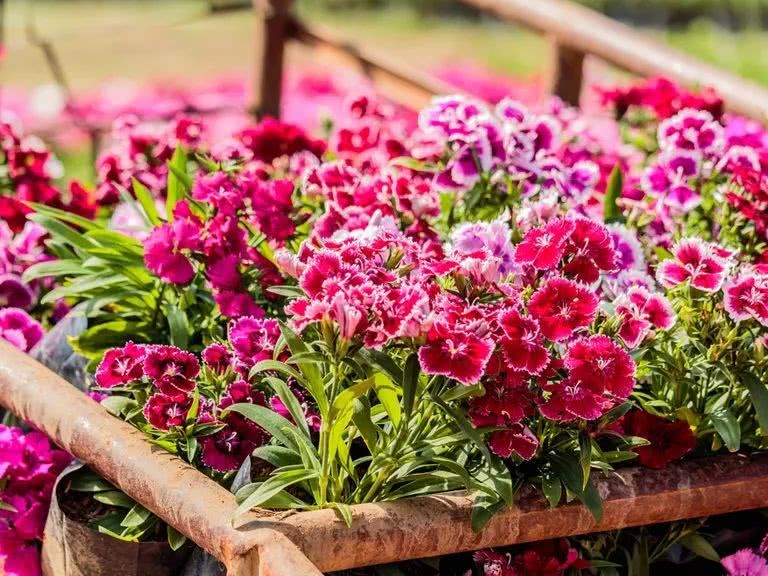
If you want to grow some plants that bloom brilliantly in summer, planting some different varieties of dianthus is a good choice. It has pink flowers and is a short-lived plant that is slightly sensitive to its environment, but in places that are warm year-round it can be grown as a perennial.
Dianthus has a certain cold tolerance and is also fairly drought tolerant, so its ability to adapt to the environment is quite good. But why do I say dianthus is relatively sensitive to its environment?
Dianthus does not like extreme summer heat. Especially when summer temperatures are high, it needs appropriate shading. Under blazing sun and high temperatures it easily wilts, and in severe cases it can even wither, so it should be misted appropriately to lower the temperature.
Dianthus can be sown in spring or autumn. Sowing can be done when the temperature is around 20 degrees. It is usually sown in autumn, so that brilliant flowers can bloom in the following spring and summer. It generally takes 5-7 days to take root and sprout.
The environment for caring for dianthus must provide relatively ample light and keep the air circulating. It grows even better in a cool, moist environment. The growing soil should be loose, fertile, well-draining humus soil or sandy soil, maintaining good drainage and avoiding waterlogging, otherwise the roots easily rot.
Dianthus grown in pots should not be planted too densely; there should be appropriate spacing, keeping a spacing of more than 20 cm, so that they can grow well. When watering, avoid water accumulating on the leaves, otherwise it easily induces fungal diseases and easily induces black mold disease.
The one above is carnation, also called xiāng shíkǎn.
After dianthus finishes blooming, promptly remove the spent flowers. This helps extend its lifespan, makes it grow more compact, and helps promote the next bloom.
During the peak growing season of dianthus, you can cut off its branches and use them for cuttings propagation. The branches should be about 9 cm long. Remove the leaves at the bottom, and then they can be used for cuttings cultivated in sandy soil. Keep the soil slightly moist, with the temperature around 24 degrees, maintain a semi-shaded environment, and provide appropriate air humidity; they will easily take root and sprout.
The ones above are different varieties of dianthus. They look especially fresh and beautiful. The care environment can provide more light, or they can be grown in a semi-shaded environment. Keep the air circulating and avoid growing them in a closed space.
Dianthus should not be watered too frequently. Generally, wait until the potting soil is completely dry, then water thoroughly, to avoid too much water causing root rot. If you want to encourage dianthus to bloom continuously, you need to pinch the tips appropriately during the growing season to promote branching, which helps produce more flowers. Any non-flowering axillary buds should be removed promptly.