Plum Blossom Grafting Propagation Methods and Technical Key Points
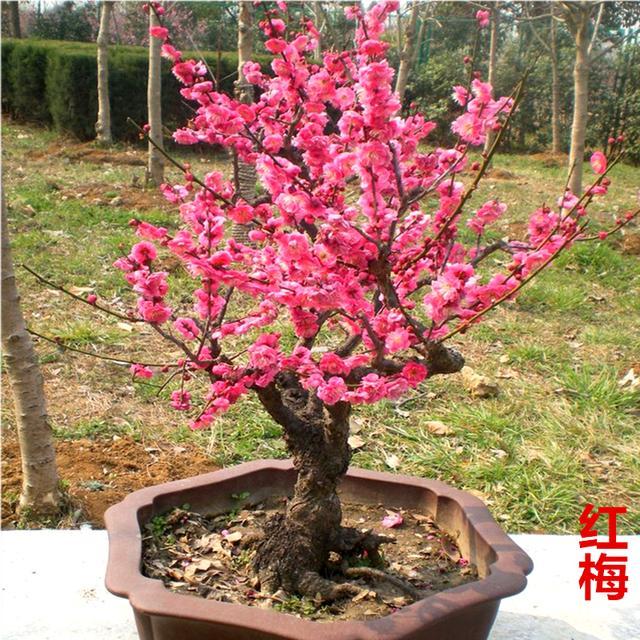
Grafting Propagation Methods for Plum Blossom
Plum blossom grafting is a commonly used propagation method in landscaping. Apricot (Prunus sibirica) can be used as the rootstock, and Saint Rose plum as the interstock for grafting plum blossom. The main technical key points are as follows.
Grafting time. It is advisable to choose mid-March in spring when temperatures rise, plant sap flows, and the temperature is 8-15°C for grafting.
Rootstock and scion selection. ① Selection of the rootstock. Choose 3-year-old apricot (Prunus sibirica) with a ground diameter of about 5 cm, growing vigorously, and free of pests and diseases as the rootstock. ② For the interstock, select 1-year-old Saint Rose plum wood as the interstock scion. ③ For the plum blossom scion, select 1-year-old 'Fenghou' plum (Prunus mume 'Fenghou') wood with strong cold resistance.
Grafting method. Use the cleft grafting method. ① Cut off the apricot rootstock at a flat plane 20 cm above the ground, split the middle of the smooth surface to form a 3.5 cm long cleft. ② Cut 1-year-old Saint Rose plum wood into 15 cm sections as the interstock scion, sharpen one end into a double-sided wedge shape, insert it into the rootstock cleft, align the cambium of the interstock scion with the cambium of the rootstock, and tie tightly with plastic strips to serve as the interstock scion. ③ Then split the upper end of the interstock scion to form a 3.5 cm long cleft. ④ Finally, cut 1-year-old 'Fenghou' plum wood into 10 cm sections as the scion, sharpen the lower end into a double-sided wedge shape, insert it into the interstock cleft, align the cambium layers of both, and finally tie tightly and wrap securely with plastic strips.
Management after grafting. After the graft survives, promptly remove buds and pinch off growing tips to encourage branching, increase growth, and promote flower bud differentiation, so that flower buds form in the same year and abundant flowering occurs the following year; apply base fertilizer or foliar fertilizer, mainly topdressing with phosphorus and potassium fertilizers, so that the plant concentrates its nutrients, promotes nutrient absorption, promotes maturity, and enhances winter hardiness; pest and disease control, routine production management, etc.
Using apricot (Prunus sibirica) as the rootstock has the advantages of a well-developed root system, fast growth, vigorous growth, strong resistance, and resistance to pests and diseases; using Saint Rose plum wood as the interstock has the advantages of vigorous growth, fast growth momentum, strong resistance, frost resistance, and abundant flowering; using 'Fenghou' plum wood as the scion has the characteristics of strong cold resistance, early flowering, beautiful flower shape, and high ornamental value. In a single season, the rootstock, interstock, and scion are connected in one-time "double" grafting, which improves propagation efficiency.[Jishan Huayao]