How does the new peach variety Guibao perform when introduced in Tai'an, Shandong?
Performance of the new peach variety Guibao when introduced in Tai'an, Shandong
Fund projects:Special Fund for the Construction of the Modern Agricultural Industry Technology System (CARS-31-Z-09), National Science and Technology Support Program Project (2013BAD02B03-3-1).
1 Materials and Methods
1.1 Experimental Site
The Tianpinghu Experimental Base of the Shandong Institute of Pomology, with an average altitude of 165m, a soil layer thickness of 0.8-1.0m, a soil organic matter content of 10.2g/kg, and a pH of 7.2. Annual sunshine is 2627 hours, the average annual temperature is 12.8°C, precipitation is 697mm, and the frost-free period is 195 days.
1.2 Experimental Materials
Guibao is a new mid-to-late ripening peach variety bred by the Institute of Forestry and Pomology of the Beijing Academy of Agriculture and Forestry Sciences. It was developed by crossing Huayu as the female parent and the American nectarine variety Flavortop as the male parent. It was introduced to the Shandong Institute of Pomology for planting in 2011.
1.3 Experimental Methods
In the spring of 2011, one-year-old Guibao peach seedlings were planted on raised ridges at a spacing of 2m x 4m, with hairy vetch sown between the rows as cover[1]. A central leader form was used for training, with pruning carried out twice a year in winter and summer, mainly for training and thinning[2]. Base fertilizer was applied in trenches every October, using about 5000kg of decomposed farmyard manure per 666.7 sq m, combined with 100-200kg of slow-release nitrogen-phosphorus-potassium compound fertilizer[3]. Conventional low-toxicity pesticides were sprayed 9 times throughout the year to control pests and diseases. Watering and drainage were carried out promptly according to soil moisture conditions. The growth, fruiting, and other conditions of Guibao were observed and recorded for 6 consecutive years.
2 Results and Analysis
2.1 Botanical Characteristics
The one-year-old branches of Guibao are reddish brown on the sunny side and green on the shady side, with an average internode length of 2.19cm; the leaves are long elliptical-lanceolate, green, with a broad wedge-shaped leaf base, bluntly serrate leaf margins, and acuminate leaf tips; leaf length is 13.3-16.1cm, width is 3.8-4.5cm, and petiole length is 0.9cm. Leaf glands are kidney-shaped, 2-4 in number. Flower buds start at nodes 1-3, with many compound flower buds. Flowers are of the rose type, with pink petals, 5-7 petals, orange-yellow anthers, abundant pollen, and pistils equal in height to or slightly higher than the stamens.
2.2 Fruit Economic Traits
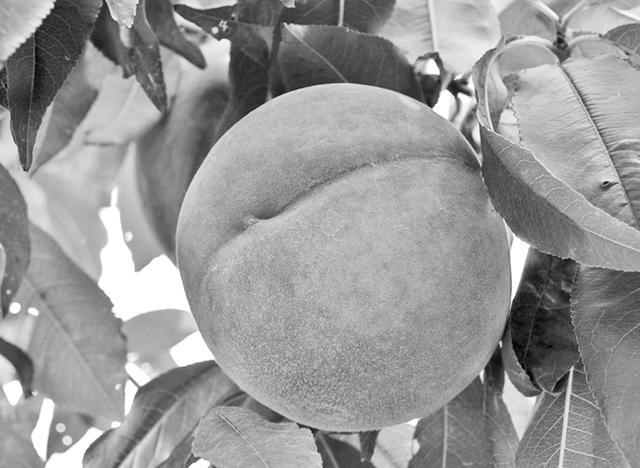
The Guibao peach fruit is nearly round, with a round and flat top; the suture is moderately deep, the two halves are relatively symmetrical, ripening is uniform, and the fuzz is moderate. The fruit is large, with an average single fruit mass of 277g and a maximum of 326g (Figure 1). The ground color of the fruit surface is milky white, with a red blush covering more than 1/2. The skin is moderately thick and difficult to peel. The flesh is milky white, with red pigment near the pit, moderate fiber content, fine, firm, and crisp texture, and abundant juice, with an average soluble solids content of 12.7%. The flavor is sweet, with aroma. It is freestone and tolerant of storage and transport (Figure 2).
Figure 1 Fruiting state of Guibao
Figure 2 Fruit traits of Guibao
2.3 Growth and Fruiting Habits
The Guibao tree has a semi-spreading posture, moderate vigor, moderate bud-breaking ability, and a high branching rate. It can produce 2-3 secondary shoots in 1 year, with an average annual growth of new shoots of 68.5cm. Young trees mainly bear fruit on medium and long fruiting branches, and after entering full fruiting stage, all types of fruiting branches can bear fruit. The natural fruit-setting rate is 36.2%. It has strong early fruiting ability and high yield. One-year-old seedlings form flower buds in the same year of planting and bear a small amount of fruit in the second year; planted at a density of 2m x 4m, the per-plant yield in the third year is about 12.6kg; in the fourth year it enters full fruiting stage, with a per-plant yield of up to 26.6kg, equivalent to 2216.7kg per 666.7 sq m.
2.4 Phenological Period
In the Tai'an area, Guibao peach leaf buds sprout in mid-March, bloom in early April, reach full bloom in early to mid-April, with a flowering period of about 1 week, and the fruit ripens in mid-to-late August. The fruit development period is about 130 days, leaves fall in mid-to-late November, and the growth period is about 240 days.
2.5 Resistance and Adaptability
When cultivated in the Tai'an area, Guibao peach has no particularly susceptible pests or diseases; it has a certain resistance to winter low temperatures and late spring cold during the flowering period, and yield is unaffected. It has relatively strong drought tolerance; no fruit cracking occurs during the rainy summer period, and its stress resistance and adaptability perform well [Qingqianliu].
3 Key Points of Cultivation Techniques
3.1 Training and Pruning
Use the central leader form for training and pruning, with the trunk headed at above 50cm, select a good central extension trunk, and evenly distribute fruiting branch groups on it. During pruning, thinning is the main method, removing strong, vigorous, and overly dense branches to ensure ventilation and light penetration in the tree canopy. Renewal of fruiting branches should be done well to avoid a tree vigor that is strong at the top and weak at the bottom. [Jishan Huayao]
3.2 Fertilizer and Water Management
Each year, autumn fertilization is the main practice. Trenches are dug on both sides of the tree canopy to apply decomposed farmyard manure, which can be combined with bag-controlled slow-release compound fertilizer; during the growing season, additional fertilizer can be applied appropriately according to tree growth. Water promptly according to weather conditions, and drain promptly during the rainy summer season.
3.3 Flower and Fruit Management
Guibao has a relatively high natural fruit-setting rate and does not require artificial pollination. During planting, flower and fruit thinning should be done well in spring, removing twin flowers, diseased and insect-damaged fruit, and deformed fruit, and reasonably arranging the fruit load to ensure fruit quality. At harvest, fruits can be picked in batches according to ripeness and transport distance so as to achieve the best fruit quality.
3.4 Pest and Disease Control
Guibao has no particularly susceptible pests or diseases, and conventional low-toxicity pesticides can be used for pest and disease control. As a mid-to-late ripening variety, Guibao can be cultivated with bagging, with key pest and disease control work done before flower bud sprouting, after flower drop, before bagging, and after fruit harvest.
4 Summary
After 6 years of continuous observation, Guibao peach showed good adaptability when cultivated in the Tai'an area. It grows well on sandy and loamy soils, has good productivity, easily forms flowers, has a high self-fruit-setting rate, and has no special pests or diseases. The fruit ripens in mid-to-late August, has a sweet aroma, and is tolerant of storage and transport. It can be developed as an excellent mid-to-late ripening replacement variety in this region and areas with similar ecological conditions.