Detailed Explanation of Jujube Tree Training and Pruning Techniques and Tree Structure
Jujube Tree Structure and Training and Pruning Techniques
1 Branch and Bud Characteristics Related to Training and Pruning
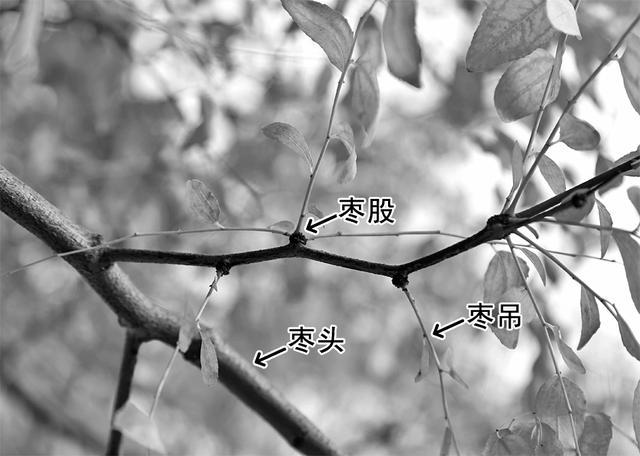
In summary, the jujube tree has 3 types of branches and 2 types of buds. The branches are the jujube head (vegetative shoot), jujube stock (bearing mother branch), and jujube hanging (bearing branch) (Figure 1). Buds are divided into main buds and accessory buds.
Figure 1 The 3 types of branches of the jujube tree
The jujube head is the only important vegetative branch capable of elongating and expanding; the tree growing taller, the canopy expanding, and the formation of the fruiting branch system all depend on the growth and development of jujube head branches. Unlike fruit trees such as apple, the jujube head branch of the jujube tree does not emerge as a single shoot; rather, as soon as it sprouts, secondary branches are produced from each node as the main axis elongates. The first one or two nodes at the base of the jujube head branch are deciduous or semi-lignified jujube hangings, while the secondary branches at the remaining nodes are all permanent branches that bend in a zigzag shape. Each node of the secondary branches bears jujube stocks (bearing mother branches), so they are called bearing basal branches. The terminal 1-2 nodes of the secondary branch have no ability to thicken and generally die back. The annual growth of the jujube head depends on tree age, tree vigor, and position of attachment. Generally, the annual growth of young trees and vigorous trees can reach 100-150 cm, and that of mature trees 40-50 cm. The jujube heads at the tips of scaffold branches (the scaffold branches of the jujube tree are formed by the continuous extension of jujube head branches.) and on the outer periphery of the canopy generally have larger growth; newly emerged jujube heads in dominant positions or stimulated by heading cuts often also have relatively large growth. When tree vigor declines to a certain extent, the jujube head branches may even fail to produce decent secondary branches.This kind of jujube head branch mostly has no utilization valueand generally should be removed.
The jujube stock is the main bearing site of the jujube and is mainly borne on each node of the secondary branches. One to several bearing branches (jujube hangings) emerge from the jujube stock, and the jujube stock is called the bearing mother branch. In fact, the jujube stock is an extremely compressed jujube head branch, and its structure is the same as that of the jujube head. The only differences are that the leaves have metamorphosed into scales, the jujube hangings produced are equivalent to secondary branches, and the main buds in the leaf axils remain dormant and do not sprout. The annual growth (elongation) of the jujube stock is very small; the number of jujube hangings that emerge indicates how many nodes the jujube stock has elongated. The terminal bud of the jujube stock and the latent main buds on its sides sometimes also reverse and grow into relatively strong jujube head branches. This further shows that the structure of the jujube head branch and the jujube stock is the same.
The jujube hanging, namely the deciduous branch, is the bearing branch of the jujube. From the beginning of sprouting, flower buds differentiate in the leaf axils as it grows; except for the first 1-2 nodes at the base of the jujube hanging, which bear a single flower, all the remaining nodes bear inflorescences with varying numbers of flowers.
The buds of the jujube are divided into main buds and accessory buds, and the "division of labor is clear": main buds produce jujube heads and jujube stocks, while accessory buds produce secondary branches and jujube hangings. Main buds can remain dormant for several years without sprouting, while accessory buds have early maturity and sprout as soon as they are produced. Therefore, on the jujube tree one can only see the derivatives of accessory buds (secondary branches and jujube hangings), but cannot see the accessory buds themselves. It is worth noting thatthe terminal bud of the jujube head branchhas both the form of a bud and is plump and full; the jujube head branch produced from it is the basis for the tree growing larger, forming scaffold branches, and forming the canopy. If this branch does not need to elongate further, it is only necessary to cut off the terminal bud.
2 Jujube Tree Structure and Training and Pruning Techniques
The tree structure of the jujube tree is relatively simple. Generally there is a trunk 100-150 cm high (except for specialized dense-planting jujube orchards); at the top of the trunk are borne 3-4 or 4-5 scaffold branches (also called main branches). On the scaffold branches are directly borne several fruiting branch systems formed by jujube head branches. These fruiting branch systems are borne on both sides of the scaffold branches, alternating long and short, all slanting or spreading horizontally. The long ones are formed by the continuous elongation of jujube head branches for 2-3 years, with a length of about 100-150 cm. The short ones are formed by one-year-old jujube heads, with a length of about 50 cm. The density of the fruiting branch systems depends on the tree space. The principle is a spacing of at least 30 cm between branches to maintain good ventilation and light penetration conditions.
2.1 Trunk determination
After planting, the jujube tree should not be cut back to determine the trunk. The reasons: first, after planting, it depends on the jujube head branch at the tip to grow taller and expand the canopy. Second, because the root system of a newly planted tree has not yet restored its absorption function, growth and branching depend entirely on the stored nutrients of the sapling. If the trunk is cut back to force the main buds in the leaf axils to sprout and produce branches, it will intensify the nutrient conflict, causing the jujube head branches produced to grow poorly. According to experiments by jujube growers in Cangzhou, Hebei Province, only after a 3 cm trunk diameter Jinsixiaozao jujube tree is cut back can it simultaneously produce 3-4 jujube heads, and only after 3-4 years after planting can the jujube tree reach a trunk diameter of 3 cm.
For the jujube tree, the suitable method of trunk determination is "chasing" the trunk, that is, removing secondary branches year by year from bottom to top until the trunk height standard is reached (during this period, any jujube head branches sprouting at the base of the tree and on the trunk must be removed). To accelerate orchard establishment, large seedlings can be cultivated in the nursery; in the future, planting large seedlings that have branches and a well-determined trunk can enter the fruiting period relatively quickly after recovering from transplanting.
2.2 Cultivating scaffold branches
When the jujube tree grows to a certain stage, jujube head branches will sprout in the canopy; as long as they grow robustly, have a suitable orientation, and emerge from the base of secondary branches on the central axis, they can all be utilized. For new jujube head branches, the terminal bud must be protected, and at the same time the thin and weak secondary branches should be removed, so that the jujube head extends and grows year after year, thereby forming robust scaffold branches. It is worth noting that jujube head branches sprouting from each node of secondary branches cannot be trained into scaffold branches. This is because the thickening of the secondary branch is not consistent with that of the jujube head branch, and the secondary branch segment is very easy to break, causing the trained scaffold branch to break.
Another method is to stimulate jujube head branches and then train them into scaffold branches. During the dormant period, head back the jujube head branch in the central position, with the cut at the thickest and strongest secondary branch, and at the same time remove the two secondary branches below the cut (the second secondary branch is the orientation for future scaffold branch training). The following year, generally two jujube head branches will emerge; the first grows upright and continues to extend; the second grows obliquely and is trained into a scaffold branch. It must be emphasized that when heading back the jujube head, the secondary branches below the cut must be removed at the same time; otherwise the main bud will not sprout and produce a jujube head branch. This is what jujube growers call "the jujube bears fruit with one cut, and grows branches with two cuts." [Jishan Huayao]
2.3 Cultivation of fruiting branch systems
The fruiting branch system of the jujube is equivalent to the large and medium-sized fruiting branch groups of apple, arranged in rows and slanting on both sides of the scaffold branches. The large and small alternating fruiting branch systems on the scaffold branches are likewise formed by jujube head branches. If a jujube head branch is pinched at the terminal bud (or together with the terminal 1-2 secondary branches) when it grows to 40-50 cm, a stable medium-sized fruiting branch system is formed. If a jujube head continuously elongates for 2-3 years before the terminal bud is removed, a relatively large fruiting branch system is formed. The fruiting branch systems arranged on the scaffold branches are required to be well-arranged and orderly, neither sparse nor dense, maintaining good ventilation and light penetration conditions. During the young tree stage, it is even more important to prefer sparse over dense. The jujube stocks on the many fruiting branch systems are the main bearing sites. Therefore, the condition of the fruiting branch systems is very closely related to high yield or otherwise.
2.4 Methods of pruning jujube trees
To sum up, pruning jujube trees mainly uses the techniques of thinning and heading back. From the young tree stage to the fruiting stage, useless jujube head branches must be removed every year, especially jujube head branches inside the canopy that affect the growth of scaffold branches and those on the outer periphery of the canopy that affect ventilation and light penetration, which must all be removed. Invalid secondary branches at the base of fruiting branch systems must also be removed in time.
There are two situations requiring heading back: first, when the jujube head branch does not need to extend and expand further, it is only necessary to cut off the terminal bud. Second, when the branch tip weakens and droops, new jujube head branches will sprout in dominant positions; at this time, cut off the drooping branch segment to complete the renewal of the old branch. In addition, timely pinching of the jujube head during the young tree stage can plump the main buds at the base of secondary branches; winter heading back plus removal of secondary branches can stimulate robust jujube head branches, thereby accelerating canopy formation. Furthermore, if while pinching the jujube head one also removes the terminal 1-2 nodes of the secondary branches and then pinches off the terminal 2-3 nodes of the jujube hangings, it can increase the fruit-setting rate and enlarge fruit size, and can serve as an effective measure for early high yield of young trees.