Symptoms, Occurrence Patterns and Causes of Pear Brown Spot Disease and Its Control Measures
Symptoms and Patterns of Pear Brown Spot Disease, Causes of Occurrence and Control Measures
1 Symptoms and Patterns of Occurrence
1.1 Symptoms
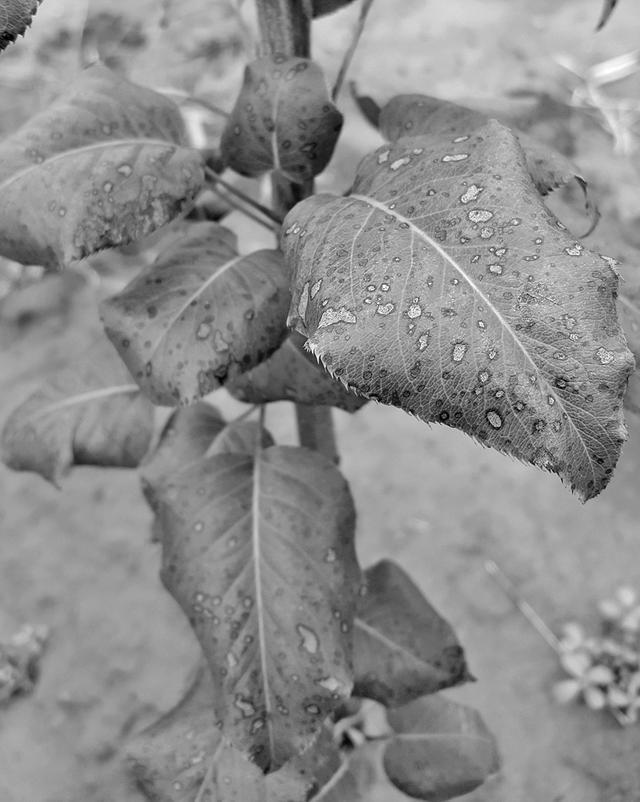
In the early stage, the leaves of affected pear trees show grayish-white dot-like spots measuring 1-2mm with clear edges, which gradually expand and develop into elliptical or irregular large lesions with a grayish-white center, brown surrounding area and black outer layer (Figure 1). In severe cases, the number of lesions on a single leaf can reach dozens, with dense black dots on the lesions. In the later stage, the center appears grayish-white, the surrounding area brown, and the outer layer black, and the diseased leaves tend to fall off.
1.2 Occurrence Patterns
Brown spot disease is a fungal disease, which overwinters on diseased leaves as perithecia or pycnidia. After rain in the following spring, spores are produced, and once mature, they are spread by wind and rain and adhere to leaves. The incubation period for leaf infection is generally 5-12 days, with a maximum of 45 days. When conditions are suitable, the spores germinate and invade the leaves, causing primary infection, and produce conidia on the leaves for re-infection. Moisture is an essential condition for the overwintering pathogens to produce and spread spores. Neither dry nor rotted diseased leaves can produce conidia [1].
From leaf unfolding to leaf drop in pear trees, brown spot disease can be observed throughout the entire growing season. Generally, the disease is more severe locally from May to June. Among varieties, the Xuehua pear of the white pear system (Pyrus bretschneideri) is most severely affected.
Figure 1 Symptoms of brown spot disease on leaves
2 Causes of Occurrence
2.1 Excessive Rain
Excessive rain is the main condition for the epidemic of pear brown spot disease. During the rainy season, high humidity and high temperature easily induce pear brown spot disease. Excessive rain also affects the ultraviolet sterilization and inhibition effect of sunlight. For example, from July to September 2015, the number of rainy days in Liaocheng reached 13, 14 and 7 days respectively. In particular, from July 14 to 18, there were 5 consecutive days of overcast and rainy weather, and the orchard was in a high-humidity environment for a long time, resulting in severe spread and infection of brown spot disease.
2.2 Closed Orchard Canopy
Pear orchards in Liaocheng basically all adopt close-planting cultivation. In addition, fruit growers leave too many and too large branches during shaping and pruning and do not pay attention to summer pruning, resulting in a closed orchard canopy and poor ventilation and light transmission conditions, so that moisture in the orchard cannot be effectively discharged and the orchard remains in a high-humidity environment for a long time, causing severe occurrence of brown spot disease.
2.3 Unreasonable Fertilization
In production, many fruit growers, in pursuit of maximizing short-term pear orchard yield, often apply excessive nitrogen fertilizer and neglect the application of phosphorus, potassium and organic fertilizers, resulting in unbalanced fertilization. This not only reduces the taste of pear fruit, but also seriously affects the normal growth of pear trees, reduces the disease resistance of the tree body, and leads to the occurrence of brown spot disease.
3 Control Methods
3.1 Manual Control
Orchard cleaning. ① Post-autumn orchard cleaning. The pathogens of brown spot disease mainly overwinter on fallen leaves. After leaf drop, promptly remove fallen leaves in the orchard and bury them deeply or burn them in a centralized manner. This is a simple, easy and extremely effective and reliable method to eliminate the pathogen and control pear brown spot disease. ② In-season orchard cleaning. Promptly remove weeds in the pear orchard to ensure ventilation and light transmission. During the growing season, promptly remove diseased leaves and diseased fruits and prune diseased shoots in the pear orchard, and burn them in a centralized manner.
Scientific fertilization. Increase the application of organic fertilizer and phosphorus and potassium fertilizers to maintain vigorous tree growth and improve disease resistance. Base fertilizer should be applied after harvest and before leaf drop, mainly with fully decomposed organic fertilizer, combined with an appropriate amount of chemical fertilizer and trace element fertilizer, with balanced fertilization. The amount of base fertilizer should reach 70%-80% of the total annual fertilizer application. Fertilizer applied at the flower bud stage should account for 20%-30% of the annual fertilizer application. For every 50kg of pears produced, 0.20-0.25 kg of pure nitrogen is required, and the ratio of nitrogen, phosphorus and potassium is 1:0.5:1 [2].
Drainage. Pay attention to drainage in the pear orchard after rain to reduce humidity in the orchard and reduce the occurrence and spread of the disease.
Reasonable pruning. Strengthen pear orchard management. For trees with excessive load, promptly thin flowers and fruits; for orchards with excessive planting density, carry out thinning; for trees with excessive branches and leaves, promptly prune and remove excessively vigorous, overly dense and inner canopy branches to improve ventilation and light transmission conditions of the tree body and avoid shading by branches and leaves.
3.2 Chemical Control
In early spring during the leaf expansion stage of pear trees, in early to mid-April, in combination with the control of pear rust, spray Bordeaux mixture once every about 10 days for 3 consecutive times, with a ratio of 1:2:200. In the rainy season, spray Bordeaux mixture once more, with a ratio of 1:2:240. After pear trees bloom, spray 70% thiophanate-methyl suspension concentrate at 800 times dilution or 50% benomyl wettable powder at 1500 times dilution, once every 15-20 days, generally 2-3 sprays, which can achieve good control effects. In addition, 50% carbendazim wettable powder at 800 times dilution and 12.5% tetraconazole at 2500 times dilution have good effects on controlling brown spot disease with no phytotoxicity, and are currently ideal agents for controlling pear brown spot disease [3].