Effects of Girdling and Ring-Barking on the Yield and Quality of Young Grey Jujube Trees
Effects of Girdling and Ring-Barking on the Yield and Quality of Young Grey Jujube Trees
Girdling and ring-barking of jujube branches and trunks are commonly used measures to increase the fruit-setting rate. Ring-barking and ring-cutting have a certain retarding effect on the downward transport of leaf photosynthates along the tree body, affecting the growth and absorption of the root system; they can control vegetative growth, promote flower formation and fruit setting, and improve yield and fruit quality. Because jujube growers lack adequate understanding and technical implementation of girdling and ring-barking of jujube trees, the fruit-setting rate is low, affecting yield and economic returns. In 2016, the author conducted girdling and ring-barking experiments on young grey jujube trees to provide a theoretical basis for selecting suitable and effective techniques for production.
1 Overview of the Experimental Site
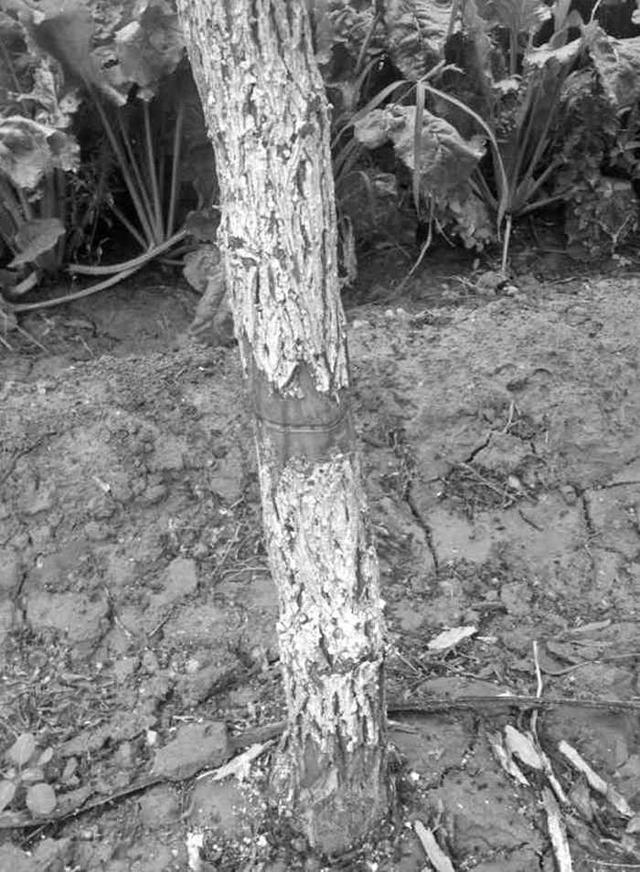
The experimental site was set up in the 100,000-mu Ecological Park in Wensu County, Aksu Prefecture, Xinjiang, with sandy loam soil and a low groundwater table. In 2010, a sour jujube orchard was established by direct seeding, with an area of 2 hm2 (30 mu), a plant-row spacing of 0.75 m x 2 m, and 444 plants planted per 666.7 m2. In 2011, grey jujube was grafted, and in that year the plants reached a height of 1.7 m; the main variety was grey jujube. Water-saving irrigation was adopted, with a small-crown, open-layer tree shape. In 2016, the trunk diameter was 6.3 cm, and trunk girdling and ring-barking experiments were carried out (Figure 1, Figure 2).
Figure 1 Ring-barking method on the main trunk of grey jujube
2 Experimental Design and Methods
Plants with uniform growth and consistent size were selected for the experiment, and girdling and ring-barking were performed at a height of 30 cm on the main trunk. A total of 5 treatments were set up in the experiment: Treatment (1) one girdling cut, performed in mid-June at full bloom. Treatment (2) two girdling cuts: after girdling in mid-June at full bloom, a second girdling cut was made 7-10 days later at 5 cm above the first girdling cut. Treatment (3) three girdling cuts: after the first and second girdling cuts, a third girdling cut was made 7-10 days later at 5 cm above the second girdling cut. Treatment (4) ring-barking: one ring-bark was made in mid-June at full bloom, with a bark-removal width of about 0.5 cm [1]. Treatment (5) control: no girdling, no ring-barking. Each treatment had 10 trees.
The ring-bark and girdling cuts were flat, straight, and complete, with no frayed edges (Figure 1, Figure 2). Within 8 hours after treatment, Guofukang was applied to the wounds to promote healing and prevent the occurrence of pests and diseases. Water and fertilizer management were strengthened to ensure nutrient supply to the tree body.
Figure 2 Girdling method on the main trunk of grey jujube
Investigation: on each young grey jujube tree, one south-facing lateral branch about 2 cm in diameter was selected at a height of 1 m and tagged with a label. On July 5, the number of bearing shoots, number of inflorescences, and number of fruit set per inflorescence were investigated; on October 20 at harvest, the number of fruit set, single-fruit weight, number of marketable fruits, number of deformed fruits, number of cracked fruits, fruit edible rate, etc. were investigated. For each treatment, 3 kg of semi-dried jujubes were randomly picked. Single-fruit weight was measured with an electronic scale with an accuracy of 0.01 g.
Inflorescence fruit-setting rate (%) = number of fruit set per inflorescence / number of inflorescences x 100
Fruit-to-bearing-shoot ratio = number of fruit set per inflorescence / number of bearing shoots
Marketable fruit rate (%) = number of marketable fruits in the sample / total number in the sample x 100
Number of marketable fruits = number of fruit set - number of deformed fruits - number of cracked fruits
Deformed fruit rate (%) = number of deformed fruits in the sample / total number in the sample x 100
Cracked fruit rate (%) = number of cracked fruits in the sample / total number in the sample x 100%
Edible rate (%) = (sample weight - jujube pit weight) / sample weight x 100
Fruit drop rate (%) = (number of fruit set per inflorescence - number of fruit set) / number of fruit set per inflorescence x 100
3 Results and Analysis
3.1 Effects of Girdling and Ring-Barking on Fruit Setting of Grey Jujube
Table 1 shows that, compared with the control, trunk girdling and ring-barking of grey jujube can all increase the fruit-setting rate and fruit-to-bearing-shoot ratio while reducing the fruit drop rate. The order of effect from greatest to smallest was: one ring-bark, three girdling cuts, two girdling cuts, one girdling cut, control. For inflorescence fruit-setting rate, the girdling and ring-barking treatments were all significantly higher than the control (5.16%); one ring-bark (14.28%) and three girdling cuts (12.54%) showed no significant difference but were significantly higher than two girdling cuts (11.55%) and one girdling cut (10.48%); three girdling cuts and two girdling cuts showed no significant difference but were significantly higher than one girdling cut; two girdling cuts and one girdling cut showed no significant difference. For fruit-to-bearing-shoot ratio, the effects among treatments were the same as for inflorescence fruit-setting rate. For fruit drop rate, the control (22.73%) was the highest and showed no significant difference from one girdling cut (21.24%); the lowest was one ring-bark (5.69%), significantly lower than three girdling cuts (13.55%), and three girdling cuts was in turn significantly lower than two girdling cuts (15.63%).
Table 1 Effects of girdling and ring-barking on fruit setting of grey jujube
Note: Different lowercase letters beside the numbers in the same column in the table indicate P<0.05水平差异显著。对照生长后才发现树势较弱,枣吊数少。
The investigation results showed that during ring-barking treatment, the healing time of the ring-bark wound was long, and its interception effect on the downward transport of leaf photosynthates was the greatest; a greater number of girdling cuts made in stages resulted in a longer wound healing time than fewer girdling cuts, and a greater interception effect on the downward transport of photosynthates [2].
3.2 Effects of Girdling and Ring-Barking on the Quality of Grey Jujube
Table 2 shows that, compared with the control, trunk girdling and ring-barking of grey jujube can improve fruit quality, but the effects of the treatments showed no regularity. For improving single-fruit weight, ring-barking was greater than girdling: one ring-bark (7.90 g), two girdling cuts (6.49 g), one girdling cut (6.45 g), three girdling cuts (6.28 g), control (4.05 g). The order of marketable fruit rate from high to low was one ring-bark (90.52%), one girdling cut (90.12%), two girdling cuts (88.66%), three girdling cuts (88.27%), control (64.29%). The order of deformed fruit rate from high to low was control (18.57%), two girdling cuts (6.19%), one girdling cut (5.73%), one ring-bark (4.31%), three girdling cuts (3.35%); the order of cracked fruit rate from high to low was three girdling cuts (6.15%), control (4.29%), one girdling cut (4.05%), ring-barking (2.59%), two girdling cuts (2.06%); the edible rate of the treatments and the control ranged from 93.42% to 94.44%, with little difference. The deformed fruit rate of each treatment was lower than that of the control, and the cracked fruit rate of each treatment was also basically lower than that of the control.
Table 2 Effects of different girdling frequencies on fruit quality
Note: Only 3 kg was randomly picked from the experimental jujube trees of each treatment; no per-tree picking investigation was carried out, and no test of significance of differences was performed.
4 Brief Summary
After girdling and ring-barking treatment of fruit tree branches and trunks, the downward transport of leaf photosynthates is temporarily obstructed, and nutrients accumulate in the upper part [3], which plays a certain role in promoting flower bud differentiation and fruit setting. Girdling and ring-barking treatment of 6-year-old young grey jujube trees can all promote fruit setting, reduce fruit drop, and improve fruit quality to varying degrees. The effect of ring-barking was better than that of girdling, and more girdling cuts were better than fewer girdling cuts. The effects of the treatments on quality indicators such as single-fruit weight, marketable fruit rate, deformed fruit rate, cracked fruit rate, and edible rate showed no obvious regularity. A relatively economical and effective method to promote flower bud differentiation and increase the fruit-setting rate is two girdling cuts, which is recommended for production. That is, at full bloom, make one girdling cut at a height of 30 cm on the main trunk, deep to the xylem, and make a second girdling cut 7-10 days later, with a spacing of more than 5 cm between girdling cuts. For trees with weaker growth, do not carry out girdling or ring-barking, or carry out at most one girdling cut.