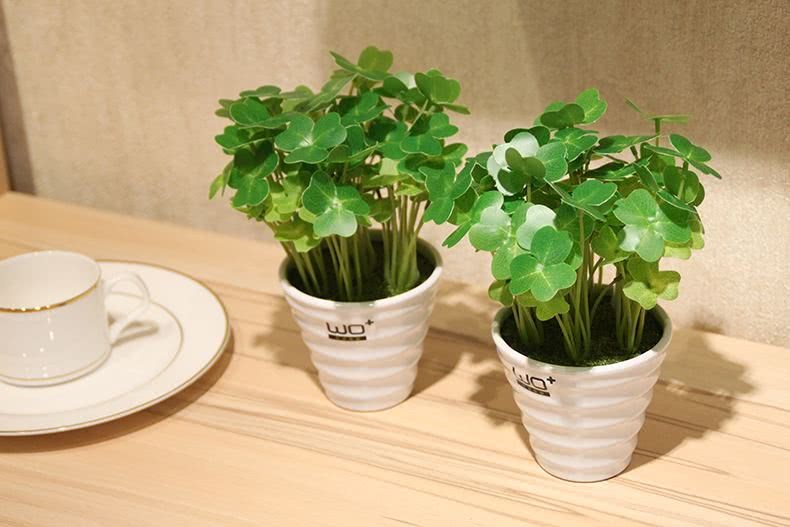
When a clover grows four leaves, it symbolizes happiness. Did you ever find one as a child?
Abstract: When caring for flowers, gardening friends may discover that all-purpose soil is not the only condition for growing flowers. Many plants may grow even more vigorously when cared for through hydroponics! But if you pay a little attention, none of this is hard to do, and your flowers will also grow quickly and be full of life!
Can clover be grown hydroponically?
1. Moderate, gentle light
Clover is the lucky plant. Find a four-leaf clover and you can find luck/happiness! As a child, a group of friends would often go looking for them. Those who found one cheered joyfully, and those who did not seemed to feel a little regret. Did you ever look for one as a child? Why not grow a pot at home ourselves and recall that childhood game?
Slightly acidic soil is most suitable for its growth, and hydroponically grown clover is even more fresh green and lovely. The premise is that hydroponic clover likes bright light, and ample, warm light is most suitable. Strong direct light is absolutely not allowed, so be sure to protect it from strong light, otherwise the clover will wilt and develop yellow leaves, which is very unfavorable for the plant's growth.
Beautiful clover
2. Plenty of water
For lush, lively hydroponic clover, the most critical point is water control. It is neither hard nor easy, neither simple nor complicated. Remember that when caring for clover hydroponically, you must not add too much water at one time, as this is not good for its growth. The water level is best kept at about 2 cm, just barely covering the roots. Spraying water once a day is essential; simply spray water directly on its leaves to keep them fresh green while also moistening the surrounding environment.
3. Frequency of changing the water
Hydroponic clover has greater ornamental value, and when well watered it looks even more spirited! At the same time, gardening friends must not change its water too frequently, but they should still change it moderately. The main reason is that water left unchanged for a long time breeds a large amount of organic matter, which most easily leads to root rot, and over time the leaves will also turn yellow and become barely alive. To avoid this situation, changing the water once a week is crucial. This important step cannot be ignored. If you want a pot of vigorous clover, be sure to remember it.
Pretty clover
4. Caring with ceramic pellets
Many gardening friends may not know that using ceramic pellets to care for clover is indeed a good method. If we want to grow it with ceramic pellets, we cannot just add them carelessly; we must wait until the water dries, then add them. Growing it with ceramic pellets is also a very good method, and it will not grow slowly; its speed is still very fast.
5. Humidity
Clover is suitable for growing in a relatively moist and suitable environment. Controlling the humidity needed for its growth is very important. Humidity should not be too low. Clover under lower humidity most easily develops yellow leaves, which is extremely unfavorable for the growth of clover and may even affect its spread and reproduction.
Clover