What kind of succulent plant is Orostachys spinosa?
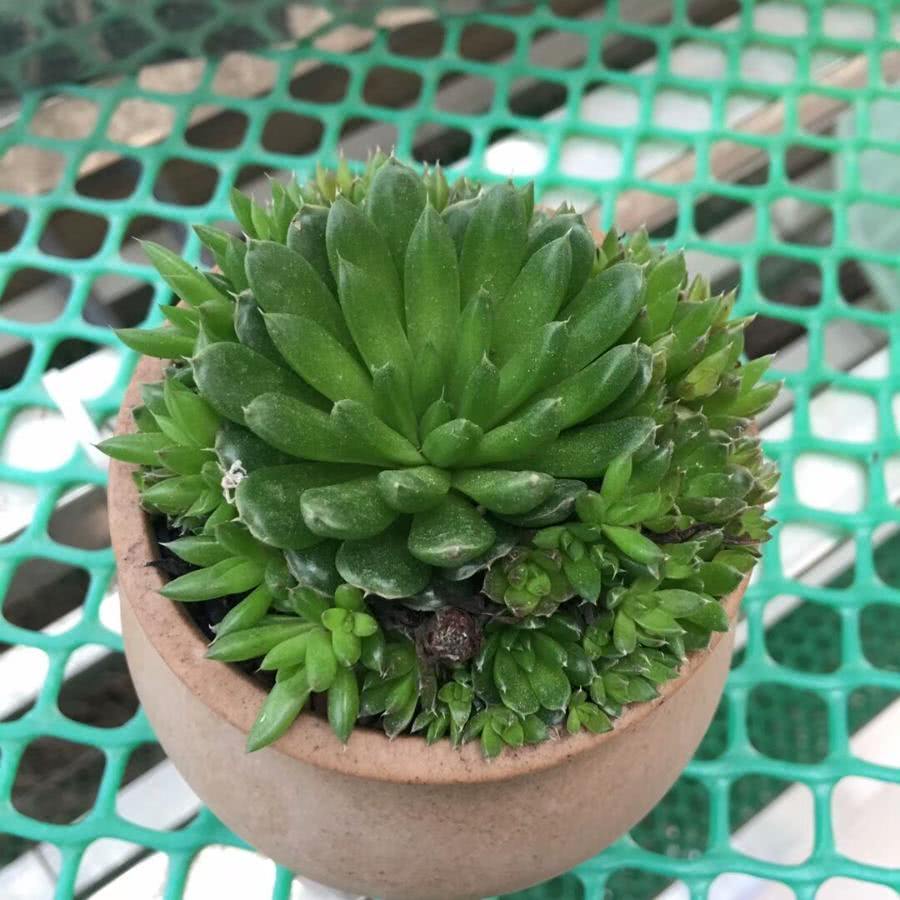
Orostachys spinosa: A biennial herbaceous plant in the genus Orostachys, family Crassulaceae. In the first year it forms a rosette, with pale green, linear-oblong leaves; in the second year a flowering stem extends from the center of the rosette, reaching up to 20 cm in height; the stem leaves are more or less separated, with cartilaginous mucronate tips. The inflorescence is a raceme, the bracts ovate-oblong, the sepals triangular-ovate, the petals white or tinged with pale red, oblong, the scale-like nectaries nearly square to nearly rectangular, the follicles erect; the seeds are small and ovate. It flowers in July-August.
Orostachys spinosa
In China it is distributed in Tibet, Xinjiang and Gansu. It is also found in Mongolia and the Soviet Union. It grows on dry mountain slopes or sunny mountain slopes at elevations of 1000-2100 m. This species has outstanding ornamental value and can be used as a flowerbed plant on hillsides, in rock gardens or on rooftops, making it a wild flower with considerable development potential.
Orostachys spinosa
Pest and disease control:
There are few pests and diseases. When air humidity is too high during the rainy season, spray once with carbendazim or thiophanate-methyl, etc., to prevent powdery mildew. When used as ground cover or in flower borders, because the stand becomes dense after establishment, the plants are crowded and ventilation is poor, making them prone to damage by greenhouse whitefly; spray with 10% imidacloprid wettable powder at 1000 times dilution or 25% buprofezin wettable powder at 1500 times dilution, once every 5-7 days, for 2 consecutive sprays, to control it.
Orostachys spinosa
Ornamental:
Around the Dragon Boat Festival, the bulbs grow to the size of a thumb; harvest them with the roots and plant them in clusters in small pots, and place them on a balcony for a very charming effect. Especially when tied with string and hung bare indoors, they grow into a U shape and make a very unique indoor decoration. The outer surface of the scales contains wax, which protects against water evaporation. In dry, water-scarce seasons, the water stored in the scales supplies the stems and leaves for normal growth until the water is used up, and the bulb withers, completing its growth cycle.
Medicinal:
The whole plant is used medicinally and has the effects of stopping bleeding, promoting blood circulation and healing sores. However, it is mildly toxic and should be used with caution.