Classic foreign varieties of climbing roses, beautiful beyond belief with just one planted on a balcony
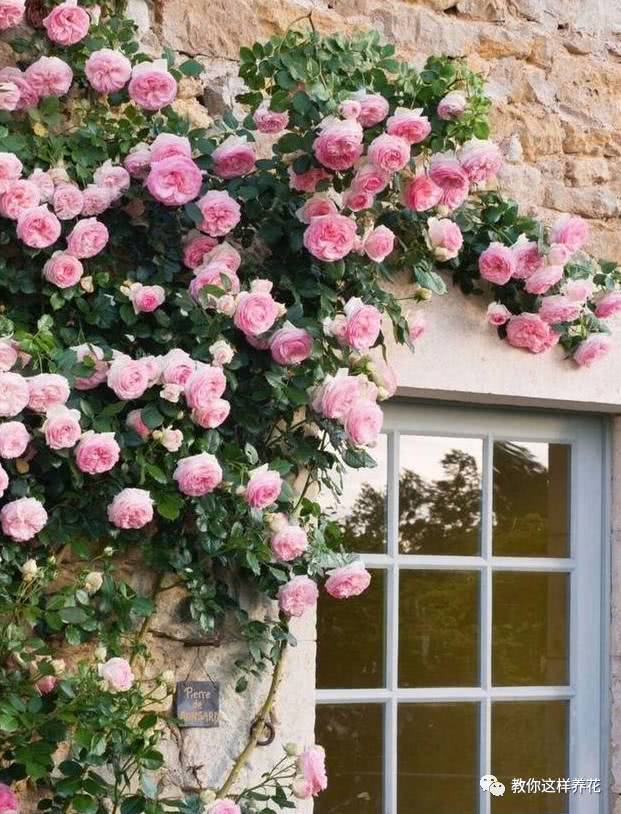
Climbing roses have brilliant colors, large and fragrant flowers, and a long blooming period, and there are many varieties with a full range of colors, including red, pink, yellow, white, orange, purple, edged colors, solid colors, bicolor front-and-back, and so on, extremely rich, with flower shapes including cupped, spherical, flat, high-centered, etc. They can climb over all kinds of well-ventilated trellises and pergolas, and can form flower balls, flower pillars, and flower walls, very beautiful, and are the first choice of many flower lovers. Today I will introduce several classic climbing rose varieties, and I hope you like them.
“
Climbing Roses
”
Climbing Roses (CL series for short), with plants that are vine-like and trailing, climbing by relying on other objects or growing prostrate on the ground. They bloom repeatedly or only once. Flowers may be single, semi-double, or double, with rich and varied colors, flower diameter 2.5~8 cm, some fragrant, some not fragrant.
Climbing roses can be classified in many ways. By growth characteristics they are classified as upright and climbing types, and by flowering habit they are divided into two major categories: once-blooming and repeat-blooming.
Once-blooming series: created in the early 19th century by crossbreeding and selecting from our country's China rose, tea rose, hybrid Bourbon rose, and hybrid tea rose.
Repeat-blooming series:
Climbing Hybrid Tea Rose: including a small number of climbing hybrid spring roses, this strain is derived from bud sports of the corresponding hybrid tea roses and hybrid Bourbon roses. Famous climbing varieties include: 'Climbing Peace', a bud sport of 'Peace'; 'Climbing Crimson Glory', a bud sport of 'Crimson Glory'; 'Climbing Perfect Ten', a bud sport of 'Perfect Ten'; 'Climbing Caiyun', a bud sport of 'Caiyun'; 'Huaxia', a bud sport of 'Samantha'; 'Kunteng', a bud sport of 'Kunteri', etc.
Climbing Floribunda Rose: famous varieties of this strain include 'Climbing Braveheart', 'Angela', 'Huaxian', 'Huanteng', 'Wolong', 'Qijing', 'Red Wolong', etc.
Climbing Grandiflora Rose: derived from bud sports of the grandiflora rose series. 'Climbing Queen Elizabeth', 'Western Earth', 'Dortmund', 'Orange Flame', etc.
Large-flowered Climbing Rose: obtained by crossing hybrid Bourbon roses with hybrid tea roses, or by crossing Rosa wichuraiana with hybrid tea roses, belonging to a relatively new strain. Varieties in this strain include 'Guangpu', 'Dushutai', 'Parade', 'Lan Yueiliang', 'Germany Venus', 'Casino', 'White River', etc.
Cold-hardy Climbing Rose: a hybrid of our country's Rosa wichuraiana and American cold-hardy roses. Famous varieties are 'American Pillar' ('Big-Flowered Seven Sisters'), and cold-hardy varieties also include 'Mozart', 'Royal Carriage', 'Chang'e Flying to the Moon', 'Summer Camp', etc.
Climbing Miniature Rose: derived from bud sports of the miniature rose series. Varieties in this strain include 'Xishui', 'Climbing Rainbow', 'Climbing Meillandina', 'Galaxy', 'Golden Sunshine', 'Climbing Red Gem', 'Climbing Purple Age', 'Climbing Hula Girl', 'Sweet Dream', etc.
Eden Rose
Chinese name: Eden Rose ⟧17⟧Latin name: Pierre de Ronsard
Latin name: Pierre de Ronsard
Aliases: Rose Eden 85/Rose Eden 88
Registered name: Meiviolin
Breeder: Meilland
Year and place of introduction: 1987 (France)
In the early 1980s, the world-renowned rose company Meilland International of France bred a very unique rose. It had elegant colors and a classic flower shape, yet it nearly came close to being abandoned because it did not fit the aesthetic trends of the time. In 1985, the company's distributor in Germany seized the opportunity to bring it to market first and achieved great success. This variety also became widely known and much loved for winning the title "world's favourite rose" at the 2006 World Rose Convention in Osaka, Japan. In memory of the French rose poet "Pierre de Ronsard", the variety was named after him, and it is the "Eden Rose" we are familiar with today.
Flower diameter 8~10 cm, petal count greater than 80, purplish red or dark red, cupped, flower surface flat, with a slight fragrance when temperatures are high. Blooming period: late March to December in the southern subtropical regions, May to October in the north, individual flowers lasting 5~7 days, repeat-flowering habit, with flower quantity noticeably reduced in summer and winter.
Eden Rose is never tiresome to look at, especially that touch of faint red beneath the pink exterior, simply the most captivating!
Bajazzo
Bajazzo - (Germany, deep pink, climbing, 2011)
Bred by: 2011 Germany, W. Kordes & Sons
In 2011 W. Kordes' Sohne (Retail) introduced it in Germany under the name "Bajazzo".
Category: Climbing
Deep pink, silver reverse, yellow stamens, gradually becoming light pink. Mild fragrance. Medium-large, semi-double (9-16 petals) bloom form. Blooms repeatedly in multiple seasons.
Branches climbing, loose. Leaves large, glossy, dark green.
Height can reach 220 cm.
Can be grown as a shrub.
Parentage: unknown.
This variety won multiple international awards in 2011.
In 1961 there was a variety with the same name "Bajazzo" - (Germany, HT red blend, 1961)
Bajazzo
New Dawn - (USA, climbing, pink, 1930) also called Pink Cloud
The New Dawn
Light pink, large-flowered climbing
Registered name: New Dawn
Discovered: 1930 USA, Somerset Rose Nursery
In 1930 Henry A. Dreer introduced it in the USA under the name "New Dawn".
Category: Climber, Hybrid Wichurana, Large-Flowered Climber.
Light pink. Mild fragrance. 35 petals. Average diameter 10 cm, medium-sized, double (26-40 petals), mostly borne singly, in clusters, small groups, flat. Blooms repeatedly in multiple seasons.
Branches arching, climbing. Leaves medium, glossy, dark green.
Height 305 to 610 cm, width 245 cm.
Cold hardiness: USDA zones 9B-5B. Can be used for cut flowers, garden or pillar. Cold hardy. Very vigorous. Tolerant of shade. Disease susceptibility: very disease resistant.
Crown Princess Margareta
Crown Princess Margareta
Bred by: 2000 UK, David Austin.
Category: English Rose [Austin], Shrub.
Apricot or apricot blend. Strong fruity, tea rose fragrance. Average diameter 10 cm. Medium to large, (41+ petals). Pointed, ovoid buds. Blooms repeatedly in multiple seasons.
Habit: medium, dense, climbing. Height 120 to 185 cm, width 120 cm.
For climbing, cut flowers, garden, pillar or shrub
Parentage: Seedling x Abraham Darby
Origin of the name: Crown Princess Margareta of Sweden was a granddaughter of Queen Victoria and an excellent garden expert. Together with the Crown Prince (later King Gustavus VI Adolfus of Sweden), she created the famous Swedish summer villa Sofiero in Helsingborg. On June 15, 1905, Princess Margareta married the Crown Prince, and on May 1, 1920, Crown Princess Margareta passed away. When Gustavus VI ascended the throne on October 29, 1950, he was already at retirement age (68), but he lived long and still reigned as king for 22 years, until his death in 1973. So although Crown Princess Margareta bore many children for the king, she never truly became Queen of Sweden before her death, and was only posthumously granted the title.
Laguna
Laguna - (Germany)
Commercial alias: KORadigel
Deep pink, large-flowered climbing.
Registered name: KORadigel
Exhibition name: Laguna
Bred by: 1995 Germany, Tim Hermann Kordes.
In 2004 W. Kordes' Sohne (Retail) introduced it in Germany.
Category: Climber, Large-Flowered Climber.
Deep pink. Strong fruity, spice fragrance. 45 to 55 petals. Average diameter 7 cm. Medium, very full (41+ petals), in clusters, small clusters, cupped open form. Ovoid buds. Blooms repeatedly in multiple seasons.
Branches climbing, upright. Leaves medium, glossy, dark green, dense. 7 leaflets
Height 250 cm, width 100 cm.
Cold hardiness: USDA zones 9b~5B.
For climbing, cut flowers, garden or pillar.
Disease susceptibility: very resistant to black spot. Very resistant to mildew.
Seed: La Sevillana x Sympathie
Alchymist
Alchymist - (Germany, climbing, apricot, 1956)
Commercial aliases: Alchemist Alchimiste Alchymiste The Alchymist
Apricot or apricot blend
Registered name: Alchymist
Bred by: 1956 Germany, Reimer Kordes
Category: Climber, Large-Flowered Climber, Shrub
Yellow, orange edges. Strong fragrance. 40 petals. Average diameter 9 cm. Old-fashioned, quartered bloom form, blooms once in spring or summer.
Height 185 to 610 cm, width 185 to 245 cm.
Cold hardiness: USDA zones 4B - 9B. Can be used for cut flowers, garden, shrub or pillar. Cold hardy.
Disease susceptibility: very disease resistant, prone to black spot.
Parentage: Golden Glow (climber, Brownell, 1937) x hybrid of Rosa eglanteria L. synonym
Ines Sastre
Ines Sastre
Flower color: deep pink combined with white stripes.
Variety type: large-flowered climbing
Petal count: 100
Average bud diameter: 7-9 cm.
Height: 120-180 cm
Bred by Meilland of France in 2010, cupped clustered flowers, rounded open form, blooming season, buds blooming repeatedly and continuously. Fresh apple fragrance, almost thornless branches, strong climbing ability, dark green glossy leaves.
Charles de Mills
Charles de Mills
Commercial aliases:
? Ardoisée
? Bizarre Triomphante
? Maheca de Dupont
? Rosa gallica atropurpurea
? Rose Bleue (gallica, Unknown, before 1811)
? Violette Bronzée
Purplish red or purplish red blend.
Registered name: Charles de Mills
Bred by: before 1790 Netherlands, breeder unknown.
Category: Gallica / Provins
Dark red and red. Strong fragrance. Average diameter 12 cm. Large, full (26-40 petals), blooms once in spring or summer.
Thornless (or almost thornless) large fruit. Dark green foliage.
Height 100 to 150 cm, width 120 to 150 cm.
Cold hardiness: USDA zones 8B~4B.
Good shade tolerance.
Teasing Georgia
Teasing Georgia
Commercial aliases: AUSbaker; P/27/88; TG2476
(RNRS Trial Ground No.)
Medium yellow, shrub.
Registered name: AUSbaker
Exhibition name: Teasing
Georgia
Bred by: 1998 UK, David Austin.
Category: English Rose [Austin], Shrub. English Rose
[David Austin], Shrub.
Yellow. Strong fragrance. 41 petals. Average diameter 8 cm. Blooms repeatedly in multiple seasons.
Habit: height 120 cm, height 105 cm, can reach 180~240 cm when grown as a climber. Cold resistant, medium-strong tea rose fragrance. Good disease resistance and repeat blooming.
Parentage: Charles Austin
× Undisclosed
David Austin recommended variety
Won the 2000 R.N.R.S Fragrance (Henry Edland)
Yellow variety, cupped form. The petal center is a deep yellow cupped form, and the outer petals gradually fall back and become lighter, forming a charming bicolor effect. This variety grows vigorously.
The Royal National Rose Society of the UK classifies it as a Cluster-flowered Shrub. Origin of the name: named after Georgia, the wife of the famous German actor Mr. Ulrich Meyer.
Shropshire - A Shropshire Lad
A Shropshire Lad
Commercial alias: AUSled, L/58/88 (Austin)
Yellow blend, Shrub.
Registered name: AUSled
Exhibition name: A Shropshire Lad
Bred by: David Austin, UK, 1997.
Class: English Rose [David Austin], Shrub.
Gorgeous coloring, soft peach with a pink center. Strong fruity fragrance. 90 petals. Cupped, repeat-flowering.
Habit: Thornless (or nearly thornless). Glossy foliage.
Height 120 to 185 cm. Width 90 to 150 cm.
Parentage: Unknown
There is a climbing sport, A Shropshire Lad Climbing, which can reach 250 cm in height.
Origin of the name: Alfred Edward Housman (1859-1936) was a famous English poet and classical scholar of the early 20th century. His poetry collection, A Shropshire Lad, was published at his own expense in 1896. To commemorate the 100th anniversary of its publication, this famous Austin rose was named after the collection: A Shropshire Lad.
David Austin was born on the border of Shropshire, so he is a Shropshire lad himself.
Shropshire - A Shropshire Lad
Pink Leonardo da Vinci (France, Floribunda, light pink, 1993)
Commercial alias:
? Leonardo de Vinc
? MEIdeauri
Also known as: Léonardo da Vinci
Light pink, Floribunda rose
Registered name: MEIdeauri
Bred by: Alain Meilland, France, before 1993.
Introduced in 1994 by Meilland International in France under the name "Leonardo da Vinci".
Class: Floribunda. Floribunda. Romantica.
Bloom: Light pink. Bengal pink. Light tea fragrance. 75-80 petals. Average diameter 11 cm. Very large, very full (41+ petals), cluster-flowered, small clusters, old-fashioned, quartered bloom form. Prolific, continuous blooming across multiple seasons.
Habit: Medium, bushy plant, thornless or nearly thornless. Medium, glossy, dark green, dense, leathery foliage.
Hardiness: USDA zone 6B and warmer. Suitable for cut flowers, garden or landscape. Rain resistant.
In the south, choose Pink Leonardo da Vinci; in the north, choose the Parade variety.
Jasmina
Jasmina (Germany)
Commercial alias: Korcentex
Pink blend, Large-Flowered Climber.
Registered name: Korcentex
Exhibition name: Jasmina
Bred by: Tim Hermann Kordes, Germany, 1997.
Introduced in 2005 by W. Kordes' Söhne (Retail) in Germany.
Class: Climber, Large-Flowered Climber. Climber, Large-Flowered Climber.
Purple and pink. Moderate fragrance. 70 to 75 petals. Average diameter 7 cm. Medium, very full (41+ petals), large cluster-flowered, cupped, quartered rosette, rounded bloom form. Medium, rounded buds. Repeat-flowering across multiple seasons.
Tall, dense, climbing canes, well-branched. Medium, semi-glossy, medium green foliage.
Height 200 cm, width 100 cm.
Hardiness: USDA zone 9b to 5B
Use for climbing, cut flowers, garden or pillar.
Disease susceptibility: Resistant to black spot, resistant to mildew.
Parentage: Seedling × Centenaire de Lourdes
Golden Celebration
Golden Celebration
Commercial name: AUSgold
Registered name: AUSgold
Bred by: David Austin, UK, 1992.
Class: English Rose [David Austin], Shrub.
Deep yellow. Strong fragrance. 55 to 75 petals, cupped form. Repeat-flowering across multiple seasons.
Height: 120 to 150 cm, width 120 cm.
Parentage: Charles Austin × Abraham Darby
Phyllis Bide
Phyllis Bide (UK, Climber, yellow, 1923)
Yellow blend, Polyantha, Climber
Registered name: Phyllis Bide
Bred by: S. Bide & Sons, Ltd., UK, 1923.
Class: Climber, Polyantha, Cl..
Apricot-yellow, salmon pink, fading to pink. No fragrance or light fragrance. 15 petals. Average diameter 3 cm. Small, semi-double (9-16 petals), repeat-flowering across multiple seasons.
Climbing
Height 185 to 395 cm, width 150 to 185 cm.
Hardiness: USDA zone 6B-9B
Ploidy: Diploid
Parentage: Perle d'Or × Gloire de Dijon (Tea Noisette, Jacotot, 1850)
Angela
Deep pink, Floribunda rose
Class: Floribunda, Shrub. Floribunda, Shrub.
Medium, dense canes. Medium, glossy, medium green foliage.
Height 80-150 cm, width up to 80 cm.
Hardiness: USDA zone 5B and warmer. Suitable for containers, flower beds and borders, cut flowers or garden. Cold hardy. Vigorous.
Westerland
Cultivar name: Westerland
Bred when and where: Germany, 1969
Class: Climbing rose
Color range: Orange-yellow to orange-red
Fragrance intensity: Strong fragrance.
Plant: about 150-365 cm
Cold hardiness: USDA zone 5B to 9B
Bloom period: Blooms in all four seasons, more in spring and autumn; a single bloom lasts 10 days
Disease resistance: Yes (resistant to black spot, powdery mildew)
Parade
Cultivar name: Parade
Bred when and where: USA, 1953
Class: Floribunda climber
Color range: Intense pink
Fragrance intensity: Basically no fragrance
Plant: 2 m - 4 m
Climbing growth habit, well-developed root system, extremely strong resistance, rapid shoot growth, vigorous growth. A single plant produces 7-8 main canes per year, and each main cane branches openly; annual growth can reach up to 5 m. It has strong disease resistance. Easy to manage, tolerant of pruning, rich in flower forms, blooms continuously through all four seasons, with brilliant, bold colors, long bloom period and rich fragrance. The flowers are pink, sprouting from two-year-old internodes, blooming all over the plant with numerous flower heads, and can form landscapes such as flower balls, flower pillars, flower walls, flower seas, flower waterfalls, arches and corridors.
Lady of Shalott
Lady of Shalott
Commercial alias: AUSnyson
Bred by: David Austin, UK, 2009.
Class: English Rose [David Austin]. English Rose [David Austin]
Apricot-yellow, with a golden yellow reverse. Pink edges.
Moderate fragrance, with notes of apple, clove and tea.
41+ petals, globular. Repeat-flowering across multiple seasons.
Habit: Medium green foliage. Height 120 cm, width 105 cm.
This is expected to be one of David Austin's most robust and hardy rose varieties. It has good resistance and unusually continuous blooming across multiple seasons. It is an ideal variety for experienced gardeners. "The Lady of Shalott" is a very poignant narrative poem by Alfred Tennyson (1809-1892). David Austin named his rose after it to commemorate the 200th anniversary of Tennyson's birth.
Graham Thomas
Graham Thomas
Bred when and where: UK, Austin, 1983;
Class: Shrub;
Also known as: Thomas;
Color range: Deep yellow;
Fragrance type: Strong tea fragrance;
Plant height: 150-305 cm;
Plant width: 130-245 cm;
Multi-flowered: Yes;
Repeat-flowering: Yes;
Petal count: 35;
Note: Has a climbing habit.
Yellow, double; medium shrub, short climber; mature plant: 150 cm x 120 cm (shrub), 300 cm - 360 cm (climber);
One of the most popular varieties in the world, with cupped, deep pure yellow flowers. The plant grows upright and upward, bushy and very vigorous, with fresh green foliage that is very disease resistant. It has a fresh tea fragrance with a hint of violet.
Reference source:
House of Sorrow, Rose Bar, https://tieba.baidu.com/p/4958377278
There are so many beautiful climbing roses
What other beautiful ones would you recommend?
Tell everyone in the comments section below~
After reading, share it with fellow gardeners who need it~