Bonsai collecting techniques: collecting is really physical work
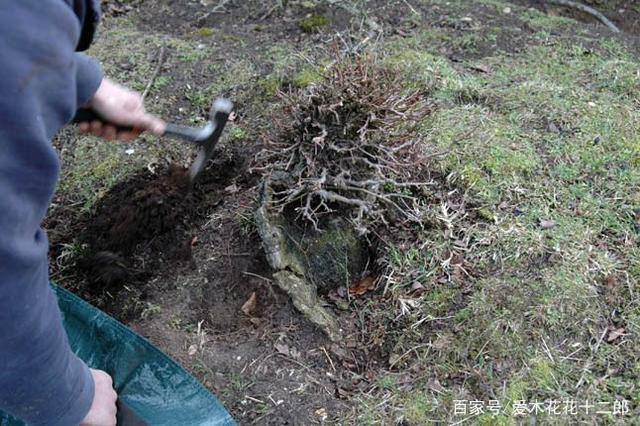
It seems that in our great Celestial Empire, the fine tradition of bringing a camera to work is not yet very popular. Friends who collect trees generally do not photograph the process as a memento, so we city farmers who have long lived in cages never get a chance to observe a return to nature. But foreigners are different; they bring a camera for everything. I have seen plenty of Filipinos in Hong Kong, China, and they are truly selfie fanatics. Two people can sit by the sea doing nothing at all and take several hundred selfies in a spot barely two sq m.
This is a British bonsai enthusiast documenting his collecting process, one blackthorn and one hawthorn.
This one is the blackthorn. Relatively speaking, this kind of spot is very easy to dig. The tools this guy brought are a bit low-end; in a place like this, you could just push a large shovel in all around and pry it right up. He used this small rake to dig down bit by bit around the edge.
He left a root ball this big, so the survival rate is absolutely rock solid. Thicker roots are best cut off with scissors; wounds torn by digging do not heal easily.
The main root is usually at the very bottom, because it has to drill down hard to anchor the whole tree trunk like an anchor.
Luckily it went fairly smoothly, without hitting big rocks or anything, and it was done in no time. The root ball must be wrapped well; if the root ball falls apart, then it would be better not to bring soil at all. If it is a collected tree without a root ball, then at the end find moss and other moisture-retaining materials on site to wrap the roots and keep the fine roots from drying out. In fact, many collected trees in China are kept without fine roots at all; the main root is simply sawed off entirely with an electric saw, which saves effort when digging and is convenient for transport, though it takes a bit more work when heeled in in the ground.
After digging, this process is quite admirable. Fill the soil back in; I hope friends who collect trees in our Celestial Empire do this too.
This is a double-trunk hawthorn.
When collecting a tree, there is also a very crucial operation: styling the trunk. This thing is just like opening raw jadeite. An experienced master knows where to open the stone, whether to cut or grind. Perhaps for the same stone, the price from a master's cut and a novice's cut can differ several times over. Styling the trunk is the same. Seeing this tree, if you want to dig it, you have to think through what shape you can make it into. If you have no idea in mind, then it is best to leave it alone for now and come back once you have figured it out.
For this double-trunk style, one branch shows twists and turns, and the two branches differ in length. When styling the trunk, leave it as one high and one low, so that later there is no need for a second round of branch cutting.
Digging a trench all around like this guy does also has an advantage: it makes dealing with the bottom easier. If you push a shovel in all around as I mentioned, it may be inconvenient to cut the main root below, and shaking the trunk may loosen the root ball.
A main root this thick is actually not very useful for bonsai; you only need to keep a section to serve as a surface root in the future and to tie wire to secure the trunk when potting.
The guy chose to first wrap the root ball well with plastic wrap.
Then use sturdy plastic sheeting to support the bottom, and it can be carried away.
These two trees are relatively very easy to dig. There are also some much more difficult collecting processes; we will talk about those another time.