What are the common ornamental varieties of wild Rosa plants?
What are the common ornamental varieties of wild Rosa plants?
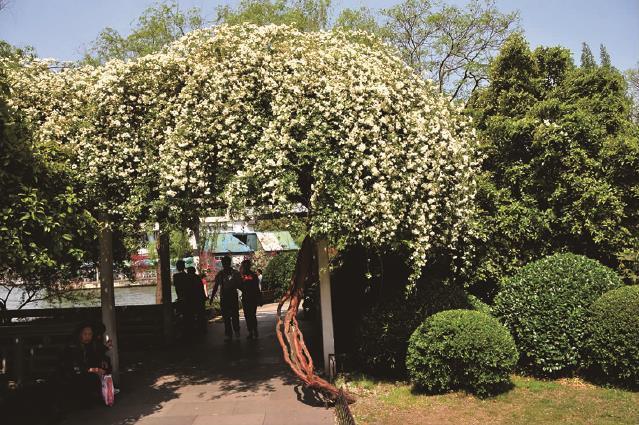
Lady Banks' rose garden applications
Yellow Lady Banks' rose garden applications
When it comes to Chinese roses, they are known to everyone. Their flowers are large and brightly colored, richly fragrant, and widely used in horticultural cultivation and cut flowers, and are loved by people all over the world. Chinese rose varieties are extremely rich, including tree roses, climbing roses, floribunda roses, grandiflora roses, groundcover roses, and miniature roses. Today, various cultivated varieties are in wide use and are extensively applied in landscaping.
As is well known, the Chinese rose (Rosa chinensis), native to China, has played a more important role in the breeding of modern rose varieties than any other Rosa species, bringing rare continuous flowering and bushy growth habits to new varieties. China's Rosa plant resources are extremely rich, with 82 native Rosa species, accounting for about 41% of the world total, making it one of the main distribution areas of wild roses. Most of them have good resistance and ornamental characteristics, can meet the requirements of urban landscaping, and can serve as original materials for breeding resistant roses, and deserve widespread attention.
1. Wild rose (Rosa multiflora)
Also known as multiflora rose. A climbing shrub, 2-3 m tall, with flat prickles on stems and branches, and 5-9 leaflets. Flowers numerous in dense conical corymbose inflorescences, single or semi-double, white or slightly pink-tinged, flower diameter 2-3 cm, slightly fragrant. Fruit spherical, about 6 mm in diameter, brownish-red when ripe, flowering period April-May, fruit ripening period September-October. Wild rose has characteristics such as cold resistance, drought resistance, and few pests and diseases. It is often used as rootstock for grafting roses, and is also a good spring flowering plant.
2. Pink cluster rose (Rosa multiflora var. cathayensis)
A variety of wild rose, with large single flowers, pink or rose-red in color, corolla diameter 3-4 cm, almost twice that of wild rose. Leaflets 1.5-5 cm long, serrated at the edges, 5-7 forming pinnate compound leaves. Fruit red, glossy. Pink cluster rose can overwinter outdoors in Hebei, Gansu, Shaanxi and other places, with strong habits, and is a good flowering plant.
3. Omei rose (Rosa omeiensis)
An erect shrub, 3-4 m tall, branchlets red-brown, often with bristles; prickles often enlarged at the base. White flowers solitary, 4 petals, no bracts, pedicels and receptacles glabrous, corolla diameter 2.5-3.5 cm. Fruit pear-shaped, bright red, with yellow fleshy pedicel. Flowering period May-June, fruiting period July-September. Omei rose is distributed in Yunnan, Sichuan, Guizhou, Hubei, Shaanxi, Gansu, Qinghai, and Tibet, growing in mixed forests or thickets at an altitude of 2000-3000 m. In full bloom, the tree is covered with white flowers, and in the fruiting period, it is covered with red fruits, extremely beautiful, and is an excellent Rosa germplasm resource.
4. Macartney rose (Rosa bracteata)
An evergreen prostrate shrub, with trailing stems and stout hooked prickles. White flowers solitary, corolla diameter 5-7 cm, fragrant, calyx with 5 lobes. Fruit spherical, 3-3.5 cm in diameter, brown, covered with grayish-yellow cottony hairs, calyx lobes persistent, containing many bony achenes. Flowering period May-June. Fruiting period October-November. Distributed in Zhejiang, Fujian, Hunan and other places, with trailing stems and a prostrate habit, it is an excellent groundcover plant and also an excellent parent for breeding groundcover roses.
5. Cherokee rose (Rosa laevigata)
An evergreen trailing shrub, branchlets densely covered with fine prickles besides hooked prickles. Leaflets 3, rarely 5, stipules linear, separate from the petiole, early deciduous. Flowers solitary at the tips of lateral branches, white, 5-9 cm in diameter, pedicels and the outside of the hypanthium densely covered with fine prickles. Fruit 2-4 cm long, with fine prickles, with long and recurved persistent sepals at the tip. Flowering period May, fruiting period September-October. Cherokee rose is distributed in Central China, East China, South China, and Southwest China, and is a rare late-spring flowering plant. Its medicinal value is outstanding: the fruit is used as medicine and can promote diuresis and tonify the kidneys; the leaves have detoxifying and swelling-reducing effects; the root used as medicine can invigorate blood and dissipate stasis, draw out toxins and astringe, and dispel wind and dampness.
6. Chestnut rose (Rosa roxburghii)
A spreading shrub, 1-2.5 m tall. Leaflets 9-15, elliptical or oblong. Flowers solitary or 2-3, borne at the tips of short branches; flower diameter 5-6 cm; sepals usually broadly ovate, apex acuminate, densely tomentose inside, densely needled outside; petals double to semi-double, pale red or pink, slightly fragrant. Fruit oblate, 3-4 cm in diameter, green-red, densely covered with needles outside. Flowering period May-July, fruiting period August-October. Produced in Shaanxi, Gansu, Jiangxi, Anhui, Zhejiang, Fujian, Hunan, Hubei, Sichuan, Yunnan, Guizhou, Tibet and other provinces and regions, both wild and cultivated. The fruit tastes sweet and sour, contains a large amount of vitamins, can be used for food and medicine, and can also be used as a raw material for making sugar and brewing wine; the root boiled in water treats dysentery. The flowers are beautiful and are cultivated for ornamental use. The many prickles on the branches and trunk can be used as a hedge.
7. Lady Banks' rose (Rosa banksiae)
A climbing small shrub, up to 6 m tall; branchlets cylindrical, glabrous, with small short prickles; prickles on old branches larger and hard, sometimes branches thornless after cultivation. Leaflets 3-5, rarely 7. Flowers small, numerous in umbel-like inflorescences, flower diameter 1.5-2.5 cm; petals double to semi-double, white, obovate, apex rounded, base cuneate. Flowering period April-May. Produced in Sichuan and Yunnan, growing by streams, roadsides, or in mountain thickets. Cultivated throughout the country. The flowers contain aromatic oil and can be used to prepare fragrances and cosmetics. A famous ornamental plant, often cultivated for climbing over trellises. Not cold-tolerant; in North China and Northeast China it can only be grown as a potted plant, moved indoors in winter to prevent freezing.
8. Yellow Lady Banks' rose (Rosa banksiae f. lutea)
The difference from Lady Banks' rose (Rosa banksiae) is that the flowers are yellow and double, without fragrance. Produced in Jiangsu. More flowers and a longer flowering period.
Fun fact: A guide to identifying rugosa rose, Chinese rose, and Rosa multiflora