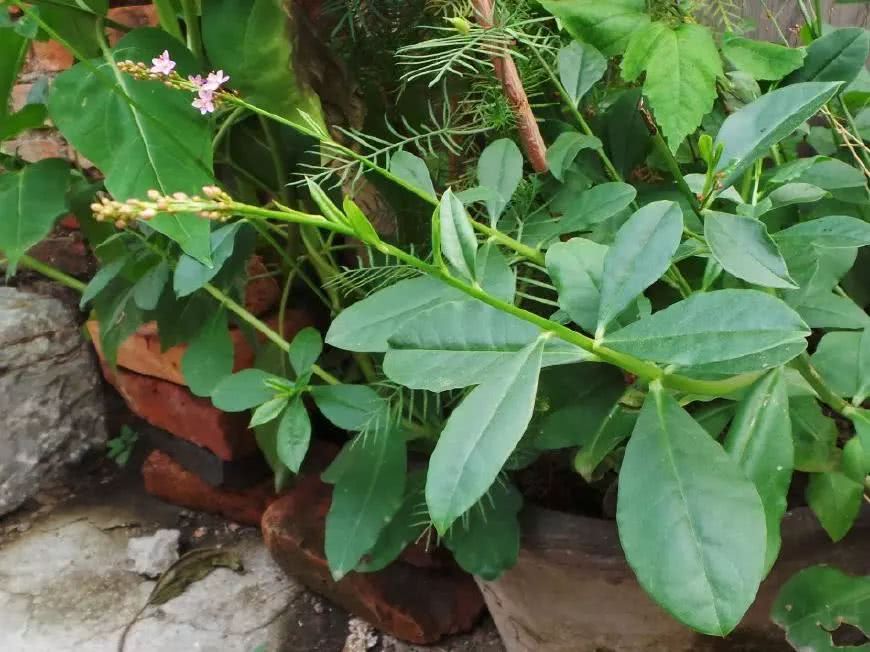
This wild grass commonly known as false ginseng comes from the Americas; its tender leaves are a top-grade wild vegetable, and its root closely resembles ginseng.
Warm reminder
Hemu Report aims to share and popularize information about various plants and their uses, for reference only. If medicinal use is needed, it is recommended to consult a professional physician to avoid problems!
In rural areas of China, many wild grasses are edible, such as dandelion, plantain, and purslane. When they grow up they are grass, but their young seedlings are delicious wild vegetables. These wild vegetables not only have a unique flavor but also possess certain medicinal value, and are therefore loved by farmer friends. In the rural areas of southern China, there is a wild grass from the Americas whose tender leaves can be eaten and whose root can also be eaten. Because the root looks very much like ginseng, people believe it has the effect of nourishing the body, and call it "false ginseng."
The scientific name of false ginseng is "Talinum paniculatum," and it is a perennial herbaceous plant. When it blooms, the red flowers and green leaves set each other off beautifully. It was first introduced to China as an ornamental garden plant, and later escaped to become a wild grass. Talinum paniculatum has strong vitality and is not picky about its environment; it can even grow in cracks between stones, and it is extremely common in southern China. The tender stems and leaves of Talinum paniculatum taste delicious and are a top-grade wild vegetable in rural areas. Except for the two coldest months of winter, the tender leaves can be picked and eaten at other times.
In the Guangzhou area, the tender stems and leaves of Talinum paniculatum are called "ginseng vegetable," and local growers cultivate it specifically to supply the markets of Guangzhou's urban districts. As for why it is called "ginseng vegetable," besides wanting to use ginseng as a "gimmick," it is also because it has effects similar to ginseng. Ginseng vegetable contains extremely high levels of protein, vitamin C, amino acids, calcium, zinc, iron and other elements, and has the effects of nourishing and supplementing qi, promoting fluid production and moistening the lungs, and promoting lactation and reducing swelling. For people with weak constitutions and qi deficiency and weakness, it can nourish the body.
The root of Talinum paniculatum grows relatively thick and resembles ginseng, and can also be dug up and eaten. In folk tradition, Talinum paniculatum root (ginseng vegetable root) is often used in cooking; common ways to eat it include cold-dressed ginseng vegetable root and pork ribs stewed with ginseng vegetable root. The price of Talinum paniculatum root is much cheaper than real ginseng, and it is sold as a vegetable in the market, so ordinary people can afford to eat it. Soup stewed with Talinum paniculatum root is comparable to a medicinal meal, and can clear heat, detoxify, tonify deficiency, and calm the mind, which indeed lives up to the name "false ginseng."
Dear readers, do you know this "false ginseng" from the Americas? Perhaps it is also growing in front of or behind your house!
Text/Hemu Report, images/Internet
If you like Hemu's articles, you are welcome to follow.