Besides being especially delicious, what else is special about ducks?
Yesterday, when we talked about ostriches, we mentioned the domestic duck, which also has a special penis. What exactly makes the domestic duck special? Let's review the introduction from the 2016 Table Species Calendar.
Look for the mallard
The domestic duck (Anas platyrhynchos domesticus) was domesticated fromthe mallard(also called the wild duck, A. p.) The mallard is widely distributed across Eurasia and North America, with scattered populations elsewhere as well, but no matter where it is, its numbers are never small. Its extremely strong reproductive capacity and wide distribution made it the most commonly domesticated duck for food (there are also domestic ducks domesticated from other wild species, which this article does not cover).
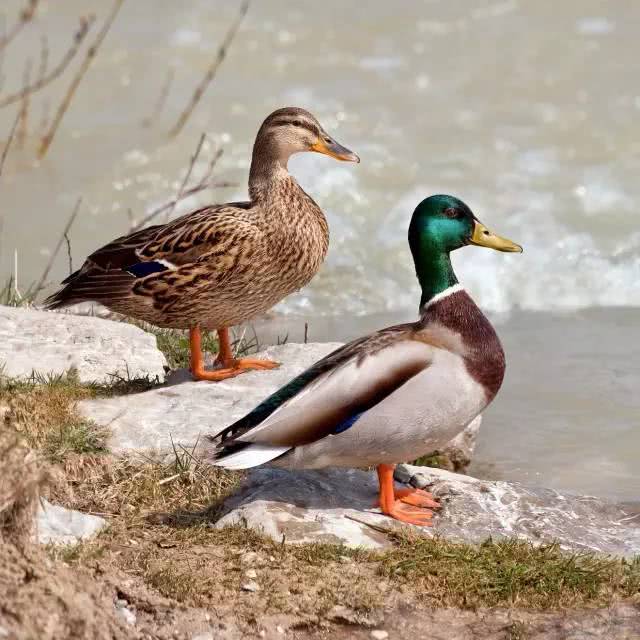
Mallard, female on the left and male on the right. Image: wiki commons
The mallard belongs to the order Anseriformes, family Anatidae, genus Anas. As the most common wild duck, because it pairs up during the breeding season (which starts in winter),it is often mistaken by passersby for mandarin ducks(Aix galericulata)。
Male mallard, and you can see the "curl" formed by the uppertail coverts. The white neck ring is also very clear. Image: Ying Zhi Wu
The breeding plumage of the male mallard is very easy to identify,as long as you see the "green head" you cannot mistake it, which is also the origin of its name. The mallard's "green head" is made up of dark green feathers with a metallic sheen. In sunlight, the glossy green is indeed as brilliant as a clump of grass, but in shadow where the light cannot reach, the metallic sheen cannot reflect, and from a distance it looks dark and blackish, appearing dark green. Besides the green head, the male mallard also has a ring of white around its neck, perfectly separating the green of the head from the purple-brown of the chest. The male's bill is bright yellow (this point is very important and will be mentioned later),and the uppertail coverts also have a "curl", which is the result of specialized upward-curving feathers and is also one of the identifying features of this species.
Male mallard scratching its face. Image: Ying Zhi Wu
The female mallard looks very different from the male's breeding plumage. Its bill is orange mixed with grayish black, its whole body is yellowish brown, and it is almost covered with dark markings of various sizes. It actually looks much the same as the females of other ducks in the genus Anas. So if there is only a female and no male, it is not easy to identify the species in the wild, and most of the time you have torely on the "speculum" on the wings to identify it。
Female mallard. Image: Edward Johnes
The speculum is not a separate structure, buta region of specific color formed by the secondary flight feathers and the greater upperwing coverts. In the mallard, this colored region isa blue-purple rectangular patch, bordered closely front and back by black edges and white bands. Ducks all have a speculum, whether male or female, and the color composition of the speculum differs for each species of duck,but males and females of the same species are the same, so the speculum can be used to determine the species. As long as the speculum can be seen, this method of identification is very reliable.
Female mallard with chicks, wings drooping to reveal the blue-purple speculum. Image: imgmob.net
The speculum is especially conspicuous in flight, because at that time the wings are fully spread and the color patch is revealed. When standing or swimming with the wings folded, it is not easy to see (though generally speaking, a little is still revealed more or less). The mallard's speculum, like its green head, is metallic and glossy. Viewed from different angles of light, the color can shift between blue, green, and purple, and it is quite beautiful.
Male mallard in flight posture; when the wings are fully spread, you can see that the speculum consists of white edges on both sides with a thin black border and a broad blue-purple rectangle in the middle. Image: birdskorea.org
What ducks are best at is...
Although a male mallard has "green head" breeding plumage for most of the year, for a few months he molts into non-breeding plumage that is almost exactly like the female's. At this time it seems hard to tell male from female, but in fact there is just one trick to solve it: look at its bill. No matter how it molts, the color of the bill never changes. As long as you seea bright yellow bill, no matter how many real females he is among, you can pick him out at a glance.
Male mallard in non-breeding plumage; apart from the bill color, which is exactly the same bright yellow as in breeding plumage, the whole body plumage is almost identical to the female's. Image: Ying Zhi Wu
Male mallards are very good at rape, not only often raping females of their own species, but also raping females of other species, thusproducing quite a lot of hybrid offspring. That alone is still not enough; they do not even spare same-sex individuals or corpses. Red-billed Blue Magpie (note: a person's name) once observed a female mallard in the water being forcibly mated in turn by seven or eight male mallards. Because of the mating posture, with the female underneath, in the end this female was never able to float up from the water again...
Male mallards attempting to mate with a female mallard. Image: Arkive.org
Because the domestic duck underwent human selective breeding during domestication, andduring rearing it easily accumulates more fat, it is generally larger in size than the wild mallard. Like the domestic goose (Anser cygnoides domestica), the domestic duck is most commonly all white after domestication. Besides the white domestic duck, there are also domestic ducks with the same color as the wild mallard, as well as domestic ducks between the white type and the wild-colored type.
White-type domestic duck. Image: nswong.50webs
Domestic ducks of various color types ranging from white type to wild-colored type. Image: animal-kid
Besides the variable-color offspring produced by mating between domestic ducks of different color types, sometimes wild mallards also enter the activity areas of domestic ducks to forage, and incidentally mate and leave offspring.
Hybrid offspring of a male mallard and a white-type domestic duck female. Image: nwv-schwaben.de
To humans, ducks mean plump and delicious
When ducks of the genus Anas swim, most of their bodies are on the water surface. They cannot dive. When foraging in the water, at most they can submerge only the front half of their bodies, and their tails are sure to be left outside (swans are like this too), so they look very plump.
Mallards foraging underwater, male on the left and female on the right. Image: cod.edu
White-type domestic duck foraging underwater. Image: youtube.com
A duck this plump is best roasted. When it comes toroast duck, the first thing that comes to mind is Peking duck. This dish is one of the must-eat dishes when in Beijing. The subcutaneous fat is thick, and eaten with the skin it is crisp and rich with oil. Eaten together with the tender, easy-to-chew lean meat inside, it is not too greasy, and the flavor is just right. Paired with shredded scallion, shredded cucumber, and sweet bean sauce, rolled in a thin pancake and eaten together, the taste is even more fresh and delicious, sweet but not greasy. After the duck meat is removed, the duck carcass can also be used to make soup. The soup is fresh, full of meaty flavor, and not oily. The soup I loved most as a child was duck carcass stewed with baby bok choy.
Sliced Peking duck. Image: jlxbjky
Besides roast duck, ways of cooking duck also includebeer duck, saltwater duck, braised duck, ginger duck, and so on. What ducks produce is not only the duck meat on their bodies; you can also eat duck feet (mustard, red-braised, mala, and so on), duck blood (duck blood vermicelli soup, mao xue wang, hot pot, and so on), duck eggs (salted duck eggs with plain rice porridge are simply a breakfast favorite!), and so on. It is late at night, so we will not go into detail.
Duck blood vermicelli soup. Image: clvyou
Finally, I recommend an animated series about the daily lives of wild birds, starring a white-type domestic duck"Duck Life". It is very scientific and lively and interesting (and silly)~
Mr. Domestic Duck mixed in with a migrating flock of wild ducks. Image: screenshot from the animation "Duck Life"
Mr. Domestic Duck being bullied by a bird of prey. Image: screenshot from the animation "Duck Life"
Mr. Domestic Duck is a master of expressions~ Image: screenshot from the animation "Duck Life"
This article is a 2016 article from the Species Calendar, from Species Calendar author @Ying Zhi Wu.
If you like her, you can also follow
Bird Life
id: birdslife
an original platform on the theme of birds and nature
Could you have imagined that ostriches and ducks also have something in common?
Calendar Girl's avatar today
Anatidae, Black Swan