Detailed Explanation of Key Points for High-Yield Cultivation Techniques of Golden Pear
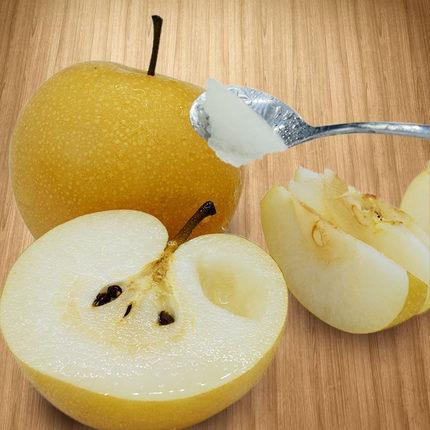
High-Yield Cultivation Techniques for Golden Pear
1 Orchard Establishment
The experimental orchard has sandy loam soil, flat terrain, irrigation conditions, and good drainage.Before establishing the orchard, the entire site was deep-ploughed to 60cm and raked level. Planned close planting was carried out,initially planted at high-density spacings of 1m x 3m or 1.5m x 2m, and after the canopiesmet, alternate trees and rows were thinned out. Planting holes were dug, each 60cm in length, width, and depth,with 15kg of organic fertilizer applied per tree, then irrigated to settle the soil. Two-year-old finished GoldenPear saplings were selected, with a height above 100cm and basal diameter above 1.0cm,using Pyrus betulifolia (birchleaf pear) as rootstock, with 'Xinshiji' and 'Zaosu' pear as pollinizer trees, and a Golden Pear to pollinizertree ratio of 5:1. After planting, the soil was firmed and irrigated, the tree basin was tidied, and 1 sq m ofplastic film was mulched. The trunk was headed at 80cm height, all buds within the training zone were notched, and a plastic film bag 6cm wideand 50cm long was slipped over, and when new shoots grew 2-3cm, a corner of the bag was cutopen for ventilation, and after 5-6 days the top of the bag was fully cut open, and from top to bottomcut open by 1/3, then folded down below the tying string, in a trumpet shape opening downward, to preventunderground pests from climbing the tree and gnawing buds and leaves.
2 Fertilizer and Water Management
In late September each year, base fertilizer was applied immediately after fruit harvest, with 3000kg of decomposed chicken manureapplied in ring-shaped trenches per 666.7 sq m, with 110g of NPK compound fertilizerapplied per tree, placed in radiating trenches 20-30cm deep and 30cm wide. Each year in mid-to-late June,the tree basin was mulched with grass at a thickness of 20cm, and no deep ploughing was done in autumn, to protectshallow roots. From the second year after planting, 0.3-0.5kg of urea was applied per tree before flowering,and 0.3-0.4kg of NPK compound fertilizer was applied per tree during the spring shoot rapid growth period and fruit enlargement periodrespectively. From late April to late May each year, every 10days, one spray of 0.3% urea plus 0.2% monopotassium phosphate plus 0.2% photosyntheticmicro-fertilizer was applied, 3 sprays in total; from late September, 2 sprays of 0.4% urea plus0.3% monopotassium phosphate were applied; at flowering stage, 0.2% borax plus 0.3% urea was sprayed.The relative soil moisture content of the orchard was maintained at 60%-80%; when below60%, irrigation was applied promptly. Combined with fertilization, the pre-flowering water, spring shoot rapid growth water,fruit enlargement water, and winter freezing water were all properly irrigated.
3 Training and Pruning
The tree form adopted was the slender spindle, with a final tree height of 2.5-3m,13-15 main branches, and a trunk height of 70cm. Each year, 3-4main branches were selected and retained on the central leader, and the main branches had no lateral branches but extended in a single axis. In spring, on bothsides of the main branches, 1 bud was notched every 2 buds, and no notching was done within 30cm of the central leader. When new shootsstopped growing, branches were bent to open the angle; when main branches exceeded 1m in length, they were bent and propped to 70-80°, to promoteflower bud formation and maintain ventilation and light penetration. After enough main branches were retained, the central leaderwas headed back to open the center. The thickness of a main branch must not exceed 1/2of the thickness of the central leader at its point of attachment; for overly thick main branches, some of their branches were removed to weaken their growth vigor.Long fruit-bearing branches that bore fruit continuously were renewed in time; those mainly bearing fruit on axillary flower budswere cut back to a branch point with stronger growth vigor when they reached 3 years of age. After the4th year, main branches whose canopies had met were cut back, and the extension branches of temporary trees were cut back,leaving space for the extension branches of permanent trees, until temporary trees were removed, and the row spacingbecame 2m x 3m or 4m x 3m.
4 Flower and Fruit Management
(1) Bee pollination. Bees were introduced 2-3 days before flowering, with 1 hive (1500-2000bees) placed per 5000 sq m (7-8 mu), positioned in a sheltered, sunny spot. 10-15 days before introducing bees, one spray of insecticideand fungicide was applied; during the bee pollination period, no chemical pesticides were allowed. (2) Flower thinningand fruit thinning. Flower buds were thinned from the inflorescence separation stage to before full bloom, leaving 1inflorescence every 20cm; on weak trees, leaving 1 inflorescence every 25cm; each inflorescence retained 3 lateral flowers;fruit thinning began 2 weeks after petal fall, leaving 1 fruit per inflorescence, occasionally 2,retaining large fruits and lateral fruits, and removing diseased, insect-damaged, deformed, and small fruits. (3) Fruitbagging. A two-time bagging method was used: the first time, 15-20 days after petal fall, asmall wax bag of 8cm x 12cm was applied. The second time, 30-40 days after the first bagging,without removing the small bag, a 16cm x 20cm double-layer bag was applied directly over it.Before bagging, a spray of 70% thiophanate-methyl plus methomyl at 1200times dilution was applied, and bagging was done after the solution dried. The bagging order on the canopy was from top to bottom, and frominside to outside.Inner rear outer.
5 Pest and Disease Control
Before flower buds sprouted, 3-5°Be lime sulfur mixture plus 100 times sodium pentachlorophenatewas sprayed to control overwintering pest and disease sources. At the inflorescence separation stage, 10% imidaclopridwettable powder at 2500 times plus 12.5% diniconazole wettable powderat 2500 times dilution was sprayed to control aphids, pear psylla, etc. After petal fall, 1.8% abamectinemulsifiable concentrate at 5000 times plus 10% imidacloprid wettable powder at 2500times plus 80% mancozeb wettable powder at 800 times dilution was sprayed to control pear psylla, aphids,and rust disease. When applying the large bags, 48% chlorpyrifos emulsifiable concentrate at 1200-1500times plus 3% acetamiprid emulsifiable concentrate at 1500 times dilution was sprayed to control Comstock mealybug, yellowaphid, and pear psylla. During the fruit enlargement period, if yellow aphids and other pests were found entering the bags,25% imidacloprid wettable powder at 4000 times dilution was sprayed, and after 7-10days another spray was applied. When red spider mites and two-spotted spider mites occurred, 20% fenbutatinoxide wettable powder at 1500-2000 times dilution could be used. For black spot disease,Bordeaux mixture at 1:2:200 was used. 15-20 days before harvest, with ring rot andblack spot disease as the main control targets, 70% thiophanate-methyl wettablepowder at 1000 times dilution was sprayed.。