Grow these 6 vegetables on your balcony, pick and eat as you go, and you'll have vegetables to eat all year round
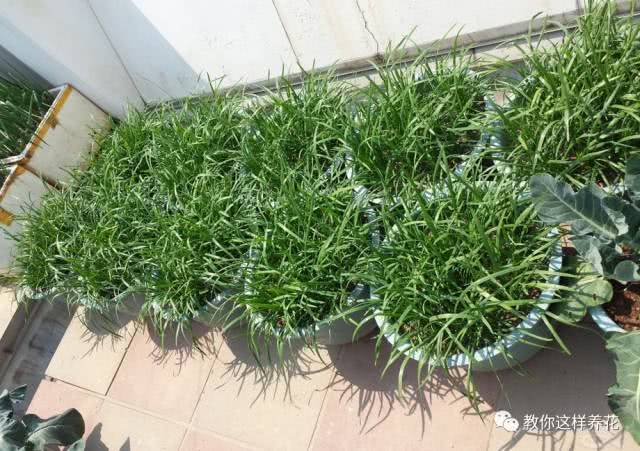
Growing vegetables on the balcony is part of modern gardening: while experiencing the joy of growing vegetables, you can also harvest healthy ingredients. If you sit in front of a computer or TV all day long, you might as well grow some vegetables and get some exercise - the benefits to your body are beyond counting! What's more, balcony-grown vegetables generally use no pesticides or chemical fertilizers, making the ingredients safer and healthier! Today we recommend 5 vegetables that keep growing as you pick them - once planted, you'll never worry about fresh vegetables for a whole year! Let's take a look~
“
Growing vegetables on the balcony
”
Garlic chives
Garlic chives grow fast and tolerate repeated cutting, so you'll have something to eat all year round. They're especially delicious scrambled with eggs or made into dumpling filling. After cutting, sprinkle a little plant ash and they'll grow even more vigorously! In a year or so you can cut them 10 times, about once a month!
Garlic chives are highly adaptable, cold-resistant and heat-tolerant. They can adapt to all kinds of soil, have a high fertilizer demand and strong tolerance to fertilizer. The optimum germination temperature for garlic chive seeds is above 12°C, the growing temperature is 15°C to 25°C, and the underground part can withstand lower temperatures. They prefer moderate light intensity and have strong shade tolerance. Normally keep the potting soil moist, but not waterlogged.
Water spinach
Water spinach is a very common summer vegetable, mainly of two types: one grows upright, the other is a trailing vine form. The taste is about the same; the main difference is whether it is old or tender.
Both the stems and leaves are edible and very tender and succulent. Water spinach is an alkaline food and contains potassium, chlorine and other elements that regulate water and fluid balance; eating it can reduce intestinal acidity, prevent imbalance of the intestinal flora and is beneficial for cancer prevention. The niacin, vitamin C and other nutrients it contains can lower cholesterol and triglycerides, giving it the effect of reducing blood lipids and helping with weight loss.
Water spinach on the market often carries a lot of pesticide, so growing your own is very suitable. Water spinach can be harvested by cutting the stems, and it will keep growing after cutting. Generally, harvest after about 40 days, when the seedlings are about 25-35 cm tall.
Water spinach is best grown in loose, airy, water-retaining soil. The optimum growing temperature is 25-30°C; growth stops below 10°C. It loves light and needs plenty of sunlight throughout the growing period. Keep the soil moist; insufficient soil moisture easily leads to more fiber in water spinach, affecting yield and quality. Water spinach has a high fertilizer demand and strong fertilizer tolerance, needing relatively large amounts of nitrogen and phosphorus fertilizer; it can be fertilized once a week.
Lettuce
Lettuce is delicious both raw and cooked; lettuce in oyster sauce, or a few leaves added to boiled pork slices - the flavor is simply wonderful!
Lettuce is rich in nutrients, containing large amounts of beta-carotene, vitamin B, vitamin C, and also plenty of dietary fiber. Eating lettuce regularly can improve blood circulation in the stomach and intestines. Lettuce grows quickly and needs little care; it can be harvested when it reaches 20 cm, either pulled by hand or cut at the root with scissors, after about 60 days.
Lettuce is best grown in loose, airy, water-retaining, slightly acidic soil, with a suitable soil pH of 5.8-6.6. During the growing period it likes a cool climate, growing best at 15-20°C with high yield and excellent quality; when it stays above 25°C, growth is poorer, the leaves become coarse and old, and there is a slight bitter taste.
It can be placed in a bright environment, but do not give too much light - too much and the leaves become hard. Watering is best done little and often, keeping it normally moist but avoiding waterlogging; in the early growth stage it is suitable to control water. Fertilize once a week, mainly with nitrogen fertilizer, with decomposed organic fertilizer being best.
Small scallions
Small scallions are an essential seasoning for cooking in many households, and potted small scallions are very easy to grow - the first choice for many flower lovers to plant. Just put a flower pot on the balcony and you can harvest a lot.
Small scallions grow fast and can generally be harvested after about 30 days; eat slowly and they grow slowly - many vegetable growers say one pot at home can last a whole year.
Small scallions have low soil requirements, with fertile, well-drained sandy soil being best. They like a cool environment, tolerate cold but not high temperatures, with a suitable growing temperature of 15-25°C.
Small scallions are not strict about light and are generally placed in a bright spot. When watering, note that small scallions do not tolerate drought, so water little and often to keep the soil moist. Apply a light fertilizer once every 10 days and the small scallions will grow very fast!
Malabar spinach
Malabar spinach is eaten as seedlings, tender shoots or tender leaves; its texture is soft, tender and smooth, and its nutritional value is high. It can be used in soups, stir-fried, blanched, or served cold; it has a fresh fragrance and, when chewed, is as crisp and refreshing as eating wood ear fungus, hence the name Malabar spinach.
It is commonly cultivated in both the north and south; in the tropical regions of the south it can be grown as a perennial, while in the north it is mostly grown as an annual. When the shoots of Malabar spinach are 10-15 cm long, cutting them allows harvest once every half month; it is also one of the vegetables that keeps growing as you cut it.
Malabar spinach likes warmth, tolerates heat and does not tolerate cold. The suitable growing temperature is around 25°C; it loves light and needs plenty of sunlight throughout the growing season, and when the sunlight is too intense a shade net should be added. Malabar spinach likes moisture, and the soil should be kept moist during the growing period.
Water little and often; generally, each harvest is combined with one application of topdressing and irrigation. Malabar spinach is mainly harvested for its tender leaves and shoots; to improve the quality and yield of the tender tips, the plants need to be trained during the growing period by leaving 2-3 strong side branches at each harvest.
Garland chrysanthemum
Garland chrysanthemum varieties are divided by leaf size into two types: large-leaf and small-leaf garland chrysanthemum. Garland chrysanthemum is also called ponghao or haozigan; because its flowers resemble wild chrysanthemums, it is also known as chrysanthemum greens.
The stems and leaves of garland chrysanthemum can be eaten together; it has the fresh aroma of mugwort and the sweet fragrance of chrysanthemum, and is praised for being fresh, fragrant, tender and crisp. It generally contains every kind of nutrient, and its carotene content in particular exceeds that of ordinary vegetables, being 1.5-30 times that of cucumber and eggplant. It tastes delicious, and is also one of Huahua's favorite hotpot vegetables!
Garland chrysanthemum can be harvested when the plant is 20 cm tall. Cut it off leaving 2-3 leaves at the base of the stem to encourage side branches to develop.
Garland chrysanthemum likes cool conditions and does not tolerate high temperatures; the suitable growing temperature is around 20°C, growth is slow below 12°C, and growth is poor above 29°C. Garland chrysanthemum is not strict about light, generally doing better with weaker light. It is a long-day vegetable: under long-day conditions, vegetative growth cannot develop fully and it quickly enters reproductive growth and flowers and sets seed. Therefore, in cultivation it should be scheduled in spring and autumn when daylight is shorter. It is not strict about fertilizer and water conditions, but it is best not to let water accumulate.
These vegetables are very simple to grow
Pick and eat as you go, and you'll keep eating all year round
If you like them too, grow a pot
Show it to flower lovers who need it!