Four strawberry propagation methods, prevent seedling-stage diseases early, and potted plants are easy to grow and give you fruit to eat
Strawberries have always been the representative of the "pink maiden" and are deeply loved by female friends. Actually, it is no wonder, even burly men cannot resist the temptation of strawberries' sweet-and-sour, soft-and-sticky taste, let alone women who are loyal to good looks.
Strawberry is a relatively delicate fruit. Anyone who has eaten it knows that its skin is very tender and will release water at the slightest touch, making it relatively difficult to transport, which also determines that the price of strawberries has remained high. The most popular kind on the market now is "milk strawberry." Actually, it is not a strawberry variety at all; it just smells like milk, and dealers gave it this name to attract customers.
Many people are curious about how strawberries grow, and they also have questions about strawberry propagation methods. Today let us look at how strawberries propagate batch after batch. What methods are commonly used in production? There are four common propagation methods for strawberries: seed propagation, stolon division, and tissue culture, among which stolon division is currently the most common propagation method in production.
1. Seed propagation: Pick fresh strawberries in May and June, select well-proportioned, smooth, disease-free and fully ripe strawberries, peel off the skin, wash away the juice, dry them, and rub them apart to obtain the seeds. Prepare nutrient soil, soak the seeds for 12 hours, then remove them, scatter them into the soil, cover with soil, and cover with plastic film; seedlings will emerge in about 10 days. Strawberry seed propagation is the most primitive propagation method. It takes a long time and is relatively complicated to operate, so it is rarely used in production.
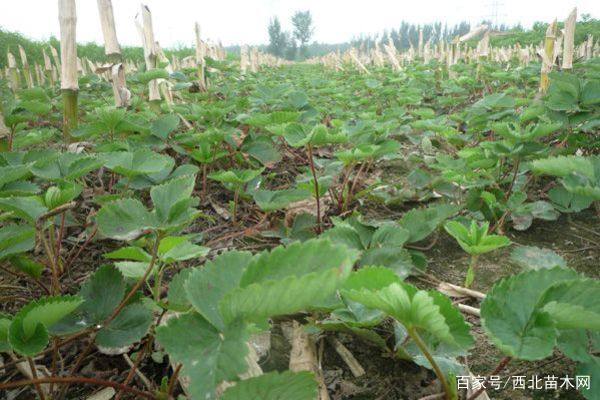
2. Stolon division: During the growing period, strawberries will grow many stolons, and these stolons can survive independently. These overgrown stolons can be used for division and planting. When each mother strawberry plant has 2-3 stolons, the stem tips can be pinched off to reduce nutrient consumption and promote the new stem seedlings to thicken. After repeated operations, basically a seedling grown for two years can produce 5 new seedlings. The new seedlings can bloom and bear fruit in the same year, and the yield increases significantly. This method has a fast propagation speed, is very convenient to operate, and can also save land and labor, so this method is commonly used to propagate strawberries in production now.
3. Rhizome division: After the fruit is harvested, carry out fertilization, watering, and weeding management to promote the mother plant to produce new stem branches. When new buds emerge from the ground and the mother plant grows new roots, the old roots can be dug out, the bad roots cut off, and plants with 5-8 functional leaves and 1-2 years of growth selected and separated out. The separated seedlings can be planted directly.
Strawberries at the seedling stage are relatively fragile and are often attacked by pests and diseases. The more common one is powdery mildew. How should it be prevented? Powdery mildew mainly damages flowers, fruits, and leaf stalks, and the affected parts will have white powdery substance. If you find this situation, you must prevent and control it early, otherwise it will affect strawberry yield and quality. Promptly remove diseased leaves, diseased fruits, and old leaves, take them outside the greenhouse and bury them deeply to reduce the pathogen base. Spray with 50% Tuzet 800-fold solution, 50% sulfur-multisulfide suspension concentrate 500-fold solution, 10% Score 1500-fold solution, 43% Junlike, 40% Fuxing and other agents, spraying continuously 2-3 times.
Strawberry seedlings are very beautiful when flowering and fruiting, but many times this scene can only be seen in strawberry greenhouses. Now there is no need to envy them. Potted strawberries can be moved home to grow. Not only can they be ornamental, but you can also eat strawberries you grew yourself. It is just unknown whether they are easy to grow. Let us take a look together!
The soil needed for potted strawberries is rather particular: fertile, well-drained, and also breathable. Strawberries like sunlight and warmth, so potted plants should be placed on a sunny balcony to grow, which is beneficial for flowering. Strawberries like water and moisture, so sufficient water should be supplied during the growing period. Water promptly when the soil is dry, and it is best to keep it moist often, but water must not accumulate when watering. Potted strawberries consume relatively more nutrients because they bloom several times a year, so timely fertilizer supplementation is still very necessary, basically liquid fertilizer once a month. Indoor temperatures are just right for strawberry growth, but in summer or winter, attention should also be paid to appropriate shading and warmth. Withered leaves and fallen flowers of potted strawberries should be pruned frequently to reduce nutrient consumption. If you care for them according to these methods, your strawberries can bear fruit several times a year, and you probably will not be able to finish eating them all!