Succulent division has its tricks; let me teach you how to plant them to improve the survival rate
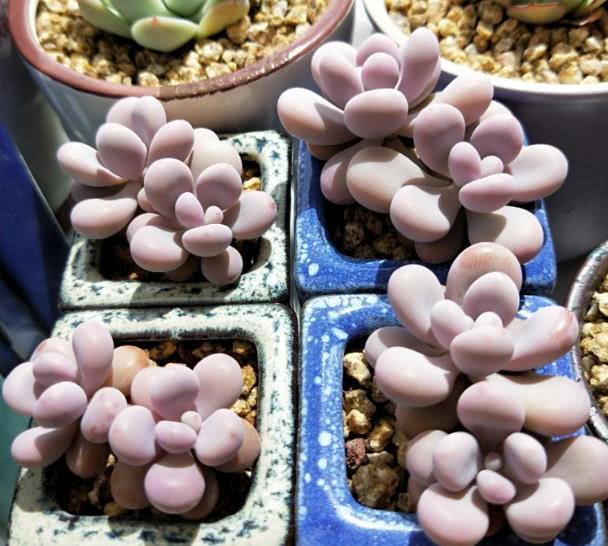
Do you like succulents? Have you also, like me, grown many little succulents, or are you just about to get started? In short, with time and our care, some succulents grow leggy and need their heads cut off, while others grow offsets on the mother plant, and once they grow to a certain size they need to be divided, after which they can be propagated by cuttings. So what should you pay attention to? Let's take a look!
Division is the simplest and safest method of propagating succulents. Any succulent with a rosette leaf cluster or a clustering growth habit can be propagated by division through its offsets, stolons, bulbs, tubers and small plantlets, and this can be done during repotting in spring. Of course, among succulents, variegated cultivars such as Sansevieria trifasciata 'Laurentii' (golden-edged snake plant), Agave potatorum 'Kichiokan' (variegated butterfly agave), Agave americana 'Marginata' (variegated century plant) and Haworthia truncata 'Variegata' (variegated horse's teeth) must be propagated by division to keep the cultivar true to type.
For dividing succulents, simply carefully twist off the individual that has almost separated from the mother plant, keeping as much of the root system as possible, and then replant it; you do not even need to let the wound dry. Choose spring or autumn if possible, and plant into moist or dry soil, but do not let the potting soil be too wet. Ensure good ventilation and guard against wound infection; if conditions allow, dab a little fungicide on the wound.
Although divided plantlets carry part of the root system, do not expose them to strong sunlight right away. Place them in a bright, well-ventilated spot without direct light, then increase the light gradually after about a week; if there are signs of etiolation, you can increase the light earlier. To reduce damage to the succulent's roots, keep the potting soil dry before dividing, as the roots become softer and less likely to break. For the divided plantlets, it is best to choose robust ones, as this gives a higher survival rate.
Some succulents readily produce many offsets at the base of the stem, forming small individual plants. You do not need to remove them from the soil; with careful twisting and pulling you can take them out, which both propagates new individuals and creates new growing space for the offsets on the old plant. Some are more tightly attached, such as Bergeranthus multiceps (yellow-flowered Bergeranthus); pulling them off directly with a bit of force is no problem either, or you can use a knife to cut them off with a bit of root attached.
In succulents, grafting is often used to propagate variegated and cristate cultivars. For example, Euphorbia neriifolia (Indian spurge tree) as rootstock, grafted with Euphorbia 'Spring Peak'; Portulacaria afra (elephant bush) as rootstock, grafted with Portulacaria afra 'Medio-picta' (rainbow bush); Adenium obesum (desert rose) as rootstock, grafted with cristate Adenium obesum; Stapelia gigantea (giant stapelia) as rootstock, grafted with Stapelia 'Purple Dragon' and so on, giving a fine ornamental effect. However, during grafting, because the plants contain white latex, it is very sticky. Therefore, the grafting operation must be as quick and skillful as possible to succeed.
If you want to increase the number of this cultivar, or the pot is simply too small to hold them, you can consider dividing them. The growing medium should be loose, breathable and well-draining, yet with some water-holding capacity, and neutral or slightly acidic. For tall columnar types, coarse quartz sand can be mixed in to stabilize the plant. Transplanting and planting should generally be done during the recovery period just after the plant's dormancy ends.
This is a gathering place for succulent lovers, sharing succulent care tips; you are welcome to follow and join the discussion.