How to grow a dawn redwood bonsai? Daily care methods and precautions for office desk bonsai
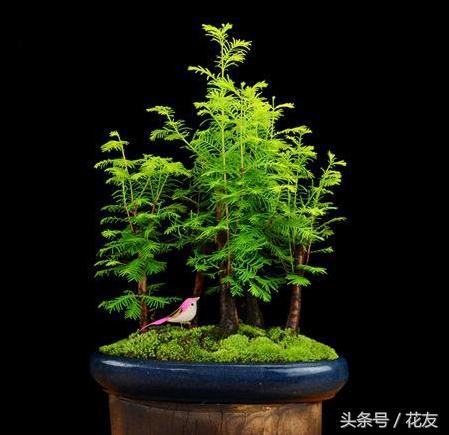
As a species native to China and one of the nationally protected trees, the dawn redwood requires special care. With the development of the times, people no longer stop at material enjoyment in life, but pay more attention to the cultivation of spiritual life. How can one enrich one's spiritual life? Growing a dawn redwood bonsai can not only delight the mind and nurture the character, but also help us resist sulfur dioxide around us; plants can help us purify harmful substances in the air. Today we will briefly introduce to flower lovers how to grow a dawn redwood bonsai.
Dawn redwood bonsai
What is the growing environment of the dawn redwood like? It is generally believed to be suitable for surviving in places with sunlight. To properly care for a dawn redwood, patience is required. Before planting, one should first apply base fertilizer, without damaging the roots of the dawn redwood. After planting, water regularly, watering thoroughly. When the dawn redwood slowly begins to grow, we can fertilize again. During the seedling stage, appropriate pruning is needed. The dawn redwood is extremely easy to keep alive and also easy to care for. For planting beginners, if they want to successfully grow plants, they might as well try a dawn redwood bonsai.
Bonsai: Chinese fringe tree bonsai shaping and fertilizer and water management
Caring for the dawn redwood is actually very simple. The dawn redwood is extremely easy to keep alive; as long as you tend to it more often in daily life and water and irrigate it regularly, it is enough. If you want to create the grandeur of a scenic forest, you can plant more dawn redwood bonsais at home.
The dawn redwood likes light, is not tolerant of barren soil or drought, purifies the air, grows slowly, and is easy to transplant and keep alive. It is generally believed to be suitable for surviving in places with sunlight.
Dawn redwood bonsai
After the initial care of the dawn redwood, within four or five years we do not need to prune it, so as not to damage the dawn redwood's original tree shape. Generally, the survival rate of planting in spring is often relatively high, because spring temperatures are mild and rainfall is moderate, which is very suitable for planting trees.
Bonsai: Five shapes of the Norfolk Island pine bonsai
Of course, when preventing and controlling red blight on the dawn redwood, one must be very careful and strictly carry out strict plant quarantine for the dawn redwood. When planting, the water used for irrigation should not be too frequent, and fertilizer should be applied in a breathable and ventilated environment to ensure the robust growth of the seedlings.
Precautions for caring for a dawn redwood bonsai
1. Why does a dawn redwood bonsai lose leaves?
Three points to note when a dawn redwood bonsai loses leaves: repot reasonably; if the pot is too small, there are likely to be many dead roots, and after rotting they form pathogens that cause disease in the new roots and they slowly die; provide ventilation and light; the dawn redwood is a large-tree type and especially likes light and ventilation. The most important thing to note is that during high temperatures, wood must be used under the pot as a base; if it is placed on the ground, it will burn the roots, which is also the main reason for leaf loss; fertilize less and water frequently, but do not let water accumulate. This needs no explanation; everyone understands it.
2. What should be done if the branches and trunk of a dawn redwood bonsai dry up?
Place the dawn redwood bonsai in a semi-shaded place. If the soil is found to be too wet, pull the plant out of the pot and put it back in the pot after the water has evaporated. In addition, change the soil; buy leaf mold at the flower market, and it must be fully decomposed and disinfected. Cut off a small section of about 3 cm from the original roots, and after disinfection or treatment with rooting hormone, put it into the pot. Remove part of the leaves to achieve the purpose of reducing nutrient consumption. If the plant is too large, nutrient solution can be purchased to supply nutrients directly.
Dawn redwood bonsai
3. The root system of a dawn redwood bonsai is intertwined and dense; how should it be separated?
The root system of a dawn redwood bonsai does not need pruning. According to the growth of the bonsai, repot once every 2-3 years. When repotting, combine it with root pruning; roots that are too dense or too long should be pruned. This can be considered according to the following situations. If the tree's new roots are underdeveloped and the root system has not densely covered the bottom surface of the soil ball, then the original pot can still be used for repotting, and the root system does not need pruning. For tree species with well-developed root systems, if the fibrous roots densely cover the bottom surface of the soil ball, then a slightly larger pot should be used, the dense root system should be thinned out, old roots should be removed, and a few new roots should be retained when repotting. For some old stump bonsai, when repotting, the roots can be appropriately raised to increase their ornamental value. Also prune away old roots and part of the root ends, and cultivate with loose fertile soil to promote new roots.
Friends interested in growing flowers can follow the official account: Flower Friends. Every day there are wonderful articles on growing and appreciating flowers to share with you, and fellow flower friends to enjoy the sea of flowers with you. Submission email: [email protected].